
For most café drinks, start with 1.5–3 grams of matcha per cup. A 2-gram dose is a practical baseline for a standard latte, then adjust for cup size, milk, sweetness, ice and the strength of the matcha.
This guide turns that dose into numbers a café can actually use: servings per kilogram, monthly purchasing volume, ingredient cost per drink and a repeatable way to test samples.
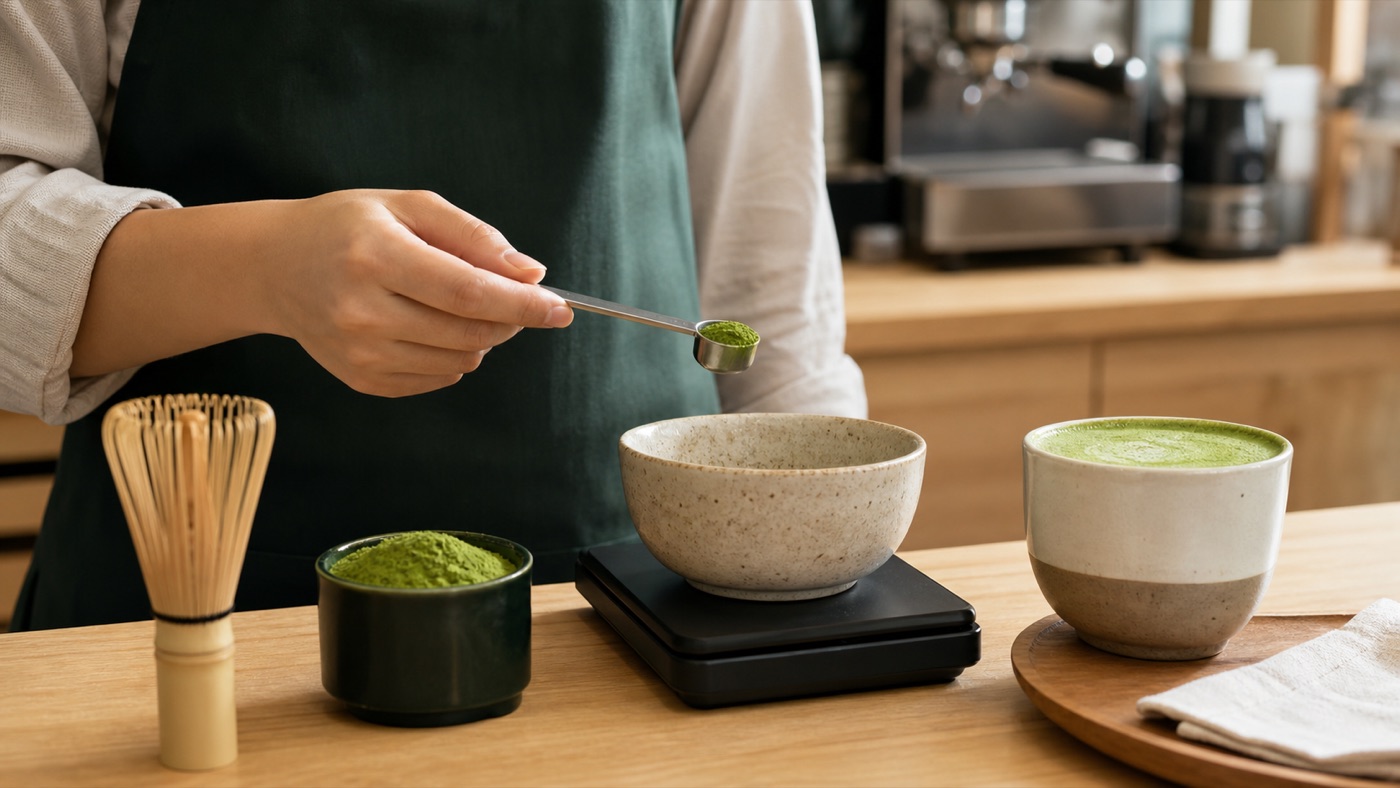
The short answer: how many grams of matcha per cup?
| Drink style | Starting dose | What to evaluate |
|---|---|---|
| Light or smaller milk drink | 1.5 g | Color and flavor may become too subtle in strongly flavored milk |
| Standard café matcha latte | 2 g | A useful baseline for recipe and cost testing |
| Larger, iced or stronger latte | 2.5–3 g | Check bitterness, texture and cost before increasing further |
| Straight whisked matcha | Test by grade and serving size | Texture, aroma, umami and astringency matter more without milk |
There is no single correct dose for every menu. The best commercial recipe is the lowest repeatable dose that still delivers the color, taste and texture your customer expects. More powder does not automatically produce a better drink; it can also increase astringency and food cost.
Use grams, not teaspoons
Teaspoons are convenient at home but unreliable behind a café bar. Matcha can settle during shipping and storage, and one scoop may be packed more tightly than another. Two employees can therefore use noticeably different amounts while believing they followed the same recipe.
- Use a digital scale with 0.1 g resolution while developing the recipe.
- Record the matcha dose, water volume, water temperature, milk type, total drink size and sweetener.
- Once the recipe is approved, select a portioning tool and verify its average weight regularly.
- Train staff to level the scoop consistently instead of compressing the powder.
A written recipe protects both drink quality and gross margin. If the intended dose is 2 g but routine service averages 2.4 g, matcha usage and cost rise by 20% before spills or waste are counted.
How many cups does 1 kg of matcha make?
Divide 1,000 grams by the dose used in one drink:
| Matcha per cup | Theoretical servings from 1 kg |
|---|---|
| 1.5 g | About 666 cups |
| 2 g | 500 cups |
| 2.5 g | 400 cups |
| 3 g | About 333 cups |
These are theoretical yields. For purchasing, add a sensible allowance for recipe trials, powder left in packaging, accidental over-portioning, remakes and spills. Track actual usage for several weeks and replace estimates with your own operating data.
Calculate your café’s monthly matcha requirement
Monthly matcha (kg) = matcha drinks per day × operating days × grams per drink ÷ 1,000
For a café open 30 days per month and using 2 g per drink:
| Matcha drinks per day | Base monthly requirement | Practical planning note |
|---|---|---|
| 20 | 1.2 kg | A small test order may cover several weeks |
| 50 | 3 kg | Monitor sales before committing to a larger stock level |
| 100 | 6 kg | Compare freight economics across pack and order sizes |
If your menu has several sizes, calculate each one separately. For example, multiply small drinks by their 1.5 g recipe and large iced drinks by their 2.5 g recipe, then add the totals. Seasonal promotions should be forecast separately rather than hidden inside the normal monthly average.
Calculate the matcha cost per drink
Matcha cost per cup = landed cost per kg ÷ 1,000 × grams per cup
Use landed cost—not only the supplier’s product price. Landed cost can include freight, duties, customs-related charges and local delivery where applicable.
Here is a hypothetical example at a landed cost of USD 60 per kg:
| Dose | Matcha cost per cup |
|---|---|
| 1.5 g | USD 0.09 |
| 2 g | USD 0.12 |
| 2.5 g | USD 0.15 |
| 3 g | USD 0.18 |
The USD 60 figure is an illustration, not a quotation. Your actual result depends on grade, quantity, destination and shipping method. Add milk, syrup, cup, lid, labor and normal operating waste to calculate the complete beverage cost.
The right grade can matter more than adding another gram
If a latte disappears under milk at 2 g, increasing the dose is only one option. A better-matched grade may provide more suitable color, aroma or flavor balance at the same dose. Sailtik’s practical starting points for café testing are:
- 3A: café drinks and premium baking; a useful starting point when cost control is important.
- 4A: premium café drinks and high-end baking; suitable when visual color and a more premium position matter.
- 5A: ceremonial use, high-end drinks and ice cream; worth testing for a flagship beverage or premium menu price.
Grade names are not a universal international standard. Compare samples in the actual recipe instead of assuming that the highest label is automatically the best commercial choice. Milk type, sweetness and serving temperature can change the result significantly.
A simple café sample-testing method
Sailtik generally supplies selected 10 g samples based on the buyer’s business model and application. Internal model codes are not published, and every variation is not sent automatically. This keeps the test focused on realistic candidates.
A 10 g sample produces roughly three to six test drinks at a 1.5–3 g dose. To make those tests useful:
- Choose one fixed recipe and cup size.
- Test the same dose for each candidate before adjusting anything.
- Use the milk and sweetener that will appear on your menu.
- Evaluate the drink immediately and again after several minutes, especially for iced service.
- Record color, aroma, matcha presence through milk, astringency, texture and aftertaste.
- Only after the side-by-side comparison, test small dose adjustments.
Photograph every drink under the same lighting and label the cups with neutral codes. If possible, ask several staff members to score them independently. Taste is subjective, so a structured comparison is more useful than a supplier promising that one model is “best.”
Order size, packaging and storage planning
Standard bulk packaging is available in 1 kg, 5 kg and 10 kg aluminum-foil bags. There is no fixed minimum order quantity for standard bulk matcha, although larger shipments are usually more economical per kilogram because freight is spread across more product.
Do not order only from a low per-kilogram price. Compare freight, expected monthly usage and how quickly opened packs will be consumed. Smaller inner packs may be easier for a low-volume café to manage, while a growing group of stores may benefit from larger consolidated shipments.
The general shelf-life reference is 18 months, subject to the final batch label and documents. After opening, reseal the bag promptly and protect the powder from moisture, light, heat and strong odors. Use disciplined stock rotation and avoid keeping unnecessary opened inventory.
Documents available for supplier review
Depending on the product and buyer’s review requirements, available supporting materials include:
- Allergen Declaration
- Certificate of Analysis (CoA)
- Food Safety Management System Certificate
- Halal Certificate
- Heavy Metals Test Report
- Non-GMO Declaration
- Pesticide / Mycotoxin Residue Test Report
- Safety Data Sheet (SDS)
Ask for the documents relevant to your market and intended use, and confirm that specifications and statements match the exact product or batch being considered.
Frequently asked questions
Is 1 teaspoon of matcha enough for a latte?
It may be, but teaspoons do not provide a dependable commercial measurement. Weigh the powder and begin around 1.5–3 g per drink. A 2 g baseline is a practical place to start for many café lattes.
How many matcha lattes can I make from 1 kg?
At 2 g per latte, the theoretical yield is 500 drinks. At 1.5 g it is about 666; at 3 g it is about 333. Allow for testing and normal operational loss when planning an order.
Should an iced matcha latte use more powder?
Often it needs testing at the upper end of the range because the drink may be larger and diluted by ice, but the answer depends on the recipe. Compare 2 g, 2.5 g and 3 g in the final cup rather than increasing the dose automatically.
Which matcha grade is best for a café?
For Sailtik’s range, 3A, 4A and 5A are useful café test points, from cost-conscious everyday drinks to premium beverages. The best choice is the sample that performs in your milk, sweetness level, cup size and target selling price.
Plan the first order from your actual recipe
Start by fixing the recipe in grams, calculate monthly demand, add an evidence-based allowance for operating loss, and then compare landed cost. This produces a far more reliable order quantity than choosing a bag size first.
Contact Sailtik with your drink type, cup size, milk, sweetness level, expected monthly volume and target price position. Carol can then recommend a focused set of 10 g samples for your café test instead of sending every available model.