
“Ceremonial,” “premium,” “café” and “culinary” are useful market descriptions, but they are not a single universal grading standard. For a business buyer, the right matcha grade is the one that performs in the finished product at a workable cost.
This guide explains what matcha grades usually mean, what they do not prove, and how cafés, bakeries and private-label brands can compare samples without relying on a name alone.
The three broad matcha categories
| Common market term | Typical use | Commercial buying priority |
|---|---|---|
| Ceremonial grade | Straight whisking, premium drinks, gifting | Smoothness, aroma, umami, color and fine texture |
| Premium or café grade | Matcha lattes, iced drinks, premium desserts | Flavor through milk, visual color, cost per cup and consistency |
| Culinary or ingredient grade | Baking, ice cream, confectionery and food production | Finished-product flavor, post-process color, dispersion and production cost |
These categories describe intended positioning more than a regulated pass-or-fail system. Two suppliers can both use the words “ceremonial grade” for products with different colors, flavor profiles and prices. Even within one category, harvest, cultivar, origin, shading, processing, storage and lot conditions can influence the result.
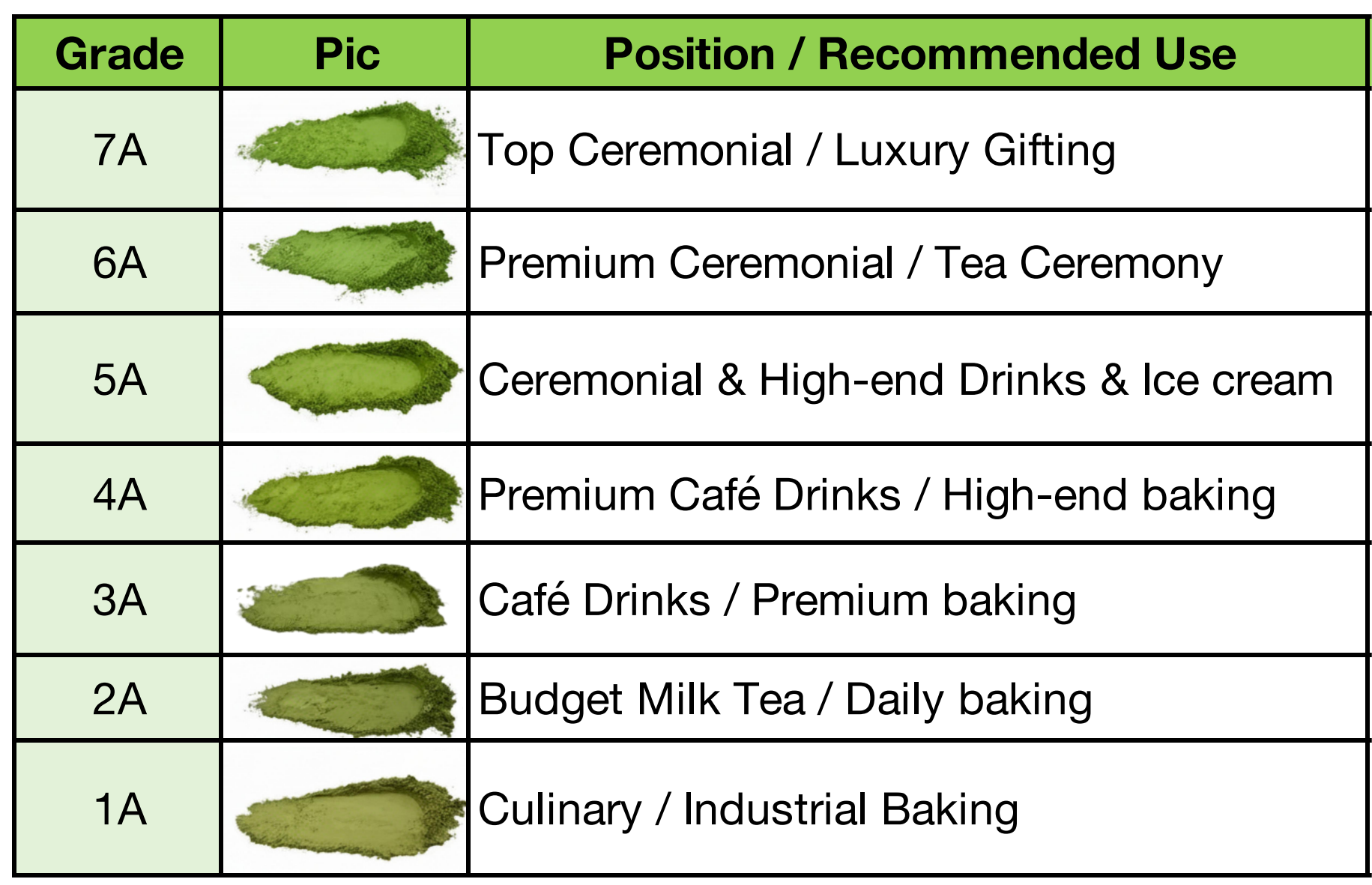
Sailtik’s 1A–7A application system
Sailtik uses an internal application ladder to make commercial selection easier. The public grade identifies a recommended use; internal model codes remain private. Each grade can include three origin options from Guizhou or Zhejiang with different color and sensory characteristics for testing.
| Grade | Recommended position and use | Indicative range (USD/kg) |
|---|---|---|
| 7A | Top ceremonial and luxury gifting | 200+ |
| 6A | Premium ceremonial and tea ceremony | 120–200 |
| 5A | Ceremonial, high-end drinks and ice cream | 90–120 |
| 4A | Premium café drinks and high-end baking | 60–80 |
| 3A | Café drinks and premium baking | 30–60 |
| 2A | Budget milk tea and everyday baking | 20–30 |
| 1A | Culinary and industrial baking | 10–20 |
These price bands are positioning references, not live quotations. Final pricing depends on the selected product, quantity, batch, packaging, destination and freight. A grade number also does not replace tasting in the buyer’s actual recipe.
How to choose matcha for a café
For milk drinks, evaluate the finished latte rather than a bowl of water alone. Milk fat, plant-milk formulation, ice and sweetener can mute aroma and change the perception of bitterness.
- 3A is a practical starting point for everyday café drinks where margin matters.
- 4A suits a more premium latte program or a menu where brighter presentation is important.
- 5A can be tested for flagship beverages, high-end drinks or customers willing to pay for a more refined position.
Begin with the same 1.5–3 g dose, cup size and recipe for every sample. If one candidate needs substantially more powder to remain noticeable through milk, compare the true cost per cup rather than the price per kilogram alone.
How to choose matcha for baking and food production
A raw powder that looks attractive may behave differently after it meets flour, sugar, fat, dairy, oxygen or heat. Commercial bakers should compare the finished cookie, cake, filling, cream or premix after the normal production and holding process.
- 1A–2A: consider for cost-sensitive culinary and industrial applications where matcha is one component of a stronger formula.
- 3A: a useful bridge between commercial cost, café use and premium baking.
- 4A: consider for premium bakery products or unbaked components where appearance has more value.
- 5A: may suit high-end ice cream or other premium applications, but test whether the extra cost remains perceptible in the final product.
Do not assume ceremonial grade is automatically better for baking. Delicate sensory differences can disappear during processing, while a more assertive culinary profile may be easier to recognize in the finished food.
How to choose matcha for private label
Private-label buyers must evaluate both the product and its retail position. Sailtik generally recommends 5A, 6A or 7A for premium branded matcha. Custom options include 30 g, 50 g and 80 g tins starting at 200 units, and printed stand-up pouches from 100 g to 1 kg starting at 300 units.
The highest grade is not automatically the best business decision. Consider the target retail price, serving method, customer expectations, packaging cost, repeat-purchase potential and the documents required in the destination market.
A six-part matcha sample scorecard
| Criterion | What to record |
|---|---|
| Color | Dry powder, prepared drink and finished product under consistent lighting |
| Aroma | Freshness, intensity and whether it remains noticeable after preparation |
| Taste | Umami, sweetness, astringency, bitterness and aftertaste |
| Texture | Mouthfeel, fineness, clumping and sediment in the intended process |
| Application fit | Performance in water, milk, ice, baking or the exact commercial formula |
| Economics | Dose, usable yield, landed cost, waste and target margin |
Sailtik samples are normally 10 g per selected model. The recommended models depend on the customer’s business and application; the full internal range is not sent automatically. This makes the trial easier to control and gives each sample enough context.
What a grade label cannot prove
- It does not prove the country or specific growing region.
- It does not prove organic certification.
- It does not prove that every batch has identical sensory characteristics.
- It does not replace a Certificate of Analysis or contaminant testing.
- It does not show whether the matcha fits your milk, recipe, process or price point.
For B2B purchasing, request the relevant product and safety information. Available Sailtik materials can include an Allergen Declaration, CoA, Food Safety Management System Certificate, Halal Certificate, Heavy Metals Test Report, Non-GMO Declaration, Pesticide / Mycotoxin Residue Test Report and SDS.
Frequently asked questions
How many grades of matcha are there?
There is no universal number. The market commonly groups matcha into ceremonial, premium or café, and culinary categories. Individual suppliers may use a more detailed system; Sailtik uses 1A–7A to guide applications.
Is ceremonial matcha always the best?
It is usually positioned for straight drinking or premium presentation, but it may be unnecessarily expensive for baking or a strongly flavored latte. “Best” should mean best for the finished use.
What grade should a café test first?
For Sailtik’s range, 3A, 4A and 5A provide three useful café positions. Test them at the same dose in your actual milk and cup size before adjusting the recipe.
Choose by finished-use evidence
A grade name is the beginning of the selection process, not the conclusion. Define the application, test selected candidates under controlled conditions, calculate the cost in use and review the relevant documentation.
Contact Carol at Sailtik with your business type, application, target position and expected volume to receive a focused sample recommendation.