
One kilogram of matcha makes approximately 333–666 drinks at a 1.5–3 g dose. At 2 g per drink, the theoretical yield is 500 servings. Whether a 1 kg purchase is sensible depends on how quickly you will use it, whether the grade works in your recipe, the landed cost and how the opened bag will be handled.
For a café, bakery or small food business, 1 kg is often a practical step between tiny samples and larger wholesale orders. It is still too much to buy blindly: approve the matcha first and calculate stock duration before ordering.
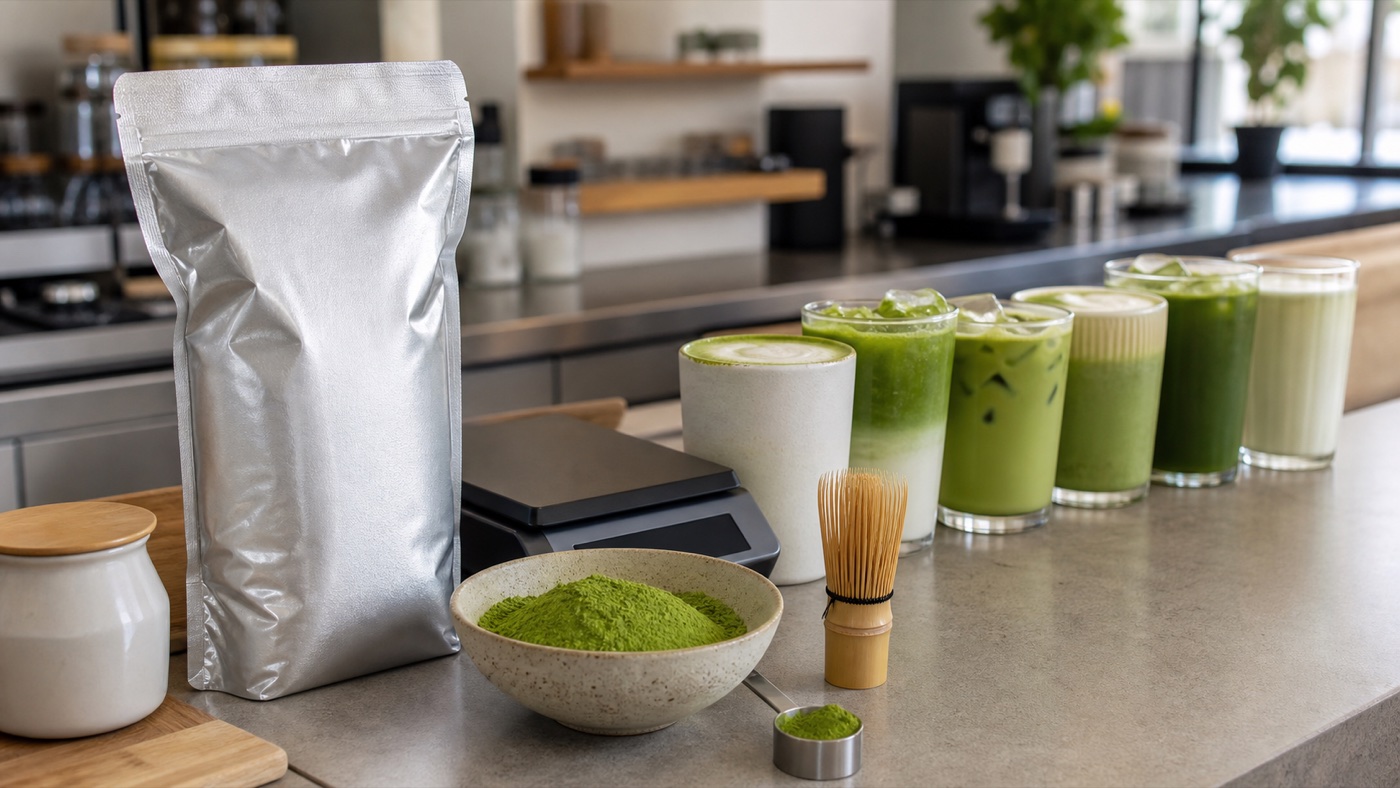
How many servings are in 1 kg of matcha?
Theoretical servings = 1,000 g ÷ grams per serving
| Matcha per drink | Theoretical servings from 1 kg | Typical planning use |
|---|---|---|
| 1.5 g | About 666 | Smaller or lighter drinks |
| 2 g | 500 | Practical standard-latte baseline |
| 2.5 g | 400 | Stronger or larger drinks |
| 3 g | About 333 | Upper end of Sailtik’s general café range |
The accepted saleable yield will be lower after recipe development, spills, powder left in the bag, over-portioning and remakes. Measure actual usage after launch instead of assuming every gram becomes revenue.
For detailed per-cup calculations, see How Much Matcha Per Cup?
How long will 1 kg last in a café?
At a 2 g recipe, divide 500 theoretical drinks by average daily sales:
| Matcha drinks per day | Theoretical days from 1 kg | Operational interpretation |
|---|---|---|
| 10 | 50 days | Opening risk and slow consumption deserve attention |
| 20 | 25 days | Potentially manageable for a small café |
| 50 | 10 days | Useful regular foodservice pack size |
| 100 | 5 days | Reorder and delivery planning become more important |
| 250 | 2 days | Larger consolidated orders may improve freight economics |
Use real sales data and subtract normal waste. If the café sells only ten drinks per day, one kilogram may remain open for weeks. If it sells 100 per day, one kilogram is only a few days of stock.
Which 1 kg matcha grade should you buy?
| Application | Sailtik starting grade | Comparison |
|---|---|---|
| Standard café latte | 3A | 4A for a more premium menu |
| Premium café drink | 4A | 5A for a flagship position |
| Premium baking | 3A | 4A for high-end baking |
| Daily baking | 2A | 3A for a premium comparison |
| Industrial culinary use | 1A | 2A where the finished result justifies it |
| Premium branded retail | 5A | 6A or 7A for higher positioning |
These are application starting points, not a guarantee. Each Sailtik grade has three internal origin/model options from Guizhou or Zhejiang with different sensory and color characteristics. Internal codes remain private. Selected 10 g samples are recommended according to the buyer’s business and recipe.
Sample first, then move to 1 kg
- Define the exact drink or food application.
- Test selected 10 g samples at a fixed dose.
- Choose the best two candidates without seeing internal identity if possible.
- Repeat the comparison on another day or with another staff member.
- Confirm the selected product and documents.
- Use the 1 kg order as the next commercial validation step.
A 10 g sample produces approximately three to six drinks within the 1.5–3 g range. It can screen candidates, but a 1 kg order gives the buyer enough product to test workflow, staff consistency, customer response and real consumption.
Calculate landed cost per drink
Matcha cost per drink = landed cost per kg ÷ 1,000 × grams used
Landed cost can include the product, freight, duties, customs-related charges and delivery where applicable. Do not compare one supplier’s ex-works or product-only price with another supplier’s delivered price.
Also compare cost per accepted drink. A lower-priced matcha that requires a higher dose or creates more remakes may not be cheaper in service.
Check whether 1 kg is the right inner pack
Sailtik’s standard bulk formats are 1 kg, 5 kg and 10 kg aluminum-foil bags. There is no fixed bulk MOQ, although larger orders generally have better shipping economics. A larger total order can still be divided into appropriate confirmed pack sizes rather than placing all stock in one opened container.
| Question | Why it matters |
|---|---|
| How many days will an opened 1 kg bag last? | Slow use increases exposure after opening. |
| Will each location receive an unopened bag? | Allocation affects consistency and stock control. |
| Can staff reseal and store it correctly? | Matcha should be protected from moisture, light, heat and odors. |
| Is the bag only for operational use? | A bulk bag is not the same as a consumer-ready private-label unit. |
| Will 5 kg or 10 kg improve freight enough? | Calculate the benefit against consumption and cash tied in stock. |
The general shelf-life reference is 18 months, subject to the specific product, batch and package label. This does not define the quality period after opening. Record open dates, reseal promptly and choose inventory that can be used sensibly.
Documents to review with a 1 kg order
Available Sailtik materials include an Allergen Declaration, CoA, Food Safety Management System Certificate, Halal Certificate, Heavy Metals Test Report, Non-GMO Declaration, Pesticide / Mycotoxin Residue Test Report and SDS. Confirm which documents apply to the selected product or batch and your destination requirements.
A 12-point 1 kg buying checklist
- Business application and recipe.
- Chosen grade and selected product.
- Origin statement.
- Matcha dose per serving.
- Theoretical and accepted yield.
- Expected days of stock.
- Product price and landed cost.
- Bag size and storage procedure.
- Shelf life on the exact package label.
- Relevant documents.
- Destination and shipping scope.
- Reorder trigger based on real consumption.
Frequently asked questions
How many cups does 1kg of matcha make?
Approximately 333–666 at a 3–1.5 g dose. At 2 g, the theoretical yield is 500 drinks before testing and operational waste.
Can I buy only 1 kg from Sailtik?
Standard bulk matcha has no fixed MOQ, and 1 kg is a confirmed pack size. Final price and shipping depend on grade, selected product, destination and current logistics; larger quantities generally have better freight economics.
Is 1 kg of ceremonial matcha a good first order?
Only after sample approval and a usage calculation. “Ceremonial” is not universally standardized, so verify the selected product, application, documents and how quickly the kilogram will be used.
Buy one kilogram when you can use it and measure it
A 1 kg purchase is most useful when it follows a successful sample test, fits a known recipe, can be consumed within a sensible operating period and provides a clear landed cost per saleable serving.
Contact Carol at Sailtik with your application, dose, monthly volume, destination and grade position for selected samples and a 1 kg quotation.