
“Japanese matcha” and “Uji matcha” are origin claims, not interchangeable quality grades. A B2B buyer should separate where the tea leaf was grown, where it was processed and ground, where it was packed, who exported it and what the approved sample actually delivers.
Transparency note: Sailtik’s confirmed matcha origins are Guizhou and Zhejiang, China. Sailtik does not sell its products as Japanese or Uji matcha. This guide is educational for buyers researching those terms and explains when an accurately labeled Chinese alternative may fit a café, food or private-label project.
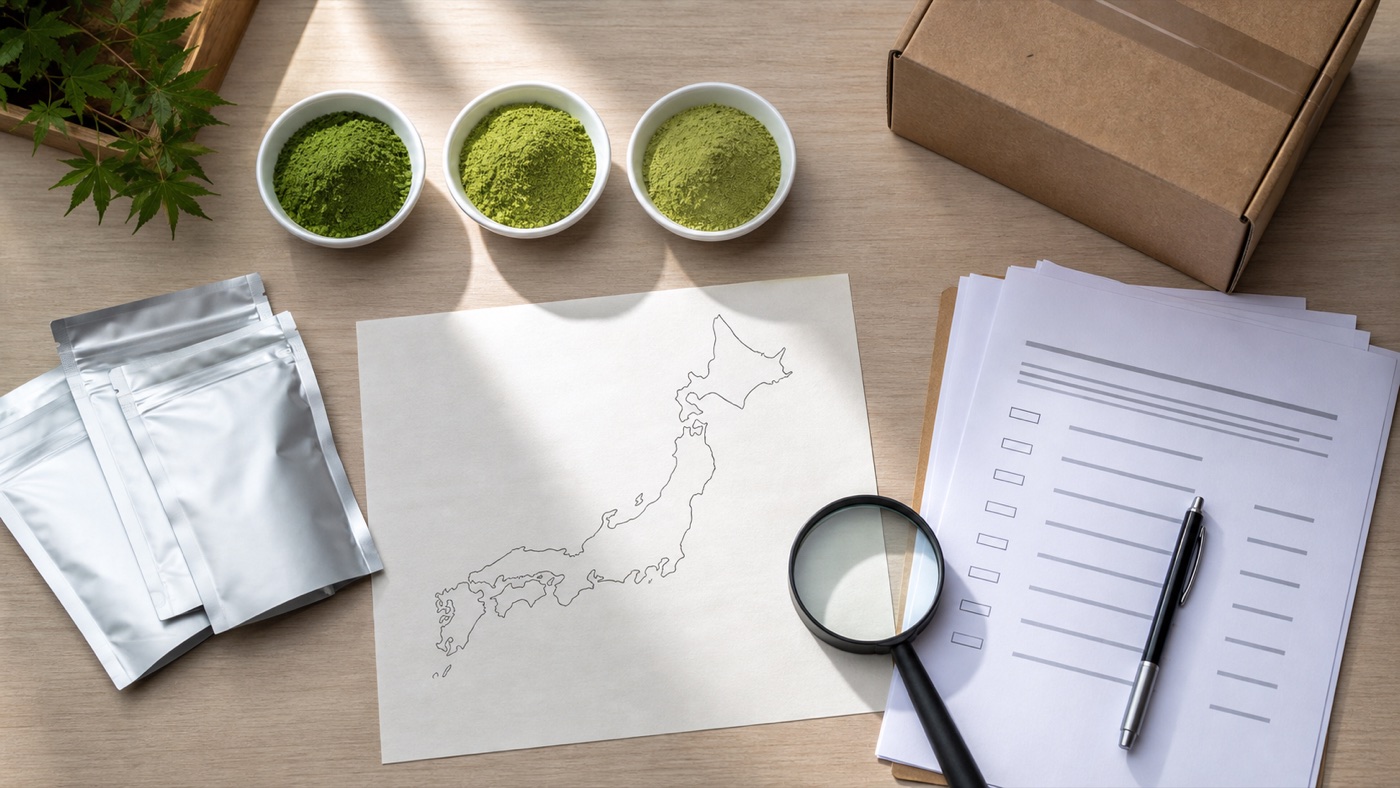
What does Japanese matcha mean?
For a buyer, Japanese matcha should mean that the tea raw material is from Japan and that any “made in,” “processed in” or regional statement is accurate for the particular product. A Japanese supplier address or Japanese-style package does not, by itself, prove where the leaf was grown.
Ask the seller to state origin in plain language and show how it is supported through its supplier, production and lot records. Keep origin separate from grade: Japan produces a broad range for direct drinking, lattes, confectionery and industrial food use.
What does Uji matcha mean?
The Kyoto Prefectural Tea Industry Chamber defines Uji tea as tea produced in Kyoto, Nara, Shiga or Mie—areas developed together as the Uji tea region—and finished and processed in Kyoto Prefecture by a Kyoto business, with priority given to tea produced in Kyoto Prefecture. This is broader and more precise than “grown inside Uji City.”
Therefore, an RFQ should not stop at “Uji matcha required.” Ask what definition the supplier is applying, where the leaf was grown, where the tencha was refined and ground, where the powder was packed and which evidence supports the statement. Your destination’s labeling and advertising rules still need separate review.
| Phrase | What it may tell you | What remains to verify |
|---|---|---|
| Japanese matcha | Claimed country of origin | Leaf origin, processing, lot linkage and labeling basis |
| Uji tea / Uji matcha | Claimed relationship to the defined Uji tea production and finishing system | Production prefecture, Kyoto finishing business and exact product records |
| Packed in Japan | Packing location | It does not necessarily state leaf origin |
| Japanese supplier | Seller or exporter location | It does not necessarily state product origin |
| Stone-ground in Japan | Claimed grinding method and location | Leaf origin, mill record and whether the claim covers the supplied lot |
| Ceremonial grade | Supplier’s market position | No universal cross-supplier specification |
Start with an application RFQ, not a prestige word
- Application: straight drinking, latte, ice cream, baking or retail tin.
- Required origin claim: Japan, Uji tea definition, a named prefecture or no origin restriction.
- Sensory target: color, bitterness, umami, aroma and mouthfeel.
- Recipe dose and other ingredients.
- Trial quantity, monthly use and annual forecast.
- Bulk or retail packaging format.
- Destination country and importer.
- Mandatory documents, testing and label claims.
- Required Incoterm and delivery location.
- Acceptable alternatives if supply or price changes.
An RFQ that only says “best Uji ceremonial matcha, lowest price” cannot produce comparable offers. It combines an undefined grade, a geographic claim and a price request without describing the business use.
Origin evidence to request
| Evidence | Review question | Common mismatch |
|---|---|---|
| Product specification | Does it name the origin and exact product? | Generic marketing sheet with no code or lot |
| Supplier origin declaration | Does it state leaf, processing and packing origin clearly? | Only the exporter address appears |
| Traceability or lot record | Can the commercial lot be connected to the approved source? | Sample and shipment references differ without explanation |
| Label and invoice | Are country/region claims consistent across records? | “Product of,” “packed in” and supplier address are conflated |
| Certificate of origin, when applicable | What transaction and origin rule does it support? | Treated as a sensory or quality certificate |
| Third-party or scheme record | Does its scope include the named product, site and claim? | Expired or unrelated certificate |
No single record substitutes for the full review. The right evidence depends on the claim, destination, contract and supply chain. A beautiful field photograph cannot link a shipment to an origin by itself.
Sample the product without seeing the prestige label
- Ask for samples linked to specific products or lots.
- Code samples so tasters do not see origin, brand or price.
- Use the intended recipe and identical dose, water, milk and sweetener.
- Score color under fixed light, aroma, taste, mouthfeel and aftertaste.
- Calculate cost per accepted serving, not only cost per kilogram.
- Reveal origin and price after sensory scoring.
- Choose whether origin value, sensory performance or both justify the commercial decision.
A café may learn that a specific Japanese matcha earns a premium in straight service but offers no meaningful advantage in a sweet flavored latte. A retail brand may decide that documented Uji positioning is central even when another origin performs similarly. Both decisions can be rational if the criteria are explicit.
Review capacity and continuity before launch
Current Japanese supply conditions can change availability and quote validity. Avoid relying on a general promise such as “always in stock.” Ask for the currently available product, lot or blend, minimum order, production/packing schedule, allocation policy, substitution rules and realistic forecast process.
| Question | Why it matters |
|---|---|
| Is the sample the same product that will ship? | Prevents approval of an unavailable showcase sample |
| Can origin or blend composition change? | Defines when reapproval is required |
| How long is the quote valid? | Separates a current offer from an old price list |
| What volume can be allocated monthly? | Tests continuity, not only first-order availability |
| What happens after a short harvest? | Clarifies substitution, notice and termination rights |
| Which documents accompany each lot? | Connects compliance to the actual shipment |
Compare landed cost on the same basis
Normalize currency, product, net quantity, inner packing, test scope, Incoterm, freight, duties, customs-related charges and final delivery. Do not compare a Japanese supplier’s ex-works powder price with a distributor’s delivered stocked price.
At 1.5–3 g per cup, the commercial effect of a price difference is best understood per accepted serving. Use the formula in Matcha Wholesale Price per kg.
When a documented Chinese matcha may be the better fit
Do not use Chinese matcha when the label, contract or customer specifically requires Japan or Uji origin. Never relabel it or use Japanese regional imagery to imply a false origin.
A China-origin alternative may be worth testing when the buyer’s true priority is café performance, low starting quantity, flexible selection, scalable food use or cost per serving rather than a Japanese geographic claim. The correct comparison is an accurately labeled product against the same recipe and specification.
Sailtik supplies matcha from Guizhou or Zhejiang, China. Grades 1A–7A cover application positions from industrial culinary through luxury gifting, with three internal origin/model options per grade. Standard bulk formats are 1 kg, 5 kg and 10 kg aluminum-foil bags, with no fixed bulk MOQ; larger orders generally improve freight economics.
Private-label origin language must remain truthful
Packaging design, Japanese characters, tea-ceremony imagery or a Japanese-sounding brand name must not contradict the actual origin statement or mislead the buyer. Sailtik generally recommends 5A, 6A or 7A for private label: 30 g, 50 g or 80 g tins have a confirmed MOQ of 200 units, and printed stand-up pouches from 100 g to 1 kg have a confirmed MOQ of 300 units. These are China-origin offerings and must be presented that way.
See the Private Label Matcha Guide and Matcha Certifications and Documents Guide.
Frequently asked questions
Is all Uji matcha grown in Uji City?
No. The Kyoto Prefectural Tea Industry Chamber’s Uji tea definition covers tea produced in Kyoto, Nara, Shiga or Mie and finished/processed in Kyoto by a Kyoto business, with priority to Kyoto-produced tea.
Is Uji matcha always better?
No origin guarantees that every product will suit every recipe. Uji has major historical and commercial value, but buyers should still compare the specific sample, evidence, consistency, availability and landed cost.
Does Sailtik sell Japanese or Uji matcha?
No. Sailtik’s confirmed origins are Guizhou and Zhejiang, China. Sailtik can supply samples for an accurately labeled China-origin alternative when Japanese/Uji origin is not mandatory.
Choose the origin claim consciously
If Japan or Uji is essential, use the evidence checklist above with a qualified Japanese supplier and importer. If performance, flexibility and cost are the priorities, contact Carol at Sailtik with your application, dose, volume and destination to arrange selected China-origin samples for an objective comparison.