
Yes, a café can prepare matcha ahead of service, but the safest operational default is a controlled, labeled, same-day batch—not an open-ended bottle kept until it looks wrong. Matcha begins changing after it is mixed with water, and every café must also follow its local food code and internal food-safety plan.
A good batching system saves service time without sacrificing recipe control. This guide explains how to calculate a matcha concentrate by servings, prepare it consistently and decide whether batching is worthwhile for your volume.
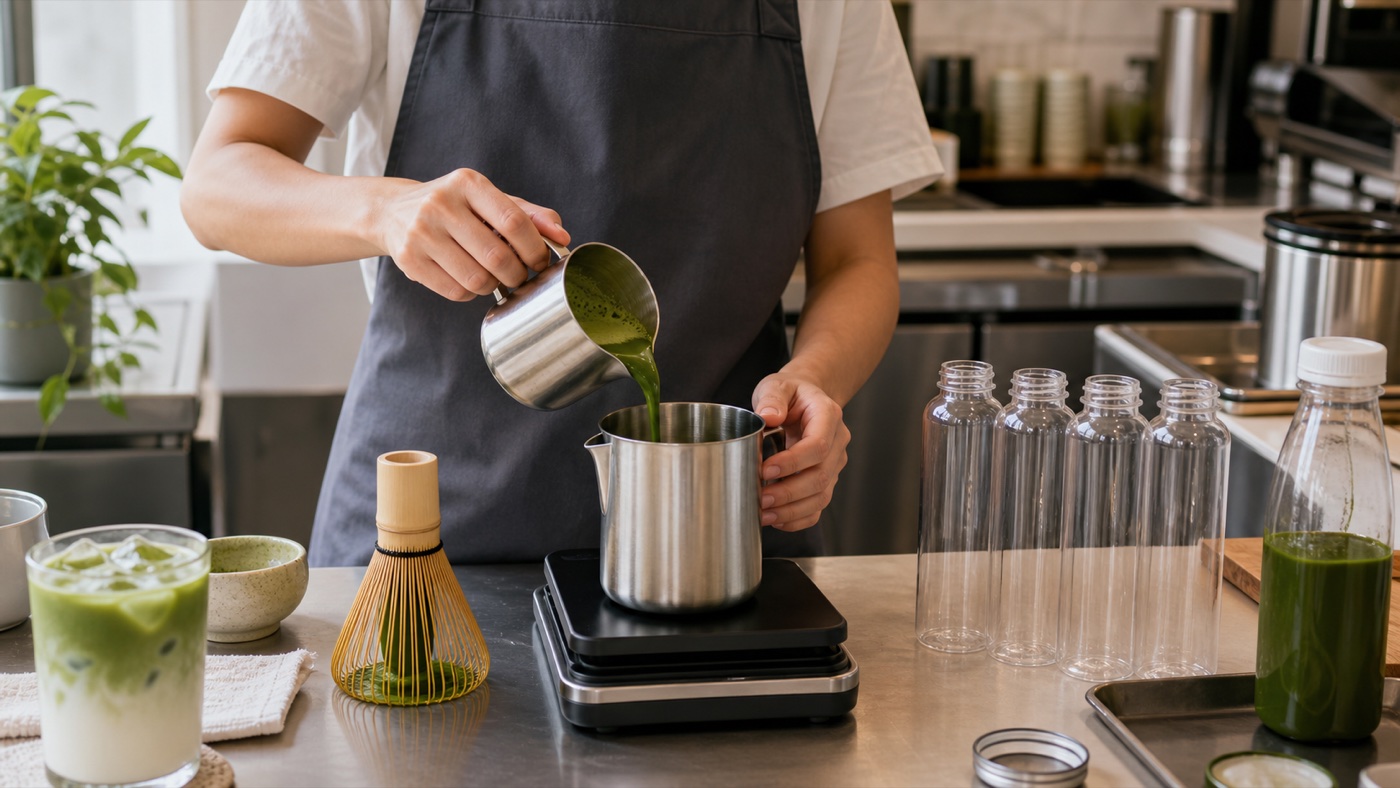
What is batch matcha concentrate?
A matcha concentrate is a measured suspension of matcha powder in water prepared for portioning into multiple drinks. It is not a true dissolved syrup: matcha particles can settle, so the batch normally needs gentle remixing and a defined portioning method.
Batching can help during a rush, but it introduces new controls: batch size, water amount, mixing method, container hygiene, temperature, labeling, holding time, remixing and waste. A café selling only a few matcha drinks per day may get better quality and lower waste by preparing each drink to order.
Calculate the batch from drinks, not from bottle size
Matcha needed (g) = planned servings × matcha dose per drink
If a café plans 20 drinks at 2 g each, the batch needs 40 g of matcha. If the approved recipe uses 40 ml of concentrate per drink, the target finished batch volume is 800 ml. The exact water volume may need adjustment for powder displacement and mixing loss, so build the batch to a measured final volume instead of simply adding 800 ml of water.
| Planned drinks | Dose per drink | Matcha required |
|---|---|---|
| 10 | 2 g | 20 g |
| 20 | 2 g | 40 g |
| 30 | 2 g | 60 g |
| 20 | 2.5 g | 50 g |
Start with a batch that covers a short, predictable service window. Track how many portions are sold and discarded. Increase the batch only when the café has evidence that the larger volume will be used within its validated procedure.
A repeatable café batching workflow
- Use a written recipe. Record matcha weight, target final volume, portion volume and drinks produced.
- Prepare clean equipment. Use food-contact-safe containers and follow the café’s cleaning and sanitizing procedure.
- Weigh the matcha. A scale is more repeatable than counting scoops.
- Sift when needed. Break up compacted powder before liquid is added.
- Make a smooth base. Mix the powder first with part of the recipe water, then bring the batch to its measured final volume.
- Label immediately. Include the product, preparation time, responsible staff member and discard time required by the café’s validated procedure.
- Control holding conditions. Protect the batch from heat, light, contamination and unnecessary air exposure; follow local rules for temperature control.
- Remix consistently. Define how staff will gently redistribute settled particles before portioning.
- Measure every serving. Use a marked dispenser, scale or verified pump rather than free-pouring.
- Record waste. Remaining concentrate is purchasing data, not just trash.
Can matcha be prepared the night before?
It is physically possible, but it should not be the default recommendation for a café without a validated process. Overnight holding can affect color, aroma, flavor and particle distribution. It also extends the time during which container hygiene, temperature and cross-contamination controls must work correctly.
If a business wants overnight preparation, it should evaluate the recipe under its actual conditions and establish a documented food-safety decision with a qualified professional. Follow local regulations and the café’s HACCP or food-safety system. Do not borrow an arbitrary online shelf life from a different recipe or operation.
Quality changes to monitor
| Change | Operational response |
|---|---|
| Settling | Use a defined gentle remixing step before portioning |
| Duller color | Reduce exposure time, light, heat and excess air; compare smaller batches |
| Changed aroma or taste | Shorten the preparation-to-service window and reassess the grade |
| Foam variation | Standardize the mixing method and do final drink texturing to order |
| Inconsistent strength | Verify final batch volume, remixing and portion measurement |
Do not rely only on the concentrate’s appearance. Test finished drinks at the beginning, middle and end of the planned service window using the same milk, ice and sweetener.
Batching versus making each drink to order
| Factor | Batch concentrate | Made to order |
|---|---|---|
| Peak speed | Faster when portioning is organized | More preparation steps per ticket |
| Freshness | Changes during the holding window | Prepared immediately |
| Recipe consistency | Good if the batch and portions are measured | Good if every barista weighs and follows the recipe |
| Waste risk | Unsold concentrate may be discarded | Low pre-batch waste |
| Food-safety controls | Requires labeling, holding and discard procedure | Simpler when prepared and served promptly |
Choose a matcha that remains present in the final drink
A batch system cannot correct a poor grade-to-recipe match. For Sailtik’s range, cafés commonly start by testing 3A, 4A and 5A at the same 1.5–3 g serving dose. Compare each candidate in the actual milk and sweetness level.
Sailtik generally provides selected 10 g samples based on the café’s concept and recipe. A 10 g sample yields about three to six test drinks, depending on dose. First validate the made-to-order recipe; only then scale it into a batch. This separates product choice from batching errors.
A one-week batching trial
- Days 1–2: record hourly matcha drink sales without batching.
- Days 3–4: prepare a small batch for the busiest window and record portions, preparation time and waste.
- Day 5: compare finished drinks from the start and end of the batch.
- Days 6–7: adjust only one variable—batch size, holding window or portioning method—and measure again.
The trial should answer three questions: Did ticket time improve? Did drink quality remain acceptable? Did labor saved exceed product wasted? If not, made-to-order preparation may be the better system.
Frequently asked questions
How long does matcha concentrate last?
There is no universal answer for every recipe and operation. Ingredients, water, container hygiene, temperature and local rules matter. For quality and simple control, begin with a small same-day batch and establish a documented discard time for your operation.
Can matcha concentrate be frozen?
Freezing can change texture and does not remove the need for a validated food-safety process. Test quality after controlled thawing before adopting it commercially, and obtain appropriate food-safety guidance.
Why does batch matcha settle?
Matcha is a suspension of fine leaf particles, not a completely dissolved ingredient. Some settling is expected. Standardize remixing and portioning rather than assuming the first and last pours have equal strength.
Batch only what your café can control
Batching is valuable when it is measured, short, clean, labeled and supported by real sales data. It becomes risky and wasteful when staff guess the formula, free-pour portions or keep an unlabeled bottle indefinitely.
Contact Carol at Sailtik with your cup size, dose, daily matcha sales and milk recipe to select focused samples for a café batching trial.