
A useful matcha accessory set is a small preparation system: the bowl gives the whisk room to move, the stand supports shape and drying, and the scoop transfers powder. Color and styling matter for presentation, but function, cleanability and consistent dosing matter more in daily service.
Scope note: Sailtik has not confirmed that it supplies matcha bowls, whisk stands, bamboo scoops or accessory sets. This article helps buyers assess tools sourced independently and makes no Sailtik accessory MOQ, price or customization claim.
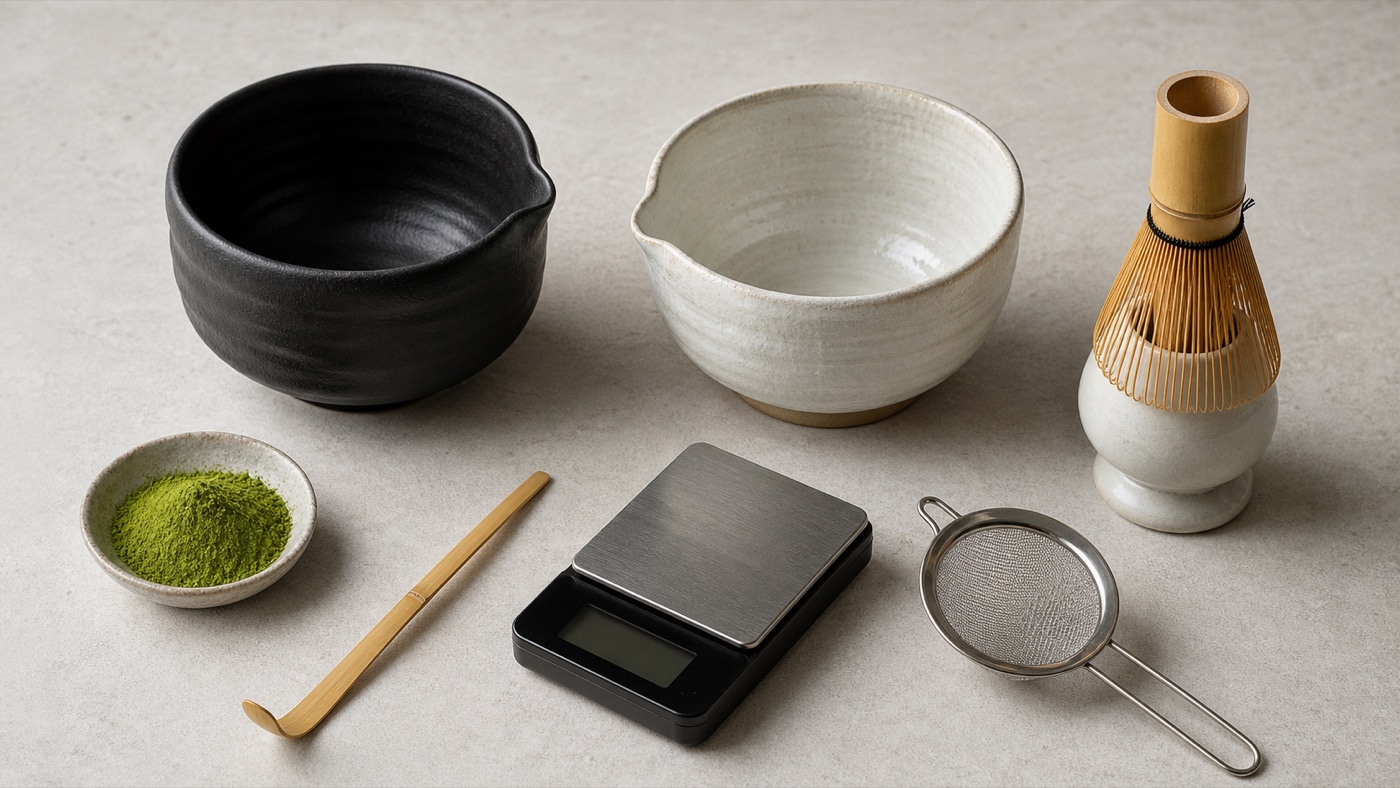
How to choose a matcha bowl
A matcha bowl, commonly called a chawan, needs enough interior width for the whisking motion and enough depth to limit splashing. A gently curved interior without a sharp corner helps a bamboo whisk travel through the liquid. A stable foot, comfortable lip and manageable weight matter during repeated café use.
| Feature | Why it matters | Sample check |
|---|---|---|
| Interior width | Provides whisk clearance | Run the intended whisk motion without striking the walls constantly |
| Interior curve | Reduces trapped powder and abrupt tine contact | Inspect the base-to-wall transition |
| Glaze/surface | Affects cleaning and whisk abrasion | Reject sharp grit, chips or exposed hazardous edges |
| Foot and balance | Supports safe preparation | Test on the real counter when dry and during whisking |
| Capacity | Controls splash margin | Measure recipe volume rather than trusting a generic label |
| Rim | Affects pouring and drinking | Check comfort, drips and chip resistance |
Searches such as “match bowl,” “macha bowl” or “match bowls” are usually spelling variants of matcha bowl. When shopping nearby, inspect the actual piece for wobble, cracks, chips and glaze defects; do not rely only on a style name.
Black matcha bowl versus white matcha bowl
A white matcha bowl creates strong visual contrast with green powder and can make residue easier to notice. A black matcha bowl can produce a dramatic service presentation, although dark interiors may make powder pockets or cleaning residue less visible under dim light. Neither color is a quality grade.
For a café, test both under actual counter lighting and photography conditions. For retail, allow for normal handmade variation if the product is handcrafted, but define unacceptable chips, cracks, wobble, glaze faults and dimensional deviations. Ask for applicable food-contact documentation for the material, glaze and destination market.
What a matcha whisk stand does
A whisk stand, or chasen holder, supports the whisk while it dries and helps retain an open shape. It is useful but not magic and not essential to making matcha. A stand that fits poorly can press the tines awkwardly, while a wet whisk left in an unventilated area can still develop odor or microbial growth.
- Check that the stand supports the inner bell without forcing or splaying the tines.
- Use a stable base that does not tip when the whisk is placed on it.
- Choose a cleanable, intact surface free of sharp edges.
- Rinse the whisk promptly and allow it to air-dry in a ventilated, clean location.
- Inspect the stand and contact area for residue, chips or contamination.
- Do not seal a damp whisk inside retail or transport packaging.
A bamboo matcha scoop is not a calibrated measure
The traditional bamboo scoop, or chashaku, is excellent for transferring small amounts of powder. It is not a standardized-volume instrument. Scoop shape, how full it is, powder aeration and operator technique change the mass. Therefore, “how many scoops of matcha per cup” has no universal exact answer.
Sailtik’s recommended powder range is 1.5–3 g per cup. To turn that into a repeatable café method, place the empty preparation cup on a suitable scale, tare it, add the intended scoop count and record the actual grams across multiple staff members and trials. Choose the final dose by recipe testing, then use weighed checks to train and audit the scoop routine.
| Use case | Recommended control |
|---|---|
| Recipe development | Weigh every trial in grams |
| Café service | Set a scoop routine only after gram calibration; spot-check by scale |
| Nutrition or costing | Use the measured recipe mass, not “one scoop” |
| Consumer directions | Give grams first and describe the scoop only as an approximate aid |
| Supplier sample comparison | Weigh the same mass because powders can pack differently |
Sifter, scale and service tray
A fine sifter can break visible agglomerates before whisking. A scale establishes dose and recipe cost. A tray organizes clean and used tools so wet accessories do not contact packaging or dry powder. These plain operational items often improve consistency more than a decorative upgrade.
Choose a sifter that is food-contact suitable, cleanable and fine enough for the powder without becoming a bottleneck. Choose a scale with capacity and readability appropriate for the small dose, then verify it according to the business’s quality procedure.
Buying an accessory set for retail
- Define the user: beginner home customer, gift buyer or experienced tea drinker.
- Assemble the exact bowl, whisk, stand and scoop before approving components separately.
- Confirm the whisk has working clearance inside the bowl and fits the stand.
- Check food-contact and labeling requirements for every relevant component.
- Run transit testing so ceramic pieces cannot crush the whisk or strike each other.
- Include truthful care instructions and a gram-based preparation guide.
- Set defect limits for cracks, chips, splinters, contamination, missing parts and packing damage.
- Ask the accessory supplier for its actual stock and customized-packaging MOQs.
A low accessory price can be erased by breakage, repacking labor or inconsistent sets. Quote on the complete delivered configuration: components, protection, printed material, assembly, inspection, freight, duties and replacements.
Incoming inspection for bowls, stands and scoops
| Component | Critical checks | Functional trial |
|---|---|---|
| Bowl | Cracks, sharp chips, contamination, wrong material | Stability, whisk clearance, pour and cleaning |
| Stand | Breakage, sharp edges, contamination | Fit, balance and cleanability |
| Bamboo scoop | Splinters, cracks, odor, finish and contamination | Transfer control and gram calibration |
| Whisk | Mold, splits, shedding, tine and binding defects | Dispersion and repeated-cycle test |
| Set packaging | Wrong/missing item, label error, poor protection | Drop/transit simulation appropriate to the route |
Agree a sampling plan with the supplier and inspector before shipment. Treat suspected mold, dangerous sharp edges, foreign matter and wrong materials differently from minor visual variation. Keep an approved set and dated photos as the comparison reference.
Use accessories to support a controlled matcha recipe
The accessories cannot compensate for an unsuitable powder or unstable recipe. Compare matcha using the same gram dose, water, temperature, milk, sweetener and tool. See How Much Matcha Per Cup and Bamboo Matcha Whisk Wholesale.
Sailtik supplies China-origin matcha from Guizhou or Zhejiang and can recommend selected 10 g powder samples based on the buyer’s application. Standard bulk formats are 1 kg, 5 kg and 10 kg aluminum-foil bags. These statements concern matcha powder; buyers should source the accessories from an independently qualified supplier.
Frequently asked questions
Is a black or white matcha bowl better?
Neither color is inherently better. Choose for visibility and presentation after confirming interior shape, surface, stability, capacity and food-contact suitability.
Is one bamboo scoop one gram?
No fixed equivalence should be assumed. Weigh repeated scoops of the actual powder and train staff against the approved gram dose.
Does Sailtik sell matcha bowls and accessory sets?
Sailtik has not confirmed an accessory offer. This guide is provided so buyers can assess independently sourced tools more carefully.
Build the set around the recipe
Select the bowl, whisk, stand and scoop as one working system, document cleaning and replacement rules, and keep grams as the dose standard. For matcha powder samples to use in a controlled café or product test, contact Carol at Sailtik with the application, target dose, monthly volume and destination.