
“Ceremonial grade” is a supplier-defined market position, not a universal regulated specification. A B2B buyer should define the drinking or retail use, compare coded samples, verify origin and product records, and contract the exact product that passed the test.
This updated guide removes the old assumptions that ceremonial matcha must always be Japanese, Uji, first harvest, shaded for one fixed number of days, ground to one particle size or sold within one universal freshness window. Those may describe individual products, but they cannot be claimed for every ceremonial-labeled powder without evidence.
What does ceremonial matcha mean?
In international commerce, ceremonial matcha generally signals a product intended for higher-end drinking, tea service or premium retail. However, suppliers apply the term differently. One seller may reserve it for straight tea; another may use it for a bright premium latte powder. The word alone does not establish origin, harvest, cultivar, shading, milling method, chemistry or safety.
| Marketing phrase | What it may signal | What remains to verify |
|---|---|---|
| Ceremonial grade | Supplier’s high drinking position | Exact product, origin, sensory result and specification |
| Premium ceremonial | A relative tier within one catalog | Difference from the seller’s other tiers |
| First flush | Claimed harvest timing | Definition, records and relevance to the product |
| Stone-ground | Claimed milling method | Which lot, where, and whether it changes acceptance |
| Uji ceremonial matcha | Japanese regional claim plus market position | Evidence supporting the Uji claim and commercial lot |
| Organic ceremonial matcha | Organic claim plus market position | Certification program, operation, product scope and transaction |
Correct misspellings such as “cerimonial,” “cermonial” and “ceremonial macha” to the intended phrase, but do not let search wording replace the specification.
Define the use before requesting samples
- Straight usucha-style service: aroma, balanced bitterness, umami, smoothness and clean finish under a water-only recipe.
- Koicha-style evaluation: concentrated texture and taste; not every high-position matcha will suit the buyer’s desired intensity.
- Premium café latte: color and flavor visibility through milk and sweetener at a commercial dose.
- Luxury gifting: powder performance plus pack design, fill quantity, origin language and shelf presentation.
- High-end food: performance after freezing, heating or mixing with fat/sugar, not straight-tea prestige alone.
A café should not pay for a ceremonial word if a lower-position sample performs equally well in its sweet milk recipe. Conversely, a straight-tea program may value nuance that disappears in flavored drinks. The application decides what quality is worth paying for.
Sailtik’s high-end grade positions
| Grade | Confirmed Sailtik position | Recommended evaluation |
|---|---|---|
| 7A | Top ceremonial / luxury gifting | Water-only tasting and premium pack concept |
| 6A | Premium ceremonial / tea ceremony | Water-only comparison at the intended dose |
| 5A | Ceremonial and high-end drinks / ice cream | Water, premium latte and final-application trial |
Sailtik’s grade names are its own application-position system, not a universal matcha standard. Each grade has three private internal options with different color and sensory characteristics. Internal model codes are not public. Sailtik selects a focused sample set from the buyer’s use and business model.
Origin: ceremonial does not mean Japanese
A ceremonial label does not prove a country or region. Sailtik’s confirmed origins are Guizhou or Zhejiang, China. Its 5A–7A products must be described as China-origin matcha and never as Japanese or Uji matcha.
If the contract or brand requires Japan or Uji, use a supplier capable of supporting that origin. See the Japanese and Uji Matcha Wholesale Guide. If origin is flexible, test accurately labeled products blind and reveal origin after sensory scoring.
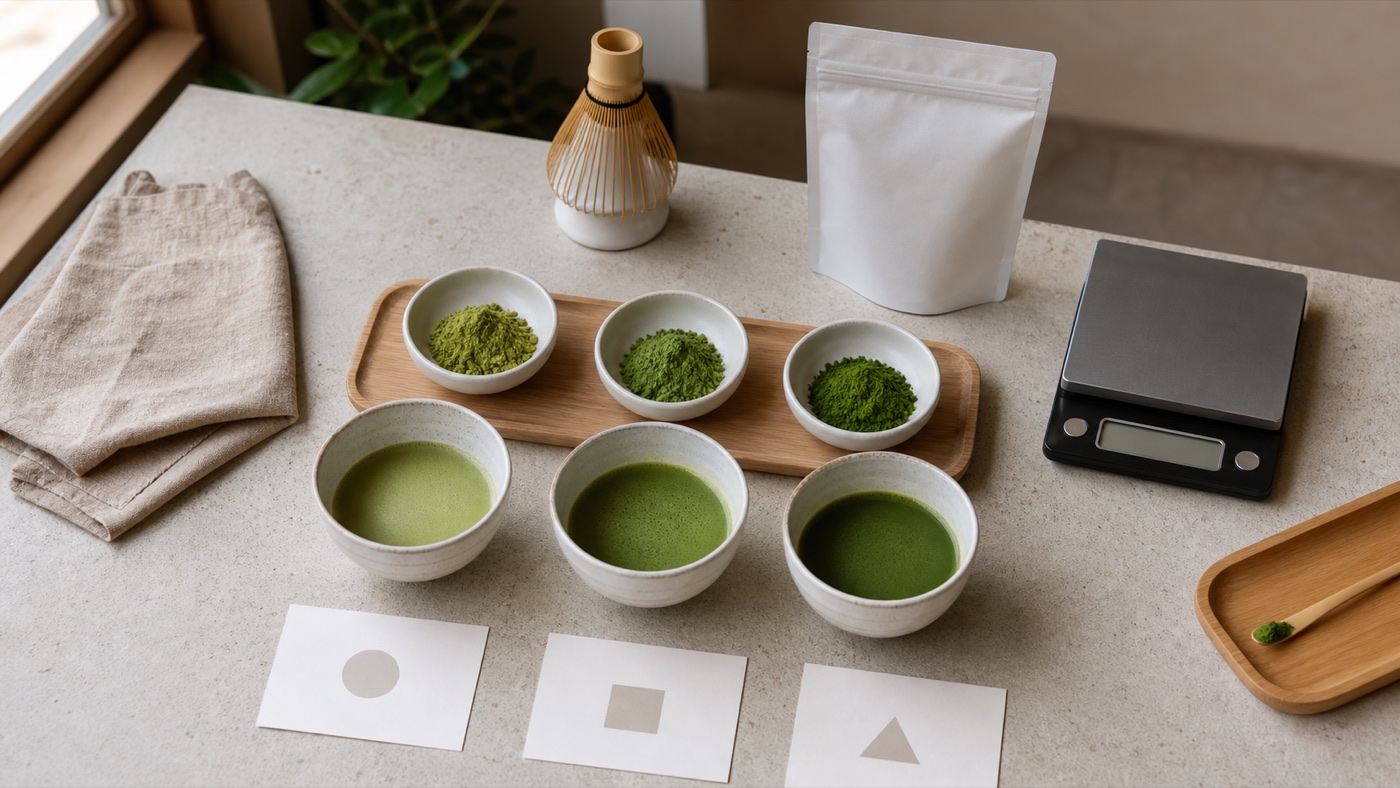
A controlled ceremonial sample test
- Write the water-only and/or milk recipe in grams.
- Code samples so tasters do not know supplier, grade, origin or price.
- Use the same powder mass, water mass and temperature.
- Sift and whisk with the same method and time.
- Assess dry aroma and prepared aroma.
- Score color under fixed light, taste, bitterness, umami, mouthfeel and aftertaste.
- For lattes, repeat with the exact milk and sweetener.
- Calculate cost per accepted serving after the tasting.
- Retain the approved sample and its product reference.
Sailtik’s general dose recommendation is 1.5–3 g per cup. Selected samples are 10 g per model. Because the differences can be subjective, the customer should decide whether a particular option fits the menu, consumer and price position.
Color is evidence of appearance—not proof of grade
Compare color with controlled lighting, background, sample depth and camera settings. A vivid image on a supplier page can be influenced by lighting or editing. Physical color also cannot prove origin, harvest, organic status, contaminant compliance or sensory quality.
Texture and froth should likewise be assessed in the intended preparation. Particle fineness may affect dispersion, but a mesh or micron headline without a defined method and application result is not enough to approve a product.
Supplier evidence to review
| Record | Review purpose | Common mistake |
|---|---|---|
| Product specification | Defines the approved identity and key requirements | Accepting a generic grade brochure |
| CoA | Reports defined results for a product/lot | Treating it as a sensory guarantee |
| Heavy-metal or residue report | Supports specific test scope and sample | Calling the product “lead free” or “pesticide free” |
| Food-safety system certificate | Shows certified management-system scope | Confusing it with product certification |
| Origin declaration/traceability | Supports country/region and lot chain | Using seller address as origin proof |
| Organic certificate, if claimed | Supports operation/program/product scope | Assuming any certificate covers the buyer’s label |
Sailtik can provide Allergen Declaration, CoA, Food Safety Management System Certificate, Halal Certificate, Heavy Metals Test Report, Non-GMO Declaration, Pesticide/Mycotoxin Residue Test Report and SDS. Confirm which exact product, lot, site and claim each document supports.
Bulk and private-label options
Sailtik’s confirmed bulk packs are 1 kg, 5 kg and 10 kg aluminum-foil bags, with no fixed bulk MOQ. Larger orders generally improve freight economics. The current quote must define grade, quantity, pack, destination, Incoterm and included documents.
For private label, Sailtik generally recommends 5A, 6A and 7A. Tins are available in 30 g, 50 g and 80 g formats with a 200-unit MOQ. Printed stand-up pouches range from 100 g to 1 kg with a 300-unit MOQ. Packaging approval does not replace powder approval; test both before launch.
Repeat-order control matters more than a perfect first sample
- Define the approved product and acceptable sensory/color range.
- State whether source, origin/model or blend may change.
- Require notice and reapproval for material changes.
- Connect every shipment to a lot and applicable documents.
- Retain references from approved and received lots.
- Set incoming checks and a nonconformance process.
- Forecast honestly and agree what happens when availability changes.
Current matcha demand can strain individual supply routes. Do not turn an availability statement into a permanent guarantee. Ask what is available for the requested period and how substitutions are controlled.
Compare value per serving
Normalize currency, quantity, pack, document scope, Incoterm, freight, duty and delivery. Then calculate landed powder cost per accepted serving. A more expensive powder can be economical if it works at a lower dose; a cheaper one can be poor value if the café must add more or customers reject the taste.
Use the Matcha Wholesale Price per kg Guide and Matcha Grades Explained for the full comparison framework.
Ceremonial supplier RFQ
- Straight tea, premium latte, gifting or food application.
- Recipe dose, water/milk and sweetener.
- Required origin and label language.
- Target color and sensory description.
- Trial, monthly and annual quantity.
- Bulk or private-label pack.
- Required documents and testing.
- Destination, importer and Incoterm.
- Launch date and change-control needs.
Frequently asked questions
Is Sailtik ceremonial matcha from Japan?
No. Sailtik’s confirmed origins are Guizhou or Zhejiang, China. Products must be labeled accordingly.
Is 7A always better than 5A?
7A has the higher Sailtik position, but the best commercial choice depends on recipe, consumer, pack and budget. Test 5A–7A options in the actual use.
Is ceremonial matcha automatically organic?
No. Organic is a separate certification claim. Sailtik has not supplied evidence that its current matcha is certified organic.
Ask for the matcha behind the word
Contact Carol at Sailtik with the application, dose, desired position, monthly quantity, packaging and destination. Sailtik can recommend selected 5A–7A China-origin samples for the buyer to evaluate objectively.