
Matcha can contain measurable trace elements, including lead, because tea is an agricultural product exposed to soil, water, air and processing equipment. That does not mean every matcha is unsafe, and a “lead-free” marketing claim is not a substitute for a laboratory report for the product being purchased.
For a café, importer or private-label brand, the practical question is not “Can any laboratory detect lead?” It is: What did a qualified laboratory find in this product or batch, by which method, against which destination-market requirement?
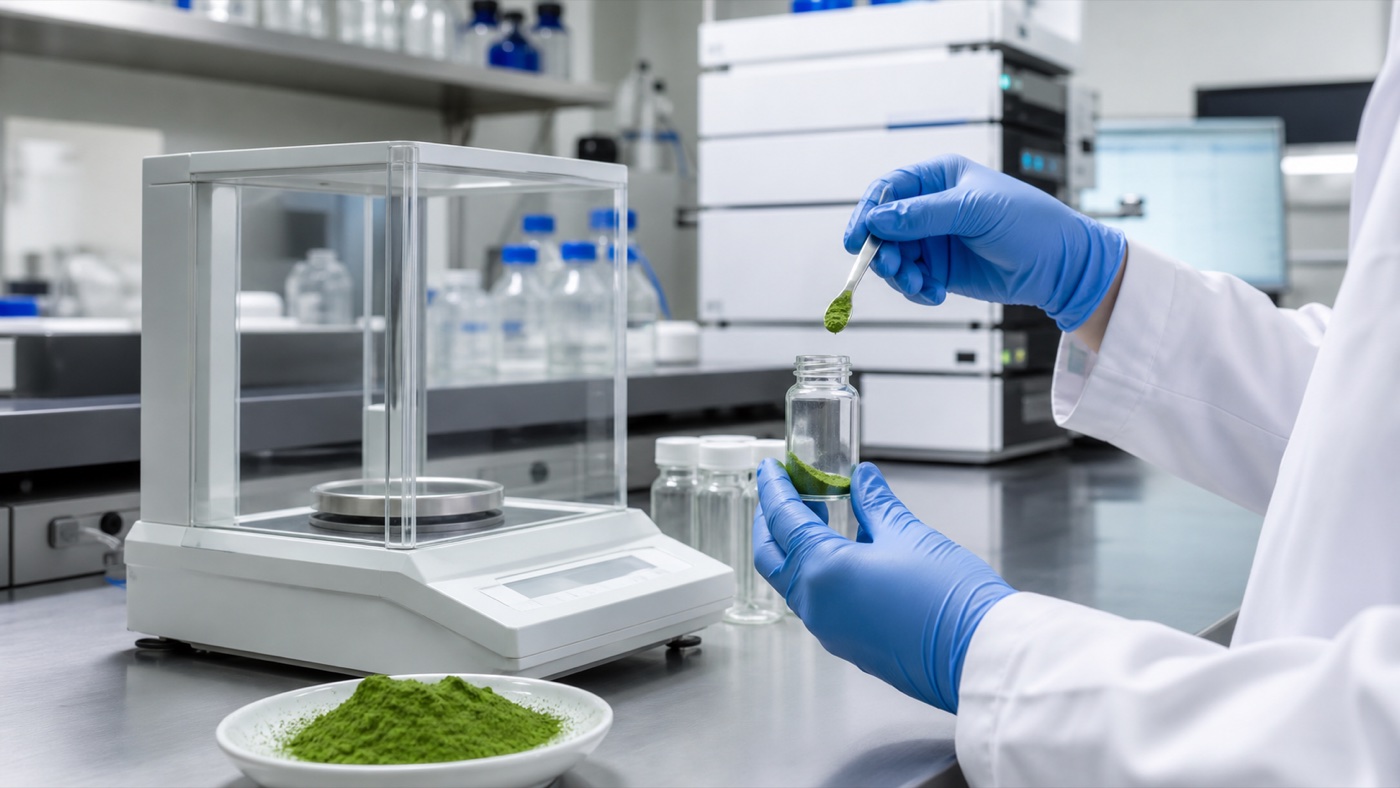
Why heavy metals are discussed with matcha
Lead, cadmium, arsenic and mercury are naturally occurring or environmentally introduced elements that food laboratories may monitor. Their presence and concentration can vary with growing conditions, surrounding contamination, agricultural inputs, water, dust, processing and handling.
Matcha deserves product-specific review because the leaf is milled into powder and consumed rather than simply removed after steeping. Research on brewed leaf tea cannot automatically be applied to matcha powder: the exposure route and serving calculation are different.
The U.S. Food and Drug Administration publishes an Elemental Analysis Manual for Food and Related Products, including methods for elements such as arsenic, cadmium, lead and mercury. This is useful evidence that buyers should focus on analytical method and report quality rather than an unsupported zero claim.
“Lead-free” and “non-detect” do not mean the same thing
Laboratory instruments have reporting and detection limits. If a report shows “ND,” it generally means the result was below that laboratory’s stated detection or quantification threshold—not proof that absolutely no atom of the element exists.
| Report wording | What a buyer should ask |
|---|---|
| ND / Not detected | What is the method detection limit or reporting limit? |
| < value | Is the value the limit of detection or limit of quantification? |
| Numerical result | What unit is used, and does it refer to the powder as tested? |
| Pass | Which specification, regulation or customer limit determined the pass? |
Absolute phrases such as “100% heavy-metal free” or “zero lead” should be treated cautiously unless their meaning and analytical limit are clearly defined. A transparent numerical report is more useful for due diligence.
How matcha heavy metals are tested
A laboratory typically digests a representative food sample and measures selected elements with validated analytical equipment. ICP-MS—inductively coupled plasma mass spectrometry—is commonly used because it can measure multiple elements at low concentrations. Other validated methods may also be suitable.
A useful report should identify the sample, test date, laboratory, method, analytes, units, results and relevant reporting limits. If the document only contains a marketing summary, request the underlying laboratory report or clarification.
Seven checks for a supplier’s test report
- Product identity: Can the report be connected to the exact matcha being offered?
- Batch or lot: Does the sample number match the batch, or is the report only a general historical reference?
- Laboratory identity: Is the testing organization clearly named, with suitable accreditation or competence for the method?
- Test method: Does the report state how the elements were measured?
- Units: Are values reported clearly, commonly in mg/kg or another defined unit?
- Limits: Are detection, quantification or reporting limits available when needed to interpret ND results?
- Specification basis: Has the buyer confirmed the applicable legal and customer requirements for the destination and product category?
Calculate exposure from the actual serving size
A concentration in mg/kg must not be confused with the amount in one drink. For a first screening calculation:
Amount per serving (mg) = report result (mg/kg) × matcha dose (g) ÷ 1,000
For example, a café using 2 g of matcha per cup would multiply the laboratory result by 0.002 kg. This arithmetic does not determine regulatory compliance or health risk by itself; those judgments depend on the applicable standard, population, consumption pattern and professional assessment.
Do not compare results without checking the units
One of the easiest purchasing mistakes is comparing ppm, mg/kg, µg/kg and amount-per-serving values as if they were identical. For many solid foods, 1 mg/kg is numerically equivalent to 1 ppm, but the report matrix and unit must still be confirmed. A µg/kg value is one thousandth of a mg/kg value.
Also check whether a number describes the dry powder, a brewed infusion or a calculated serving. A study of brewed teas, such as research indexed by PubMed on total and infusion concentrations of metals in teas, illustrates why the tested matrix matters. Matcha buyers need powder-specific evidence because the powder is consumed.
Does organic certification prove low heavy metals?
No. Organic certification addresses defined production and handling requirements; it is not automatically a heavy-metals test for each matcha batch. An organic product can still require contaminant testing, while a non-organic product can have acceptable analytical results. Treat certification and laboratory analysis as different parts of supplier verification.
What documentation can a Sailtik buyer request?
Sailtik can provide a Heavy Metals Test Report among its available supporting materials. Other available documents include a CoA, Allergen Declaration, Food Safety Management System Certificate, Halal Certificate, Non-GMO Declaration, Pesticide / Mycotoxin Residue Test Report and SDS.
Availability alone is not the end of due diligence. Ask Carol which document applies to the selected product, whether it is batch-linked, and whether additional testing is needed for your destination, customer specification or private-label program.
Frequently asked questions
Does all matcha contain lead?
It is not responsible to answer for every product without testing. Trace elements can occur in agricultural foods, and results vary. Review a suitable laboratory report for the specific product or batch.
Is Chinese matcha automatically high in lead?
No country name can replace product-level evidence. Growing and production conditions vary within every origin. Compare current reports, methods, specifications and supplier controls instead of relying on a geographic assumption.
What should a café ask its matcha supplier?
Request product identity, lot information, heavy-metals results and units, the laboratory and method, reporting limits where relevant, and the specification used for review. Confirm local requirements with a qualified regulatory or food-safety professional.
Use evidence, not a zero-risk slogan
A responsible buyer does not choose between panic and blind trust. Verify the product, read the numbers correctly, connect the report to the batch, calculate from the real serving size and confirm the destination-market requirements.
Contact Carol at Sailtik to request the available heavy-metals documentation for the matcha grade you are evaluating.
This article provides general supplier-evaluation information and is not medical or legal advice.