
Matcha for ice cream must be tested in the complete frozen base, not judged from powder color or a cup of water. Fat, sugar, milk solids, plant proteins, overrun and cold serving temperature can mute aroma, change bitterness and lighten green color. A matcha that is excellent for straight drinking is not automatically the most effective or economical frozen-dessert ingredient.
For commercial development, begin with a weighed 1 kg base and compare three matcha levels under identical processing. Evaluate after hardening and again during the intended display or storage period.
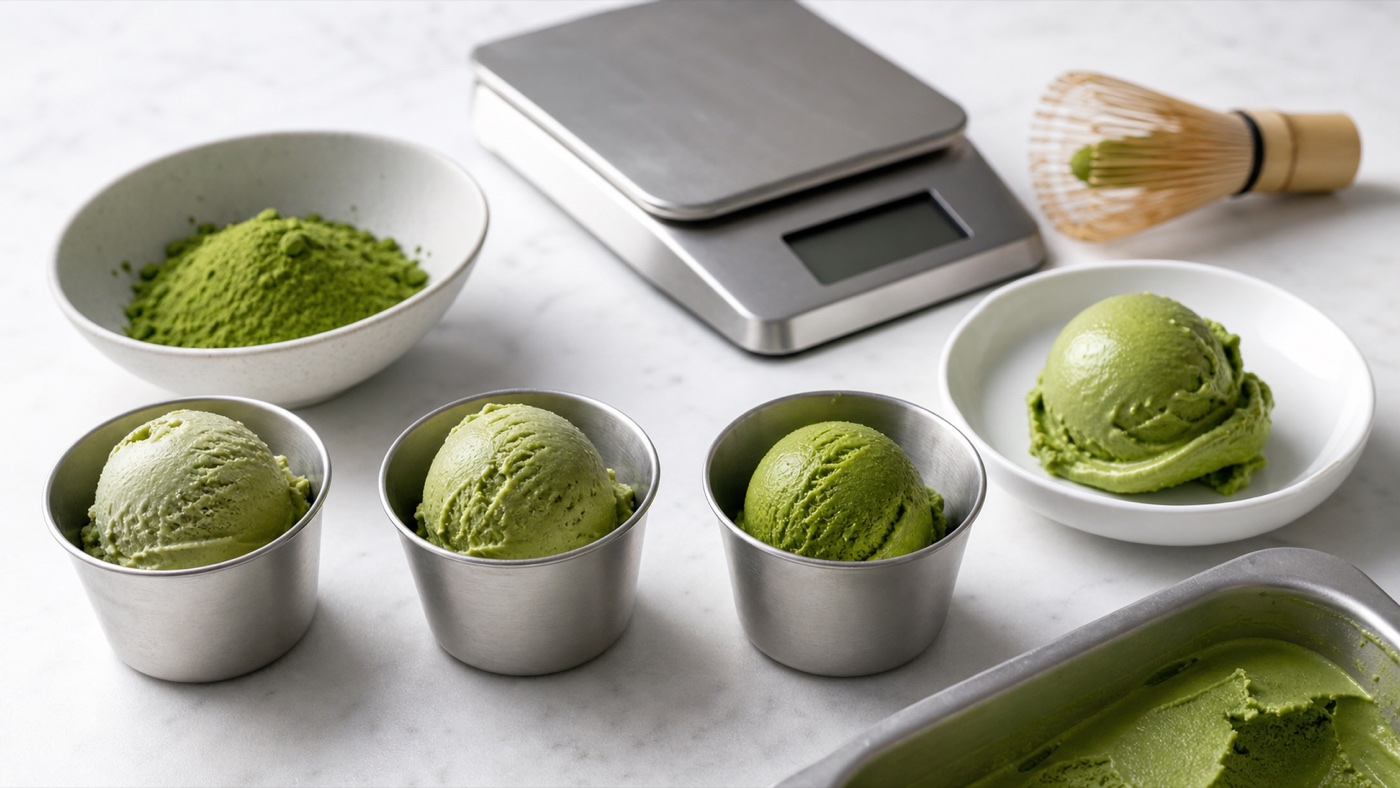
A practical 1 kg matcha ice-cream test
| Trial | Matcha per 1 kg mix | Percentage | Purpose |
|---|---|---|---|
| A | 5 g | 0.5% | Light flavor and lowest powder cost |
| B | 8 g | 0.8% | Middle benchmark |
| C | 11 g | 1.1% | Stronger color and matcha identity |
| Control | 0 g | 0% | Shows the base color, sweetness and flavor without matcha |
These are formulation starting points, not universal targets. Some products and concepts need less; others need more. Keep every other ingredient, process setting, batch size and final overrun constant. If the base is very sweet, high in cocoa-like flavors or high in fat, it may require a different range.
Why the frozen result tastes weaker than the liquid mix
Cold temperature reduces aroma release and changes flavor perception. Air incorporated during freezing increases volume and can make flavor seem less concentrated per spoonful. Fat and milk solids can soften astringency but also mask delicate green notes. Sugar suppresses bitterness and changes freezing behavior.
Do not approve the warm mix alone. Taste at the actual serving temperature and portion size. A green, intense liquid base may become balanced after freezing; a subtle base may become nearly anonymous.
How to incorporate matcha without clumps
- Weigh the matcha. Do not use tablespoons for production development.
- Sift it. Break compacted powder before it contacts liquid.
- Premix with dry solids. Disperse the matcha through part of the sugar or other suitable dry ingredients when the process allows.
- Make a smooth slurry. Alternatively, blend it with a measured portion of the liquid base before returning it to the batch.
- Use controlled shear. Mix enough to disperse but avoid unnecessary air before the freezing step.
- Follow the validated process. Integrate matcha at a stage compatible with the operation’s pasteurization, sanitation and hazard controls.
- Record the sequence. Time, temperature, mixer and addition point must be repeatable.
Adding dry matcha after a heat-treatment step can create sanitation and dispersion problems. Do not bypass a validated process merely to protect color. If a later addition is required, it needs an appropriately controlled ingredient and process designed by the manufacturer’s qualified food-safety and formulation team.
Choose the matcha for the base, not the label
| Frozen application | Matcha requirement | Useful comparison |
|---|---|---|
| Premium dairy ice cream | Enough color and aroma to remain present through fat and sweetness | Sailtik 4A versus 5A |
| Gelato with lower overrun | Clean flavor and controlled bitterness at a dense serving texture | 4A baseline; compare 5A for a premium position |
| Soft serve | Consistency in a standardized liquid or powder base and machine workflow | 3A or 4A cost/performance screen |
| Plant-based frozen dessert | Compatibility with cereal, nut, coconut or legume flavors | Blind-test 3A, 4A or 5A in the actual base |
| Matcha swirl or variegate | Higher local concentration, controlled water activity and visual contrast | Develop as a separate component |
Sailtik 5A is positioned for ceremonial use, high-end drinks and ice cream. Sailtik 4A is positioned for premium café drinks and high-end baking; it is a practical frozen-dessert comparator. Sailtik 3A may be screened for a more cost-sensitive formulation. These are application starting points, not guarantees.
Each grade has three internal Guizhou or Zhejiang origin/model options with different color and sensory characteristics. Internal codes are private. Selected 10 g samples are recommended according to the buyer’s base and commercial position.
Dairy, gelato, soft serve and plant bases behave differently
| Base factor | Possible effect on matcha | Control |
|---|---|---|
| High fat | Rounder taste but muted green aroma | Compare matcha level after hardening |
| High sugar | Less bitterness and lower freezing point | Do not add matcha by replacing sugar without rebalancing |
| High overrun | Lighter color and flavor per apparent volume | Measure overrun and serving weight |
| Oat/cereal base | Sweet cereal notes can support or mask matcha | Run a separate sensory test |
| Coconut base | Strong aroma and fat profile | Decide whether coconut is a feature or interference |
| Soy/legume base | Protein and beany notes can alter finish | Test sweetness and matcha dose together |
Evaluate at four points, not one
- Liquid mix: dispersion, base color and immediate bitterness.
- Fresh from the freezer: texture, overrun and flavor impact.
- After hardening: actual serving color, scoopability and balance.
- During intended storage/display: color drift, surface drying, ice crystals, aroma and flavor stability.
Photograph every sample under the same lighting with a neutral reference card. Do not compare a fresh scoop in daylight with an older sample under a warm display lamp.
A frozen-dessert scorecard
| Attribute | Question | Reject or adjust when |
|---|---|---|
| Color | Does it match the menu and remain acceptable? | Dull, gray, yellow or inconsistent beyond the target |
| Matcha identity | Can trained tasters recognize it after freezing? | Base flavor dominates |
| Bitterness/astringency | Does it finish cleanly? | Drying or harsh finish limits a full serving |
| Texture | Is it smooth at the target serving temperature? | Clumps, grittiness or formulation imbalance appears |
| Aftertaste | Is the finish green and pleasant rather than stale? | Hay-like, oxidized or lingering harsh notes |
| Cost | Does the higher dose or grade improve purchase intent? | Added powder cost brings no meaningful sensory gain |
Calculate matcha cost per batch and serving
Matcha cost per batch = landed cost per kg ÷ 1,000 × grams added
If 8 g is used per kilogram of mix, a 20 kg production batch uses 160 g matcha. Divide that cost by the number of accepted saleable portions, not theoretical volume. Include process loss, overrun, giveaway, melting and rejected display product.
For the underlying price logic, see Matcha Wholesale Price per kg. For grade positions, see Matcha Grades Explained.
Packaging and production planning
Sailtik’s standard bulk formats are 1 kg, 5 kg and 10 kg aluminum-foil bags. There is no fixed bulk MOQ, although larger orders generally have better freight economics. Choose inner packs that fit batch size and opening frequency. An ice-cream maker using 160 g per production run may prefer multiple sealed inner bags over one large container left open for many weeks.
The general shelf-life reference is 18 months, subject to the specific product, batch and package label. It does not define quality after opening. Protect opened matcha from moisture, light, heat and odors, and record open dates.
Frequently asked questions
How much matcha should I use in ice cream?
Start with controlled trials rather than one universal number. For a 1 kg base, 5 g, 8 g and 11 g provide a useful 0.5%, 0.8% and 1.1% comparison. Adjust after tasting the hardened product.
Is ceremonial matcha necessary for gelato?
No. “Ceremonial” is not a standardized global grade, and subtle advantages may be masked by the base. Choose by sample performance, dosage, consistency and cost.
Why did matcha ice cream turn dull?
Possible contributors include the original powder, process heat, oxygen exposure, light, storage time, base color and photography or display lighting. Investigate one variable at a time.
Approve the frozen product, then scale
Contact Carol at Sailtik with your base type, target matcha percentage, batch size, serving format and destination. Selected 10 g samples can screen initial color and flavor; production approval should use the complete frozen process before a larger order.