
Matcha has more than one valid “origin” answer. Botanically, it comes from leaves of Camellia sinensis. Historically, powdered-tea practices developed in China and reached Japan centuries ago. Culturally and technically, the shaded-tencha, finely milled matcha recognized around the world was refined in Japan. Commercially, matcha is now produced in Japan, China and other tea-growing locations, so a product’s actual country and region must be verified.
The common one-word answer—“Japan”—captures matcha’s strongest modern cultural association but leaves out the earlier Chinese history and today’s international supply. The opposite shortcut—“China invented matcha”—can also flatten the distinctive cultivation, processing and tea-ceremony tradition developed in Japan.
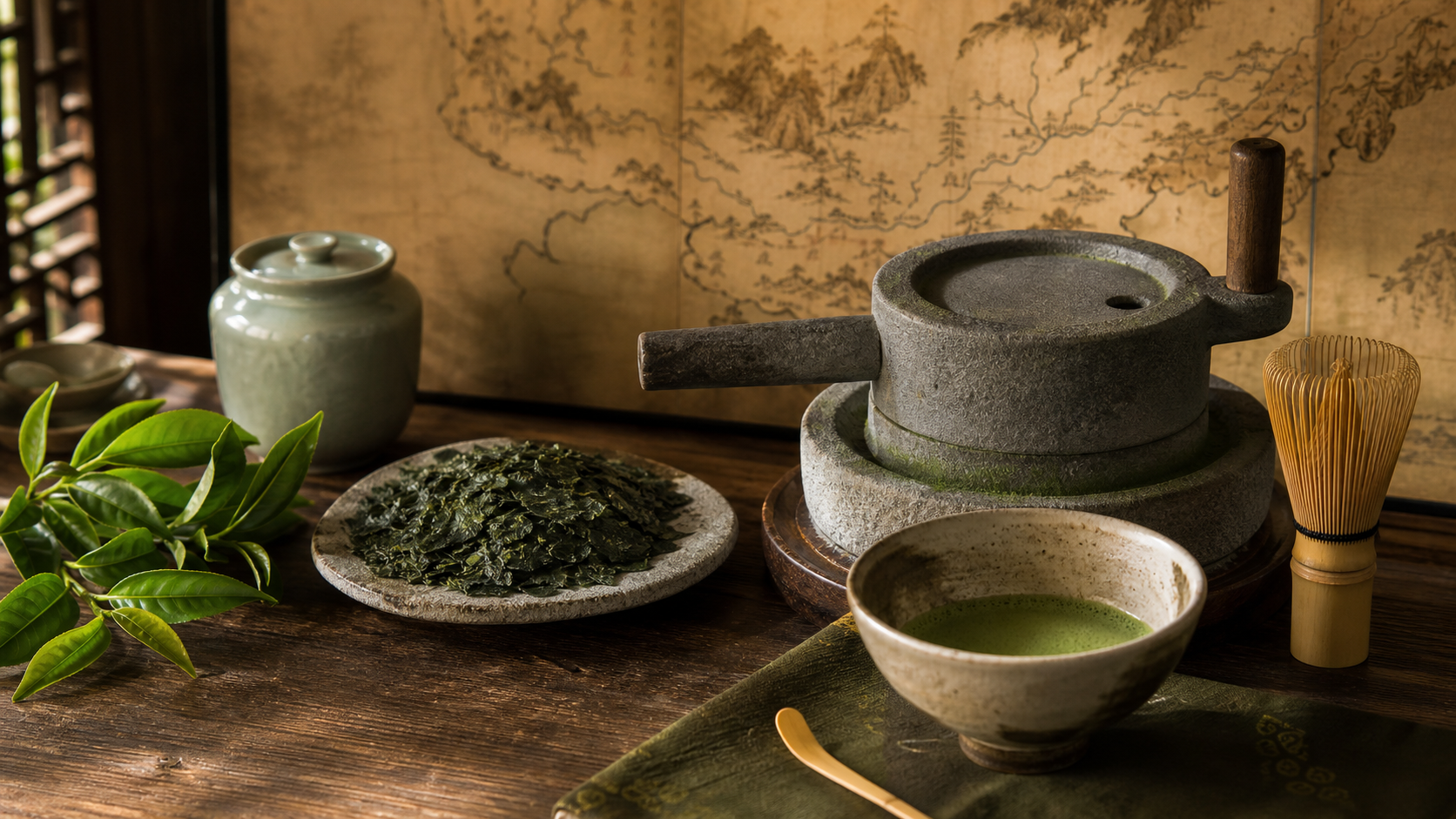
Four different meanings of “where matcha comes from”
| Meaning of origin | Useful answer |
|---|---|
| Plant | Leaves of Camellia sinensis, the tea plant also used for green, oolong and black teas. |
| Early powdered-tea history | Powdered tea preparation has roots in China and was transmitted to Japan. |
| Modern matcha tradition | Japan developed and preserved the shaded-tencha, milling and chanoyu traditions most closely associated with matcha today. |
| Actual product | The declared country, region, farm or processing chain for that specific lot; do not infer it from the word “matcha.” |
Matcha starts with the tea plant
Matcha is not a separate plant species. It is made from Camellia sinensis, whose leaves can become many kinds of tea depending on cultivation and processing. Matcha differs from ordinary loose-leaf green tea because the prepared drink contains finely ground leaf material dispersed in water or milk rather than only an infusion drawn from leaves.
Under the classical Japanese definition, matcha is made by grinding refined tencha. Tea shoots intended for tencha are grown under shade before harvest, steamed to stop enzymatic oxidation, dried without the rolling used for sencha, refined, then ground. Our separate guide follows how matcha is grown and produced step by step.
The historical answer begins in China
Tea drinking and powdered-tea practices existed in China before matcha became established in Japan. During the Song period, tea could be powdered, whisked and appreciated through formal practices. Japanese Buddhist monks encountered Chinese tea culture and helped transmit tea materials and preparation knowledge to Japan.
Japan’s Ministry of Agriculture, Forestry and Fisheries traces Uji tea history to 1191, when the priest Eisai brought tea back from Song China. It says Myoe later planted tea associated with Eisai and that cultivation spread to Uji. This history supports a layered description: the antecedent powdered-tea practice came from China, while the Japanese matcha tradition evolved in its own agricultural, religious and cultural setting.
Japan refined the matcha known today
Tea cultivation took root in several Japanese regions, and Uji became especially important. MAFF reports that tea gardens were established in Uji under elite patronage in the 15th century. In the 16th century, covered cultivation developed in response to tea-ceremony demand, contributing to the dark green color and umami associated with Uji matcha.
Chanoyu—the Japanese tea ceremony centered on powdered tea—helped preserve and refine preparation, utensils, aesthetics and quality expectations. This is why matcha is reasonably described as a Japanese tea tradition even while acknowledging its earlier Chinese antecedents.
Important Japanese production names include Uji/Kyoto and Nishio/Aichi, along with tea-producing areas in Shizuoka, Kagoshima and elsewhere. These names are not interchangeable. For example, MAFF’s geographical-indication entry for Nishio Matcha defines a specific production area and method. “Japanese matcha” is a country statement; “Uji matcha” or “Nishio Matcha” is a narrower regional claim that should meet the applicable definition.
Is matcha only made in Japan?
No. Modern matcha and matcha-positioned green-tea powders are produced outside Japan, including in China. Country of origin does not, by itself, disclose cultivar, shade regime, harvest, fixation method, particle size, sensory profile, safety results or suitability for a recipe.
Terminology is not perfectly uniform across the global market. A buyer should ask what raw material was used, how it was grown and processed, where each meaningful transformation occurred, and what the finished batch documentation supports. A romantic origin story cannot replace traceability and testing.
Where Sailtik matcha comes from
Sailtik supplies China-origin matcha from Guizhou or Zhejiang. It should not be described as Japanese or Uji matcha. Sailtik’s 1A–7A system is an internal application-positioning structure, not a Japanese legal grade or proof of a particular region, cultivar, harvest or milling method.
Each Sailtik grade has three internal origin/model options with different color and sensory characteristics. The internal model codes are not published. Rather than sending every model, Sailtik recommends selected 10 g samples according to the buyer’s business model and intended use so the customer can compare suitability directly. Learn how to interpret the Sailtik matcha grade range.
How a buyer verifies origin
- Ask for the country and region of the tea raw material.
- Clarify where steaming or other fixation, refining, grinding and packing occurred.
- Check the product label, commercial documents and lot-specific specification for consistency.
- Request evidence for narrow claims such as Uji, Nishio, organic, single origin or first harvest.
- Keep origin verification separate from sensory approval and food-safety review.
- Test a representative sample in the final recipe and confirm the production lot before ordering.
A blend can include material from more than one farm or region. That is not automatically a defect: blending can be used for sensory and price consistency. The issue is whether the description is accurate and whether the blend meets the agreed specification.
Frequently asked questions
Did matcha originate in China or Japan?
Both countries belong in a careful answer. Early powdered-tea practice came from China; Japan preserved and transformed that lineage into the shaded-tencha, milling and tea-ceremony tradition recognized as matcha today.
Where is most matcha grown?
Japan is the country most strongly associated with traditional matcha, but a precise “most” claim requires a defined year and comparable statistics because trade categories often combine matcha with other powdered green teas. Check current official production data rather than repeating an unsourced market percentage.
Does Uji mean the tea was grown inside Uji City?
Not necessarily. MAFF explains Uji tea using a regional production-method definition that can include tea leaves from Kyoto, Nara, Shiga and Mie processed in Kyoto by the Uji method. Verify the exact claim and supporting documentation.
Is Japanese origin automatically higher quality?
No country name replaces product evaluation. Origin can be commercially and culturally important, but sensory performance, contamination controls, freshness, consistency, documentation, application and price must still be assessed for the specific lot.
Sources
- Japan MAFF: Uji Tea history, production and regional definition
- Japan MAFF: Nishio Matcha geographical-indication summary
- Japan MAFF: tencha, matcha and Uji tea culture
- Japan Matcha Association: definition and production outline
This page distinguishes botanical, historical, cultural and commercial origin. It does not treat a country name as proof of quality and makes no Japanese or Uji origin claim for Sailtik products.
Business buyers can contact Carol at Sailtik with the application, target taste and color, estimated volume and destination for a focused China-origin sample recommendation.