
Matcha is made by growing tea for a powder-focused quality target, harvesting the leaf, stopping enzymatic oxidation, drying and refining the material, then grinding it finely and protecting the powder from heat, moisture, light and odors. In the classical Japanese process, shaded leaves are steamed and dried without rolling to make tencha; refined tencha is then ground into matcha.
That short definition hides many commercial decisions. Cultivation, harvest timing, fixation, drying, sorting, grinding, blending, packing and storage can all change color, aroma, bitterness, texture, consistency and cost. The exact terminology and equipment also vary by producing country and supplier, so buyers should verify a specific product rather than assume every powder follows an identical story.
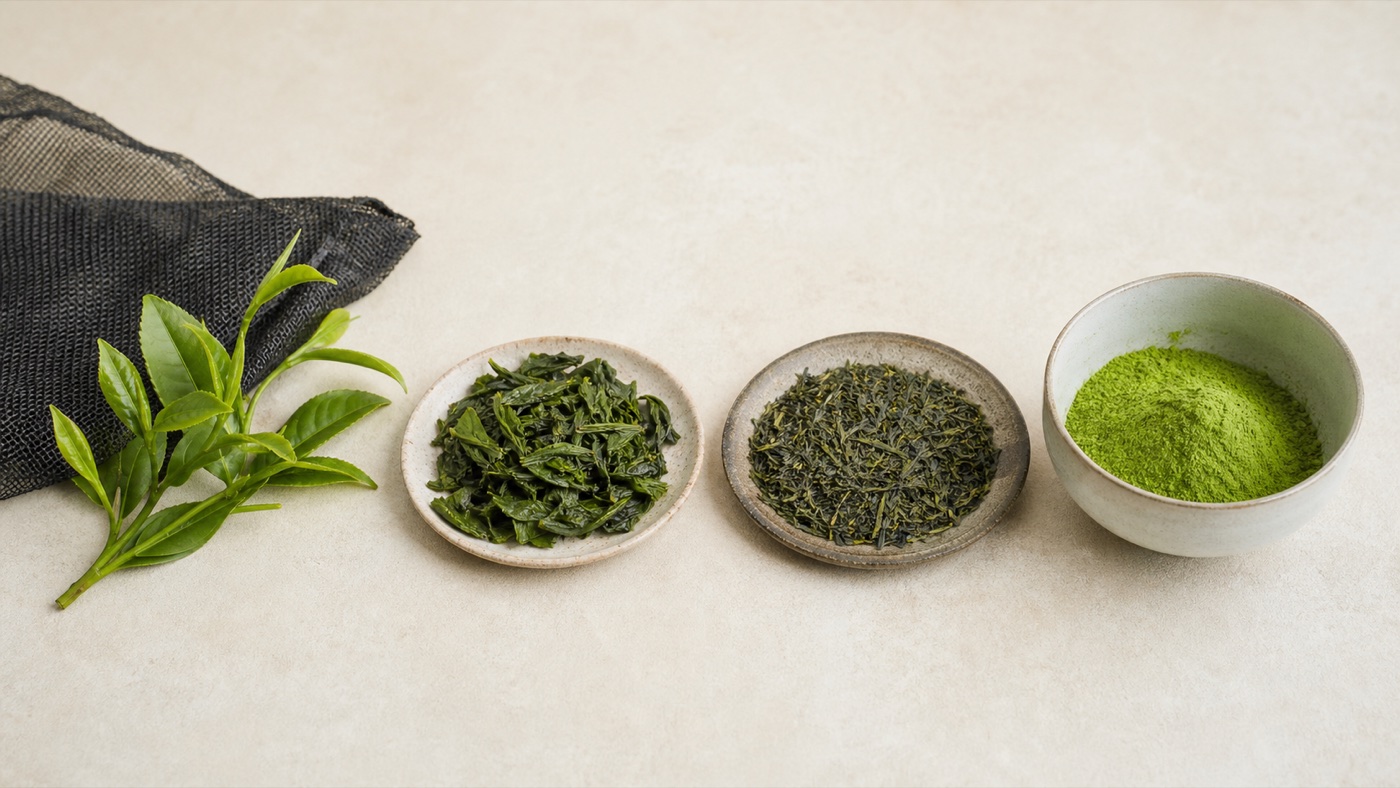
The matcha production process at a glance
| Stage | Main purpose | What a buyer may notice |
|---|---|---|
| Cultivation and shading | Manage leaf growth and composition for the intended quality target | Color, umami, astringency, aroma and cost |
| Harvest | Select leaf material at the planned maturity and season | Tenderness, flavor balance, consistency and availability |
| Fixation | Use heat to stop enzymatic oxidation | Green color, fresh aroma and cooked or harsh notes if control is poor |
| Drying | Reduce moisture and stabilize leaf material | Aroma cleanliness and storage stability |
| Refining | Remove or separate stems, veins and unsuitable material; grade or blend the leaf | Texture, flavor refinement and batch consistency |
| Grinding | Reduce refined leaf to fine powder while controlling heat and contamination | Mouthfeel, dispersion and color |
| Packing and storage | Limit exposure to moisture, oxygen, light, heat and odors | Shelf stability and retained sensory quality |
| Testing and release | Check defined quality and safety criteria | Whether the lot meets the agreed specification |
1. Tea cultivation starts before the shade goes up
Matcha comes from Camellia sinensis, the same plant species used for many teas. Region, cultivar, soil, weather, field management and plant health shape the starting material. No single origin guarantees a particular flavor or grade; product and batch evaluation still matter.
Shade is associated with traditional matcha raw-material production. The system, coverage, intensity and duration vary. Shading changes how the plant grows and is used to develop the color and taste profile sought for tencha and matcha, but “shade-grown” alone does not tell a buyer the exact duration, harvest, sensory result or finished-powder quality.
2. Harvest material determines the ceiling
Harvest timing, leaf maturity and the proportion of tender leaves influence flavor, fiber, color, yield and cost. Earlier or more selectively harvested material is often positioned higher, but “first harvest” should be treated as a claim to verify, not a synonym for automatic superiority.
Hand-picking and mechanical harvesting can both appear in the market. The meaningful procurement questions are what material was selected, how consistently it is controlled, and whether the finished powder meets the application. Do not infer hand-picking from the word “ceremonial.”
3. Heat stops oxidation after harvest
Fresh tea leaf changes quickly after picking. Heat fixation inactivates enzymes that would otherwise drive oxidation. In the Japanese tencha method described by the Kyoto Prefectural Tea Industry Chamber, fresh leaves are steamed, cooled, spread and dried. Other green-tea processing traditions and supplier systems can use different equipment, so the exact method should be confirmed for the product being evaluated.
Control matters: uneven processing can contribute to inconsistent color, raw-green odor, cooked notes or poor stability. A process diagram is useful, but the sample is where the buyer observes the result.
4. Tencha is dried without the rolling used for sencha
Classical tencha processing keeps steamed leaves open rather than rolling them into needle-like shapes. After drying, stems and larger veins are removed or separated and the leaf material is refined. Japan’s Ministry of Agriculture describes matcha as the fine powder made after this refined tencha is ground.
The word tencha is useful when discussing Japanese production, but a global buyer should still ask for a supplier’s own process and specification. A powdered green tea is not proven to be equivalent merely because its marketing uses “matcha.”
5. Refining and blending create a repeatable target
Refining can include screening and separating leaf material by size, color or other quality criteria. Blending is not automatically a defect: it can be used to build a consistent sensory and commercial profile from suitable components. The key is traceability and performance against an agreed specification.
For cafés, repeatability between deliveries may matter more than a romantic single-field description. For a premium retail brand, origin detail or harvest identity may carry more value. Define which attributes are essential before paying for them.
6. Grinding changes leaf into a suspension-ready powder
Traditional stone mills are strongly associated with premium Japanese matcha, while modern producers may use other controlled fine-grinding systems. Mill type alone does not disclose particle distribution, heat exposure, throughput, hygiene or sensory result. Ask what the supplier can substantiate and evaluate the powder in use.
Fine matcha does not truly dissolve like sugar. It disperses as small leaf particles in water or milk, and it can settle over time. Particle characteristics affect mouthfeel, clumping, foam and suitability for beverages or food manufacturing.
7. Packing protects a sensitive powder
Once ground, matcha has far more exposed surface area than intact leaf. Moisture, light, heat, oxygen and surrounding odors can damage its sensory quality. Packaging should therefore be evaluated as part of the product system, not as decoration.
Sailtik’s confirmed standard bulk formats are 1 kg, 5 kg and 10 kg aluminum-foil bags. The general shelf-life reference is 18 months, subject to the specific product, batch and package label. That unopened shelf-life statement does not define quality after opening; buyers should choose an inner pack that fits their rate of use.
8. Testing connects the process to a commercial lot
Sensory approval and documentation answer different questions. Test the sample in the intended recipe for color, aroma, taste, texture and dose. Separately, review identity, specification, CoA and relevant safety or claim documents. Sailtik’s available document types include an Allergen Declaration, CoA, Food Safety Management System Certificate, Halal Certificate, Heavy Metals Test Report, Non-GMO Declaration, Pesticide / Mycotoxin Residue Test Report and SDS; confirm applicability to the selected product, lot and destination.
See the detailed matcha document review guide and supplier due-diligence checklist.
How production choices appear in the cup or recipe
| Observation | Possible contributors | Buyer action |
|---|---|---|
| Bright or muted green | Leaf material, processing, grinding, age, storage and recipe conditions | Compare under identical light, dose and liquid |
| More umami or more bitterness | Cultivation, harvest, material selection, processing and dose | Blind-test at controlled temperature and recipe |
| Gritty mouthfeel | Particle characteristics, clumps, preparation or powder-to-liquid ratio | Sift, standardize mixing and compare products |
| Weak result in milk | Grade/application mismatch, dose, milk or sweetener masking | Test in the final commercial recipe |
| Batch variation | Agricultural variation, blending, process or storage differences | Set acceptance criteria and retain reference samples |
What Sailtik can and cannot infer from a grade
Sailtik supplies China-origin matcha from Guizhou or Zhejiang. Grades run from 1A to 7A as internal application positions, and each grade has three internal origin/model options with different color and sensory characteristics. Internal model codes are not published.
A grade does not, by itself, prove cultivar, harvest method, shade duration, stone milling, organic status or Japanese/Uji origin. Sailtik recommends selected 10 g samples according to the buyer’s business model and application so the customer can decide suitability directly. Review the matcha grades guide for application starting points.
Frequently asked questions
Is all matcha made from tencha?
Under the classical Japanese definition, matcha is finely ground refined tencha. Global commercial usage can be less consistent, so buyers should ask how the raw material was grown and processed rather than rely on the product name alone.
Is all matcha stone-ground?
No. Stone milling is traditional and strongly associated with high-end products, but other fine-grinding systems are also used. Evaluate substantiated process information, particle performance, sensory quality and consistency together.
Does darker green always mean better matcha?
No. Color is important but can be affected by lighting, camera processing, dose, liquid and storage. Judge color alongside aroma, taste, mouthfeel, application performance and documentation.
Buy the result, then verify the story
Contact Carol at Sailtik with your application, target taste and color, serving dose, monthly volume and destination. The next step is a focused sample comparison and document review—not assuming that one production phrase guarantees suitability.