
A matcha latte does not have one universal calorie count. Its total is the sum of the matcha, actual milk poured, sweetener, syrup, cream, cold foam and other additions. An 8 oz unsweetened home latte and a 16 oz sweetened café drink can differ far more than their green color suggests.
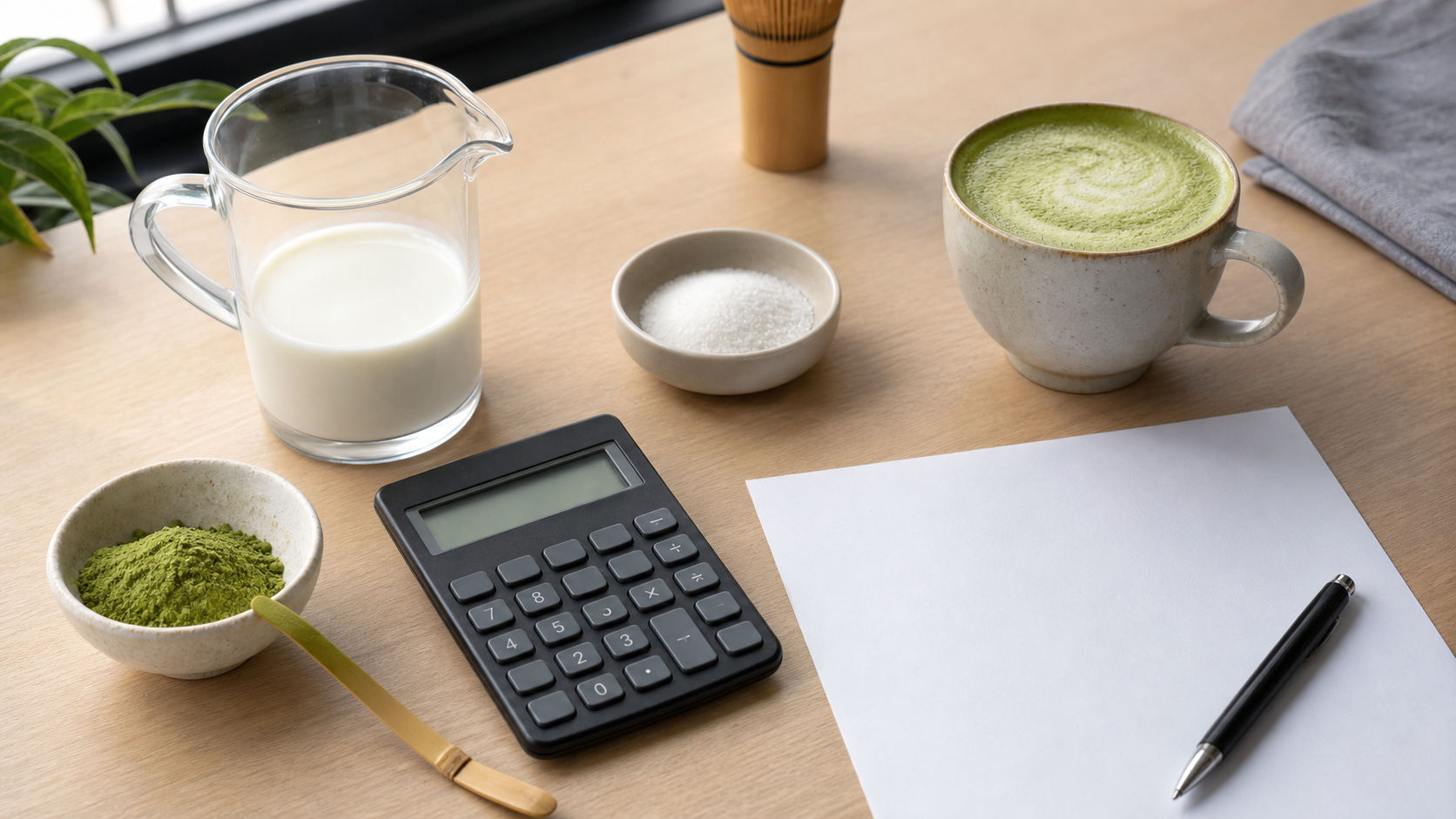
The calorie formula
Total calories = matcha + milk + sweetener + toppings. Use the Nutrition Facts panel for each packaged ingredient and the quantity that actually enters the cup. Water and ordinary ice add no calories, but ice changes how much milk fits in an iced drink.
| Component | Measure this | Common mistake |
|---|---|---|
| Matcha powder | Grams used × calories per gram from its label | Treating a sweetened matcha mix as pure powder |
| Milk or plant drink | Milliliters or grams actually poured | Using printed cup size as milk volume |
| Sugar, honey or syrup | Grams, pumps or milliliters with label conversion | Calling a drink unsweetened when the base is pre-sweetened |
| Foam, cream or sauce | Finished portion added | Ignoring a topping because it looks small |
Worked example: calculate from your labels
Suppose a test latte uses 2 g of matcha, 200 ml of milk and 8 g of sugar. Imagine the specific labels used in that kitchen show 4 calories per gram of powder and 50 calories per 100 ml of milk. The arithmetic is:
- Matcha: 2 × 4 = 8 calories
- Milk: 200 ÷ 100 × 50 = 100 calories
- Sugar: 8 × 4 = 32 calories
- Total: 8 + 100 + 32 = 140 calories
This is a method example, not a declared value for every powder or milk. Replace all three inputs with your labels. The U.S. Food and Drug Administration explains that carbohydrate provides 4 calories per gram, while packaged foods may use permitted rounding conventions. For formal menu labeling, use the applicable regulatory method rather than an informal estimate.
Why 12 oz and 16 oz are not calorie values
Cup capacity includes everything: milk, matcha concentrate, ice, foam and headspace. A 16 oz iced latte can contain less milk than a 12 oz hot latte if the larger cup is packed with ice. A “large” label also differs among cafés.
For an accurate count, build the drink on a scale. Weigh the empty cup, add each ingredient, and record the net amount. For service operations, repeat the test across several baristas to capture normal variation. The same principle used in our matcha grams-per-latte guide applies here: lock the recipe before calculating purchasing or nutrition.
What usually drives the total
- Milk volume: it is often the largest energy source in an unsweetened latte.
- Sweetener: sugar contributes about 4 calories per gram before label rounding.
- Premixed powder: some products combine tea with sugar, creamer or flavoring, so the scoop cannot be counted as plain matcha.
- Plant-drink formulation: oat, almond, soy and coconut drinks vary by brand and by sweetened or unsweetened version.
- Toppings: cold foam, whipped cream and sauces can materially change the result.
Café worksheet
| Ingredient | Recipe amount | Label basis | Calculated calories |
|---|---|---|---|
| Matcha | ___ g | ___ per ___ g | ___ |
| Milk | ___ ml | ___ per ___ ml | ___ |
| Syrup | ___ ml / pumps | ___ per ___ | ___ |
| Toppings | ___ g / ml | ___ per ___ | ___ |
| Total | ___ | ||
If a supplier provides only kilojoules, convert to kilocalories using the accepted energy conversion, then retain appropriate precision until the final rounding step. Keep the source label, formula version and date with the worksheet so a recipe change triggers recalculation.
Generic estimates versus named café drinks
A named chain drink must be answered from that company’s current menu and customization, not from this generic formula alone. Starbucks Tall, Grande and Venti queries have therefore been separated for a current brand-specific review. La La Land, frozen matcha lattes and explicitly unsweetened formulations are also separate intents because their ingredients differ.
Frequently asked questions
Does matcha itself have calories?
Powdered tea leaf is not literally calorie-free. At the small gram dose used in a latte, its contribution is usually much smaller than milk and added sugar. Use the powder’s own nutrition declaration.
Does oat milk always have more calories?
No. Formulations and serving sizes differ. Compare the exact oat drink with the exact dairy or plant alternative at the same poured volume.
Can I estimate a café latte from a photo?
Only very roughly. A photograph cannot reveal the milk brand, syrup quantity, sweetened powder or hidden toppings. Ask the café for its current nutrition information when accuracy matters.
Sources and calculation references
- U.S. FDA: calories on the Nutrition Facts label
- USDA FoodData Central
- Example of a current named-product nutrition page
Sources reviewed August 2, 2026. This calculator method is educational and does not replace required laboratory, supplier or regulatory nutrition substantiation.