
A practical starting range is 1.5–3 grams of matcha per latte. Start near 2 g for a smaller, lightly flavored drink and test upward when the cup contains more milk, ice or strong flavorings. There is no universal gram dose: the right number is the lowest repeatable amount that delivers the target color, aroma and finish in your actual recipe.
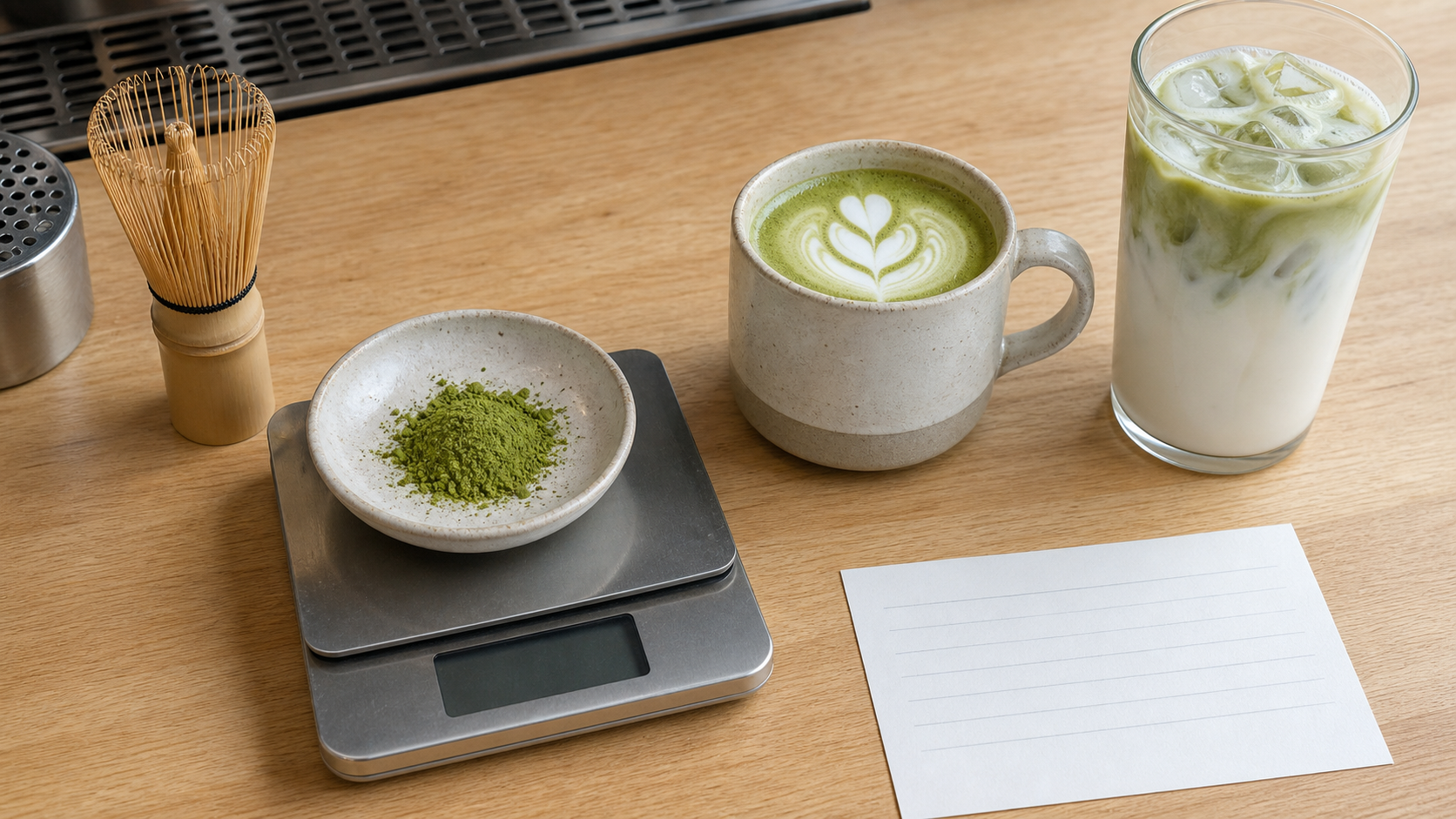
Starting doses by latte format
| Finished drink | Useful first test | When to test higher |
|---|---|---|
| 8 oz / 240 ml hot latte | 1.5–2 g | Milk masks the tea or a stronger café profile is intended. |
| 12 oz / 355 ml hot latte | 2–2.5 g | The recipe includes more milk, syrup or a bold flavor target. |
| 12 oz / 355 ml iced latte | 2–2.5 g | Ice dilution makes the finish disappear. |
| 16 oz / 475 ml iced latte | 2.5–3 g | There is a large milk volume, slow service or melting ice. |
These are development points, not grade guarantees or intake recommendations. Published café recipes vary. One current first-page guide uses 2 g for an 8 oz latte, while other recipes use 3–4 g or propose a stronger powder-to-liquid ratio. The disagreement is useful: recipes depend on the powder and beverage design.
Why cup size alone cannot determine the dose
- Actual milk volume: two 16 oz cups can hold different milk quantities after ice, foam and headspace.
- Milk choice: dairy, oat, coconut and almond beverages differ in sweetness, fat, aroma and color.
- Powder profile: bitterness, umami, aroma strength, particle behavior and color vary among samples.
- Ice and holding time: an iced drink continues to dilute after handoff.
- Syrups and inclusions: vanilla, fruit puree, cream, foam and sweeteners can cover delicate tea notes.
- Customer target: a mild entry-level latte and a tea-forward specialty drink are different products.
A five-cup calibration test
- Lock the base recipe. Fix finished cup size, milk brand, milk quantity, ice mass, water, temperature and sweetener.
- Choose a center dose. For most café lattes, 2 g is a sensible first reference within Sailtik’s recommended 1.5–3 g range.
- Prepare a ladder. Make five coded cups at evenly spaced doses around the center, such as 1.5, 1.75, 2, 2.25 and 2.5 g.
- Evaluate blind. Score color, aroma, matcha identity, bitterness, astringency, milk balance and finish.
- Repeat the finalists. Reproduce the best two doses on another day and after the normal service hold time.
Use a scale readable to at least 0.1 g. Teaspoons and bamboo scoops are convenient for service only after the utensil has been calibrated against mass. Powder density, settling and how heavily a spoon is filled can change the actual dose.
How to scale from 12 oz to 16 oz
Do not automatically multiply matcha by 16/12. First compare the amount of milk and melted ice, not just the printed cup capacity. If a 12 oz drink works at 2 g and the 16 oz version adds about 25% more diluting liquid, test 2.5 g before assuming that a full one-third increase is necessary.
Keep the dispersion water modest and consistent. Too little makes mixing difficult; too much weakens the milk base. Sift the powder, make a smooth concentrate, then combine it with the measured milk. The separate hot and iced matcha latte method covers mixing workflow, while the general matcha dose guide explains inventory and beverage-cost calculations.
Café cost and purchasing math
Once the recipe is locked, theoretical servings per kilogram equal 1,000 divided by grams per drink. At 2 g, that is 500 theoretical servings; at 2.5 g, 400; at 3 g, about 333. Real yield will be lower because of scale residue, spills, training drinks and remakes.
Monthly powder demand equals drinks per day × grams per drink × trading days ÷ 1,000. A café selling 40 lattes daily at 2.5 g for 30 days would plan from 3 kg before adding a waste and safety allowance. This makes dose testing a purchasing decision as well as a sensory one.
How Sailtik samples should be tested
Sailtik does not send every internal model automatically. After learning the business model, target drink and price position, suitable grades and selected 10 g samples can be recommended. Each sample should be tested in the same locked milk recipe; changing both powder and formula at once makes the comparison unreliable.
For cafés, the 3A–5A range often provides practical starting points depending on the desired positioning, while premium branded retail customization is generally considered around 5A–7A. This is positioning guidance, not a promise that a grade number alone determines the dose. Color and taste differ among origins and models, so the customer should approve the actual sample.
Frequently asked questions
Is 1 gram enough for a matcha latte?
It can make a mild small drink, but milk often suppresses the tea character. Compare it directly with 1.5 and 2 g in the same formula before adopting it.
Is 3 grams too much?
Not necessarily. Three grams can suit a large iced latte or a tea-forward profile. It may be excessive for a small delicate drink or a powder with strong bitterness, so sensory testing matters.
How many teaspoons are 2 grams?
Many recipes approximate 2 g as one level teaspoon, but teaspoons are not reliable production controls. Weigh the powder, then document the utensil method for staff.
Reference examples
- Current first-page ratio guide: 2 g in an 8 oz latte
- Alternative first-page ratio example for a stronger latte
- Barista method emphasizing weighing and recipe standardization
Recipe references reviewed August 2, 2026. The dose table is a test framework, not a universal serving or health recommendation.