
Bulk matcha buying should start with the finished cup or food—not with the biggest bag or the lowest price per kilogram. Define the application, approve a traceable sample, compare landed cost on the same basis and control what may change after approval.
This updated guide replaces old fixed price bands, arbitrary minimums, standard delivery-time promises and unverified certification requirements. Those values vary by product, quantity, destination, document scope, freight market and current availability.
What bulk and wholesale matcha mean
Bulk matcha powder is matcha sold for business use rather than as a small consumer tin. Wholesale describes the commercial relationship and quantity basis; bulk describes the ingredient format. A café can buy wholesale 1 kg bags, while a factory or distributor may buy multiple 5 kg or 10 kg packs. The terms do not define origin, grade, certification or quality by themselves.
| Buyer | Decision priority | Typical first validation |
|---|---|---|
| Café or small chain | Drink consistency, staff workflow and cost per cup | Blind latte/straight-tea sample trial |
| Bakery or ice-cream producer | Color and flavor after processing | Bench and pilot batch |
| Importer/distributor | Lot consistency, documents, inventory and customer segmentation | Multi-grade sample panel plus commercial review |
| Private-label brand | Product position, pack, claims and launch MOQ | Powder approval plus finished-pack prototype |
| Food manufacturer | Specification, process performance and supply continuity | Qualified ingredient trial in the final matrix |
Write the application before asking for a grade
- Straight tea, latte, flavored drink, ice cream, bakery or other food.
- Recipe dose and finished serving/batch size.
- Milk, sweetener, flavor and processing conditions.
- Target color, bitterness, umami, aroma and aftertaste.
- Trial quantity, monthly use and annual forecast.
- Origin requirement and destination-market claims.
- Bulk or private-label packaging.
- Required specifications, documents and testing.
- Delivery point, Incoterm and target launch date.
A request for “premium matcha, cheapest price” cannot produce comparable offers. A request for “2 g per 12 oz oat-milk latte, 20 kg monthly, moderate sweetness, visible green color, low lingering bitterness, delivered to our city” gives the supplier a testable target.
How Sailtik positions its bulk matcha grades
| Sailtik grade | Position / recommended starting use | Buyer validation |
|---|---|---|
| 7A | Top ceremonial position / luxury gifting | Straight-tea and premium-pack test |
| 6A | Premium ceremonial / tea ceremony | Straight-tea comparison |
| 5A | Ceremonial and high-end drinks / ice cream | Water, milk and frozen-application trial |
| 4A | Premium café drinks / high-end baking | Target drink and processed-food trial |
| 3A | Café drinks / premium baking | Milk visibility, taste and cost per cup |
| 2A | Budget milk tea / daily baking | Sweetened drink and food trial |
| 1A | Culinary / industrial baking | Process, color and flavor at target inclusion |
These are Sailtik’s own commercial positions, not an industry-wide standard. Each grade has three private internal options associated with different origin/model and sensory/color characteristics. Internal model codes are not published; the buyer receives a focused recommendation based on the business model and recipe.
Run a sample trial that predicts the purchase
- Receive samples identified well enough to link to an offer.
- Code them so tasters cannot see grade, price or origin.
- Weigh the same dose; Sailtik’s general starting range is 1.5–3 g per cup.
- Use identical water, milk, sweetener, temperature and mixing.
- Score color under fixed light, aroma, taste, mouthfeel and aftertaste.
- For food, evaluate after the full process and expected holding/storage.
- Calculate cost per accepted serving or batch.
- Approve the exact product and retain a reference sample.
Sailtik samples are 10 g per selected model. Not every internal model is sent on every inquiry; sample selection follows the application, target position and budget. Sample suitability remains a buyer judgment because sensory differences are partly subjective.
Bulk packaging and quantity planning
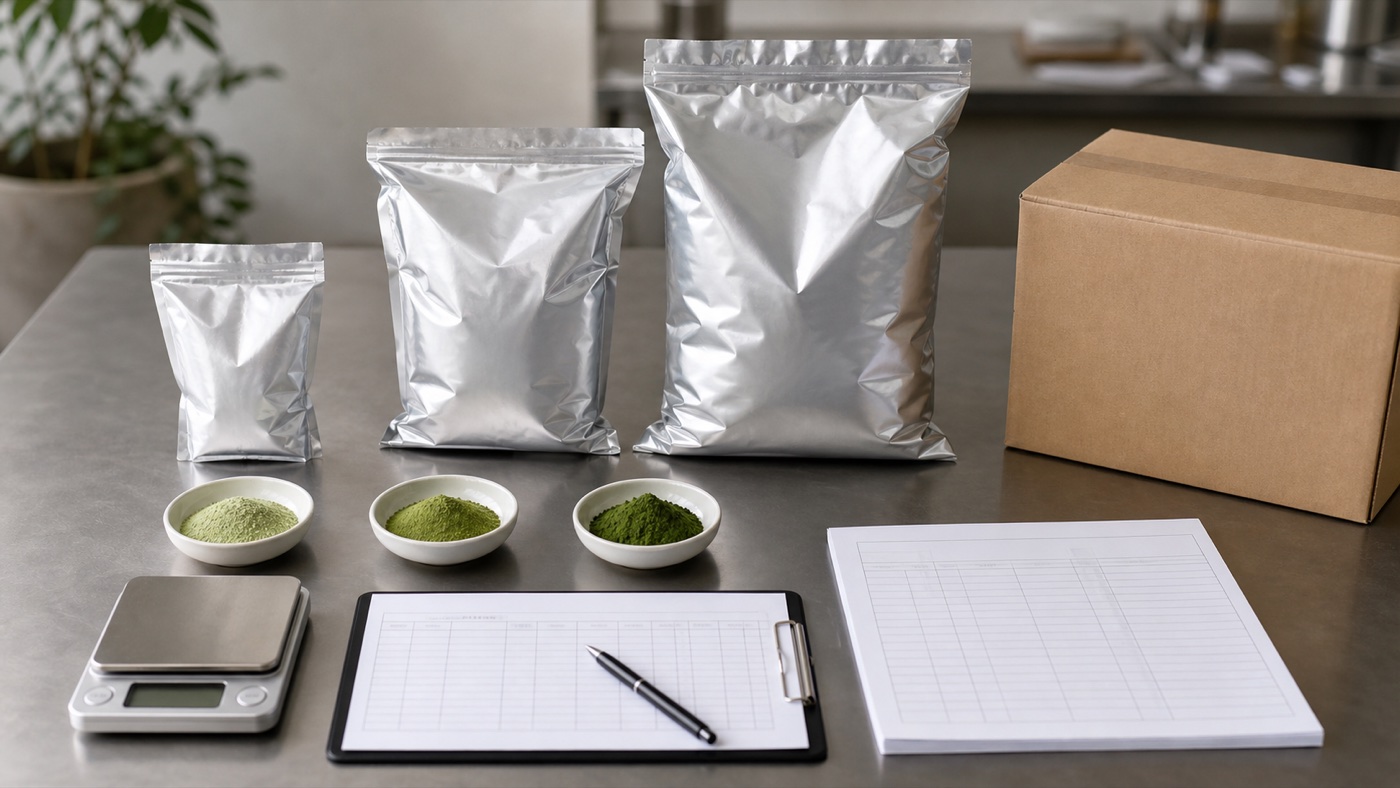
Sailtik’s confirmed bulk formats are 1 kg, 5 kg and 10 kg aluminum-foil bags. There is no fixed bulk MOQ, although the supplier still needs to confirm current availability, quote and shipment feasibility. Larger orders generally improve freight economics because transport and handling are spread across more product.
Choose pack size by consumption rate after opening, dispensing control, warehouse conditions and number of sites—not merely by the lowest packaging cost. A café group using 10–50 kg should compare a master-carton plan that protects unopened inner packs and supports stock rotation.
| Question | Why it matters |
|---|---|
| How much does each site use per week? | Sets a practical inner-pack size |
| How long is an opened bag exposed? | Affects sensory deterioration risk |
| Can staff reseal and date the pack? | Controls handling and rotation |
| Is the quote ex-works, FOB, CIF or delivered? | Prevents false price comparison |
| How many lots are in the shipment? | Guides sampling, approval and inventory records |
| What is the reorder trigger? | Connects lead time, buffer stock and cash flow |
Documents: request the right scope
Sailtik can provide the following document types: Allergen Declaration, CoA, Food Safety Management System Certificate, Halal Certificate, Heavy Metals Test Report, Non-GMO Declaration, Pesticide/Mycotoxin Residue Test Report and SDS. Availability of a document type does not mean every document automatically covers every product, lot, legal entity, market or label claim.
- Match the legal supplier and production/handling site.
- Check product name/code and covered scope.
- Distinguish management-system certificates from lot test results.
- Review issue date, validity and certifying/testing body.
- Confirm whether the shipment needs a lot-specific CoA.
- Have the importer determine destination requirements.
- Do not infer organic, Kosher, FDA approval or Japanese origin from unrelated records.
Use the detailed Matcha Certifications and Documents Guide for the review sequence.
Compare wholesale prices correctly
Do not compare a 1 kg trial price with a 50 kg recurring quote or an ex-works price with a delivered price. Normalize product, quantity, inner packing, certification/testing scope, Incoterm, currency, freight, duties and final delivery. Then convert the total into cost per accepted serving or finished product.
Current price and freight depend on the specific inquiry. Use the Wholesale Matcha Price per kg Guide rather than relying on fixed bands copied from an old article.
Origin must stay explicit
Sailtik’s confirmed origins are Guizhou or Zhejiang, China. China-origin matcha can be evaluated for café, food and accurately labeled private-label applications, but it must never be described as Japanese or Uji matcha. If Japan or Uji origin is mandatory, qualify a supply chain that can support that claim.
See the Japanese and Uji Matcha Sourcing Guide for origin evidence and comparison.
Private label is a separate workstream
Bulk powder supply does not automatically include retail packing. Sailtik generally recommends 5A, 6A or 7A for private label. Confirmed formats are 30 g, 50 g and 80 g tins at a 200-unit MOQ, or printed stand-up pouches from 100 g to 1 kg at a 300-unit MOQ.
Artwork, label claims, barcode, language, destination compliance, fill tolerance, master carton and approval samples must be defined before printing. See the Private Label Matcha Guide.
A practical bulk-matcha RFQ
- Business type and number of locations.
- Exact application and recipe dose.
- Target sensory/color position.
- Trial, monthly and annual quantity.
- Required origin and claims.
- Bulk or private-label pack.
- Destination, importer and delivery address.
- Required documents and tests.
- Requested Incoterm and currency.
- Launch date and reorder plan.
Frequently asked questions
What is Sailtik’s MOQ for bulk matcha?
There is no fixed bulk MOQ. The buyer should still request a current quote for the specific product, pack, destination and quantity; larger orders generally improve freight economics.
What is the shelf life?
Sailtik matcha generally has an 18-month shelf life, subject to the exact product, batch, package and label. The commercial label and shipment documents control.
Are free samples available?
This guide does not claim free samples. Sailtik’s confirmed sample format is 10 g per selected model; commercial terms should be confirmed with Carol.
Start with a focused sample request
Contact Carol at Sailtik with the application, dose, target grade position, monthly quantity, destination and required documents. That information allows a smaller, more relevant China-origin sample set and a quote that can actually be compared.