
The best culinary matcha for commercial baking is the sample that delivers acceptable color, recognizable flavor, workable texture and consistent cost after the complete production process. Raw powder appearance and a “ceremonial” label cannot predict the final cookie, cake, filling or premix.
Heat, time, oxygen, moisture, pH, flour, sugar, fat, dairy and other flavors can all change how matcha appears and tastes. Commercial buyers should therefore approve matcha through a controlled finished-product trial, followed by a scale-up test.
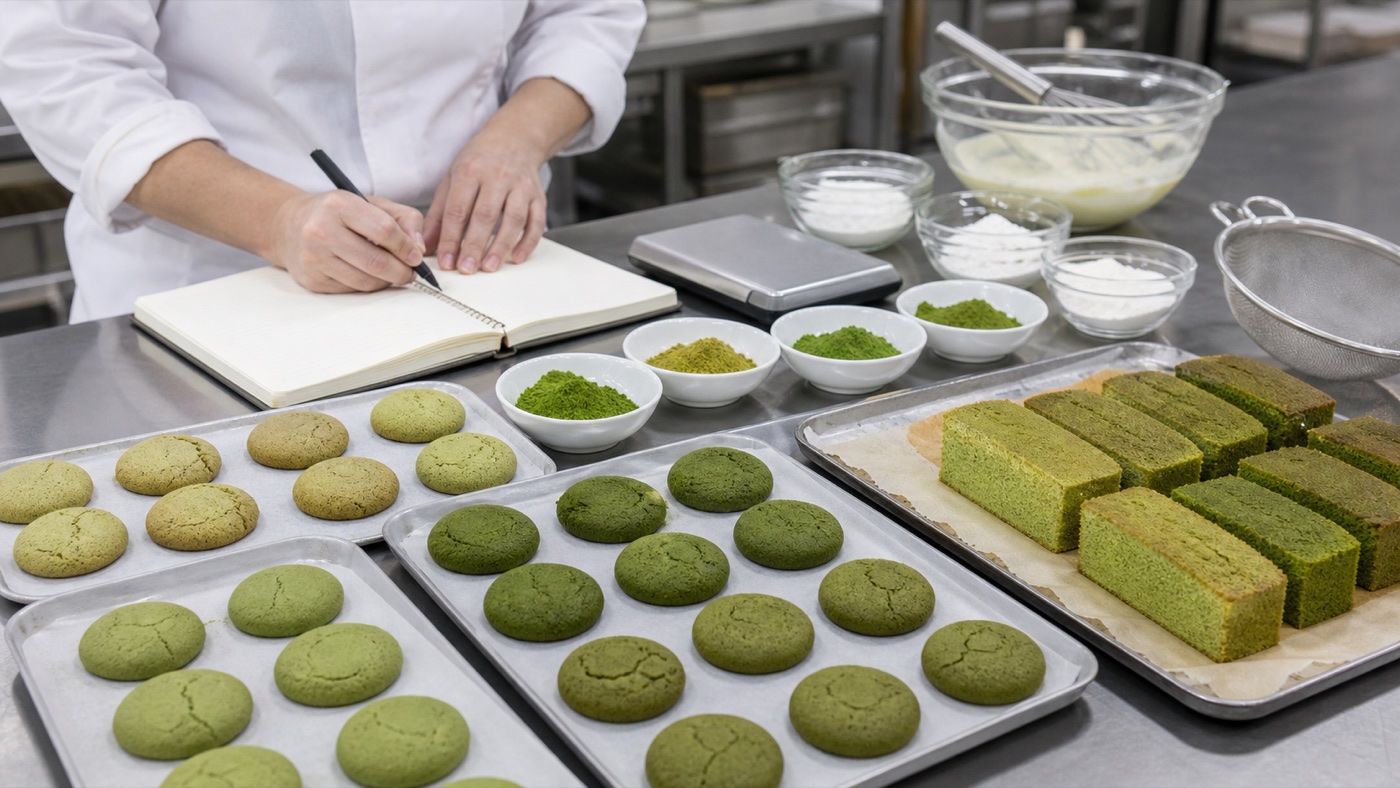
What culinary matcha means
“Culinary grade” is a market term for matcha intended for food applications. It is not one globally regulated quality level. Some culinary matcha is designed for daily bakery use, some for industrial formulations, and some for premium pastry products where greener appearance or a more refined flavor can justify a higher input cost.
Ceremonial-positioned matcha is generally selected for straight preparation and premium sensory experience. Its higher price does not guarantee a proportional improvement after baking. Strong sugar, cocoa, fruit, spices or high heat may mask the characteristics for which the premium was paid.
Choose by finished application
| Application | Main selection risk | What to test |
|---|---|---|
| Cookies and biscuits | Flavor disappears or color dulls during baking | Center and edge color, bitterness, aroma and appearance after display |
| Cakes and sponge | Uneven dispersion or weak flavor in a larger crumb | Cross-section color, clumps, moisture, crumb and next-day result |
| Buttercream and fillings | Fat and sugar change flavor perception | Color, aftertaste, texture and holding stability |
| Chocolate and confectionery | Cocoa butter, sweetness or other flavors dominate | Matcha presence, color and dosage economics |
| Premixes | Segregation and inconsistent portions | Blend uniformity, reconstitution and batch-to-batch repeatability |
| Industrial baking | Small bench results do not survive scale-up | Full process, equipment, line time, yield and commercial waste |
Which Sailtik grades should a bakery test?
| Grade | Confirmed positioning | Practical test role |
|---|---|---|
| 1A | Culinary and industrial baking | Cost-focused industrial baseline |
| 2A | Daily baking and budget milk tea | Routine bakery baseline |
| 3A | Premium baking and café drinks | Compare for stronger premium presentation |
| 4A | High-end baking and premium café drinks | Test where visual and sensory position may justify the cost |
Higher is not automatically better. Start with the grade aligned to the product position, then compare one lower-cost and one higher-positioned option where practical. Sailtik has three internal origin/model options per grade from Guizhou or Zhejiang. Their names remain private; selected variants can be screened for different color and sensory characteristics.
Indicative grade price bands are available in the matcha grades comparison. Final quotations depend on product, quantity, packaging, destination and current freight.
Build a controlled bench test
- Freeze the control recipe. Do not change flour, sugar, fat, liquid, leavening, process or bake profile between matcha samples.
- Weigh every ingredient. Volume spoons hide small but important differences.
- Choose three loading levels. Use a low, target and high level appropriate to the product developer’s current formula.
- Randomize sample codes. Avoid letting price or grade name influence the first sensory judgment.
- Record the raw stage. Photograph powder, dry blend and batter under the same light.
- Record the finished stage. Evaluate immediately after cooling and at the normal customer display or consumption time.
- Repeat the finalist. One successful tray is not a production specification.
Use baker’s percentage for reproducible comparisons
For flour-based products, matcha loading can be recorded against flour weight:
Matcha baker’s percentage = matcha weight ÷ flour weight × 100
This lets a bakery reproduce the same level at a larger scale. For non-flour products such as cream, chocolate or ice cream, record matcha as a percentage of the defined total base instead. Always state the calculation basis; “2% matcha” is ambiguous without it.
Score four stages, not one
| Stage | What to record |
|---|---|
| Raw powder | Color, aroma, clumping and sample identity |
| Mixed batter or dough | Dispersion, apparent color and process behavior |
| Finished product | Flavor, bitterness, color, texture and defects after cooling |
| Normal holding point | Appearance and sensory result after the actual display, packaging or storage interval |
Customers buy the last stage, not the raw powder. A vivid batter that becomes dull during processing should not outrank a less dramatic raw sample that finishes better.
Calculate usable cost, not only ingredient price
Matcha cost per batch = landed cost per kg ÷ 1,000 × matcha grams used
Then divide by the number of accepted saleable units—not merely units produced. Include rejects caused by color, flavor, clumping or process variation. A slightly more expensive matcha can be the lower-cost option if it reaches the target at a lower loading or produces fewer rejected batches.
| Cost component | Include |
|---|---|
| Ingredient | Matcha used in the approved formula |
| Logistics | Freight and other costs needed to reach the bakery |
| Process loss | Powder left in packaging, dusting, transfer and mixing loss |
| Quality loss | Rejected trials or sale units that miss the specification |
| Testing | Bench, pilot and production validation where applicable |
Move from sample to production in gates
- Gate 1 — screening: use selected 10 g samples for small controlled comparisons where the recipe allows.
- Gate 2 — pilot: obtain enough of the finalist to run representative equipment and normal process conditions.
- Gate 3 — production: approve the specification, reference result, documents and incoming-lot procedure before a commercial launch.
- Gate 4 — reorder: compare the new lot in the approved recipe before it reaches full production.
A 10 g sample is a screening tool, not proof of industrial performance. The larger and more complex the production process, the more important the pilot and first-production checks become.
Packaging and storage for bakery buyers
Sailtik’s standard bulk formats are 1 kg, 5 kg and 10 kg aluminum-foil bags, with no fixed minimum order. Larger orders usually have better freight economics. Choose an inner-pack size that matches batch consumption and limits unnecessary time after opening.
Protect matcha from moisture, light, heat and odors, and reseal opened bags promptly. Shelf life is generally 18 months, subject to the selected product, batch and package label. Your finished baked product needs its own shelf-life validation; the ingredient’s shelf life cannot be copied to a cookie, cake or premix.
Documents for commercial review
Available Sailtik materials include an Allergen Declaration, CoA, Food Safety Management System Certificate, Halal Certificate, Heavy Metals Test Report, Non-GMO Declaration, Pesticide / Mycotoxin Residue Test Report and SDS. Confirm the document scope for the exact product and the requirements of the destination market and customer.
Frequently asked questions
Can ceremonial matcha be used for baking?
Yes, but it may not be economical. Test whether its sensory or visual advantage remains after the full recipe and process. A culinary-positioned matcha may provide a more practical finished result.
Why does matcha change color in baked goods?
Heat, time, oxygen, moisture, pH and other ingredients can all influence the final appearance. Compare candidates under the exact commercial bake and holding conditions instead of accepting a generic “heat stable” claim.
How much culinary matcha should a bakery use?
There is no universal amount for cookies, cakes, fillings and premixes. Define the calculation basis, test several controlled loading levels, and approve the lowest level that meets the finished-product specification and margin.
Approve the baked product, not the label
Successful commercial matcha baking is a formulation and process decision. Select an application-appropriate grade, run a controlled comparison, calculate accepted-unit cost, scale through pilot equipment and connect every reorder to a repeatable incoming test.
Contact Carol at Sailtik with your product type, formula environment, target position, estimated volume and destination to receive a focused culinary-matcha sample recommendation.