
Choose matcha packaging from the way the product will be used and sold. A café or bakery normally needs efficient bulk packs; a consumer brand needs retail units, branding space and a manageable first production run. The package that looks most premium is not automatically the package with the lowest inventory risk.
Sailtik’s confirmed formats fall into three groups: 1 kg, 5 kg and 10 kg aluminum-foil bags for standard bulk supply; 30 g, 50 g and 80 g tins for custom projects; and printed stand-up pouches from 100 g to 1 kg.
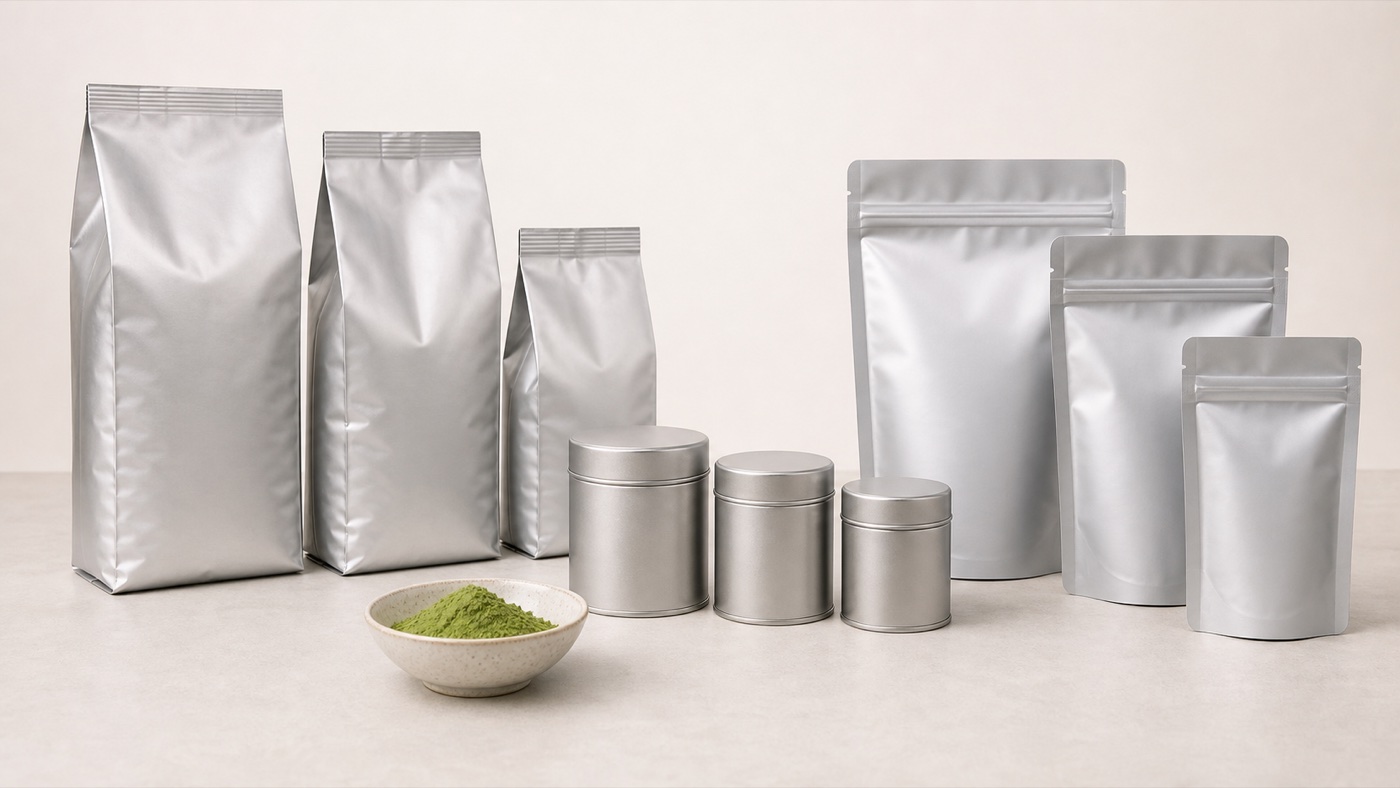
Quick comparison of Sailtik matcha packaging
| Format | Confirmed sizes | Minimum | Best starting use |
|---|---|---|---|
| Standard aluminum-foil bag | 1 kg, 5 kg, 10 kg | No fixed bulk MOQ | Cafés, bakeries, food production and repacking operations |
| Custom tin | 30 g, 50 g, 80 g | 200 units | Premium retail, ceremonial position and gifting-oriented concepts |
| Printed stand-up pouch | 100 g–1 kg | 300 units | Retail refills, larger consumer packs and branded café or foodservice packs |
Bulk matcha and custom packaging follow different minimums. There is no fixed minimum order for standard bulk supply, although larger quantities normally have better shipping economics. Custom packaging has a production minimum because containers and printing must be ordered and processed.
Bulk bags for cafés, bakeries and production
A bulk bag is usually the simplest option when the buyer consumes matcha internally or packs it through another approved operation. The 1 kg format can support recipe testing and lower-volume sites. Larger 5 kg and 10 kg packs can reduce packaging per kilogram, but they must fit consumption speed and handling practices.
- 1 kg: useful for smaller cafés, pilot baking and allocating unopened packs to separate locations.
- 5 kg: useful where production batches or monthly consumption justify fewer inner packs.
- 10 kg: useful for higher-volume operations that can control opening, resealing and stock rotation.
The general shelf-life reference is 18 months, subject to the selected product, batch and package label. After opening, protect the powder from moisture, light, heat and odors and reseal promptly. Do not treat the unopened shelf life as a guarantee of identical color or aroma after a large bag has been open for an extended period.
Custom tins for premium retail positioning
Sailtik’s confirmed custom tin sizes are 30 g, 50 g and 80 g, with a minimum of 200 units. Private-label projects generally begin with 5A, 6A or 7A matcha according to the brand position and intended use.
| Tin size | MOQ | Minimum matcha fill | At 2 g per serving |
|---|---|---|---|
| 30 g | 200 units | 6 kg | 15 servings per tin |
| 50 g | 200 units | 10 kg | 25 servings per tin |
| 80 g | 200 units | 16 kg | 40 servings per tin |
The fill-weight calculation is important: “200 units” does not mean the same inventory investment for every size. It also does not include any production allowance, retained samples, quality checks or other operational loss that may apply to the final project.
Printed stand-up pouches for larger retail packs
Printed stand-up pouches are confirmed from 100 g to 1 kg with a minimum of 300 units. Their larger front and back panels can support branded information, while the wider size range can serve consumer refills, ecommerce, cafés or foodservice customers.
| Example pouch size | MOQ | Minimum matcha fill |
|---|---|---|
| 100 g | 300 units | 30 kg |
| 250 g | 300 units | 75 kg |
| 500 g | 300 units | 150 kg |
| 1 kg | 300 units | 300 kg |
A higher pack weight can reduce the number of units needed to sell a given volume, but the same 300-unit MOQ creates much more total inventory. Forecast sell-through before choosing the largest pack.
Protection comes before appearance
Matcha is sensitive to environmental exposure. A packaging review should consider the complete system, including the primary contact package, closure, opening size, headspace, secondary container if any, shipping carton and the consumer’s ability to reseal it.
| Packaging question | Why it matters |
|---|---|
| How will the pack limit moisture and light? | Both can damage usability and appearance. |
| How much air remains after repeated opening? | Pack size and closure affect the consumer’s exposure pattern. |
| Can the user measure without contaminating the powder? | Opening design and instructions affect handling. |
| Will the pack survive shipping? | Dents, punctures and seal damage can create loss before sale. |
| Can every required label element fit? | Brand graphics must not crowd out mandatory information. |
Exact tin material, shape, color, pouch material, surface finish and closure options have not been publicly fixed for all Sailtik projects. Confirm them during quotation and approve physical packaging samples before production.
Separate matcha approval from packaging approval
- Approve the matcha: test selected 10 g samples in the intended recipe or preparation.
- Lock the public grade and product: private-label projects normally consider 5A, 6A or 7A.
- Select the pack size: use serving count, retail price and sell-through.
- Confirm the package specification: dimensions, construction, closure and finish must be project-approved.
- Review the label: confirm destination-market information with a qualified reviewer.
- Approve a physical sample or proof: check fit, color, print, legibility and handling.
- Confirm the production quantity and quotation: include matcha, packaging, freight and any project costs.
Do not print before these details are settled
- Product name and ingredient statement.
- Net quantity and measurement unit.
- Responsible business details required for the destination.
- Storage instructions and batch/date coding plan.
- Required nutrition, allergen, origin and certification statements.
- Barcode, traceability and importer/distributor information where applicable.
- Evidence supporting every marketing and certification claim.
Artwork responsibility, label-printing responsibility, compliance-review scope and lead time are confirmed project by project. A supplier document does not automatically make finished consumer artwork compliant in every market.
Frequently asked questions
Is a matcha tin better than a pouch?
Not universally. A tin may support premium presentation, while a pouch can provide efficient storage and more printable area. Compare the complete barrier and closure system, pack size, handling, freight and customer use.
Can I order only 200 custom 30 g tins?
The confirmed tin MOQ is 200 units, so 200 × 30 g equals 6 kg of fill before any project allowance. Final feasibility, packaging specification, quotation and production requirements must still be confirmed.
What is the lowest-risk way to start?
Approve the matcha first, validate demand, and choose the smallest confirmed format whose MOQ and total fill weight fit the launch. Bulk supply can also be used before moving into custom packaging.
Choose the inventory commitment, not only the container
The correct package protects the matcha, communicates the brand and can be sold through before quality or cash flow suffers. Compare MOQ in units, total fill weight, landed project cost and realistic monthly sales together.
For the full launch workflow, read the private-label matcha guide. Contact Carol at Sailtik with the desired pack size, units, destination, sales channel and brand position for project review.