
Yes, matcha can leave a visible green mark on clothes, especially pale or absorbent fabric. That does not mean every spill becomes permanent. The result depends on whether the spill is dry powder, plain tea or a latte; the fiber and dye; how long it remains; previous washing or drying; and what the garment’s care label permits.
Treat the garment, not an internet average. A washable white cotton T-shirt, a wool sweater, a silk blouse and a dry-clean-only jacket should not receive the same treatment.
Why matcha can mark fabric
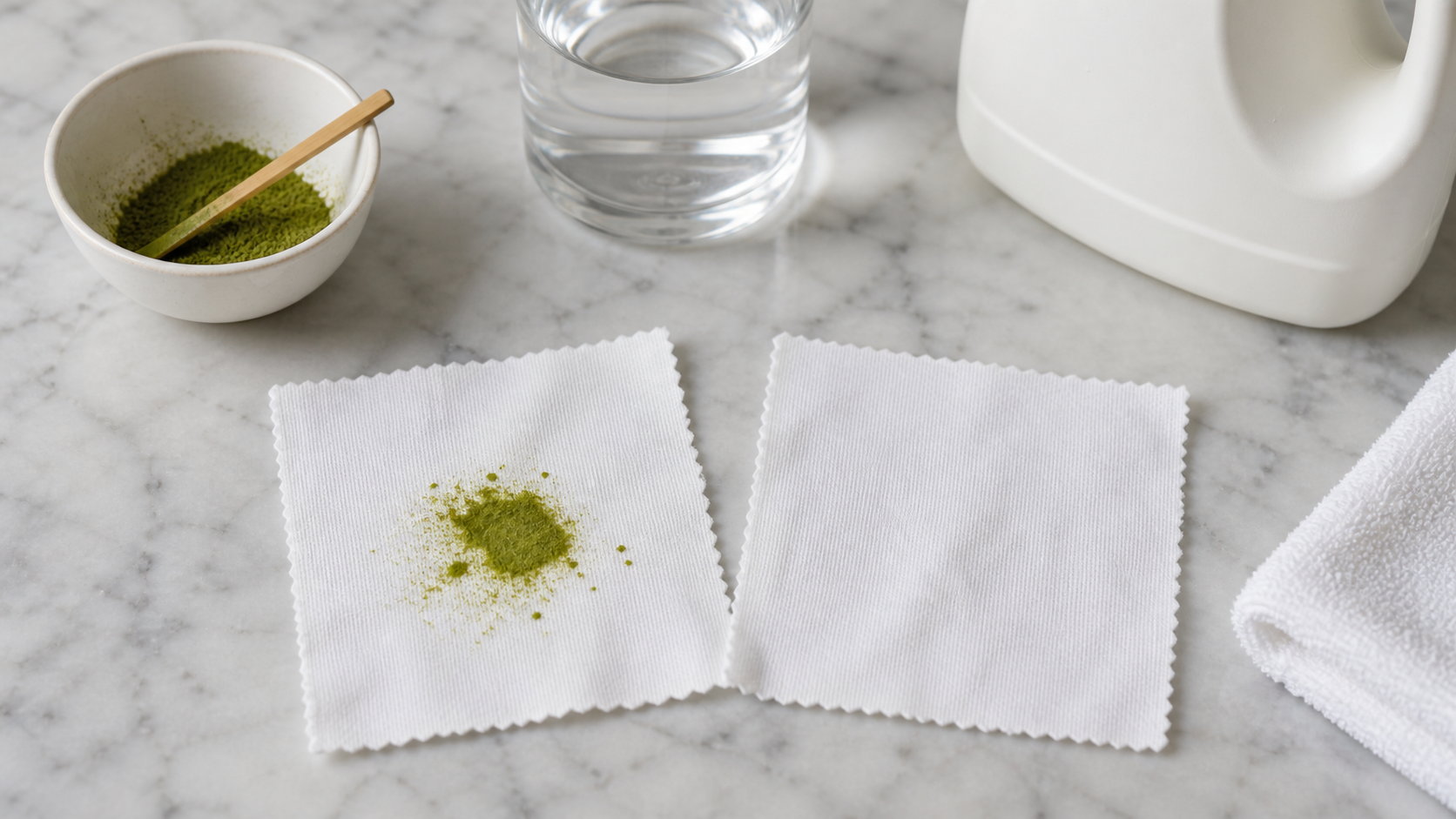
Matcha is finely powdered tea leaf. Its green plant pigments and small insoluble particles can settle between fibers, while dissolved or suspended components spread with liquid. Because the whole powder remains in the drink, a spill is not identical to a clear filtered tea stain.
Fine powder can also be rubbed deeper into a weave before any liquid is added. A latte adds milk fat and protein, sugar, syrup, fruit or flavoring, turning one green spot into a mixed stain. The cleaning question therefore starts with “what spilled?” rather than just “was it matcha?”
Dry powder, plain matcha and latte spills differ
| Spill | What reaches the fabric | Immediate concern |
|---|---|---|
| Dry matcha powder | Fine leaf particles | Rubbing or wetting can spread powder through the weave |
| Matcha with water | Suspended powder, pigments and water | Liquid carries color beyond the initial drop |
| Matcha latte | Tea plus milk or plant beverage | Protein, fat and beverage solids make it a combination stain |
| Sweetened or flavored latte | Tea, milk, sugar, syrup and possibly fruit | The extra ingredients may need their own treatment logic |
| Matcha paste, frosting or ice cream | Concentrated pigment plus fat and other solids | Scraping, smearing and fabric sensitivity all matter |
Will matcha stain permanently?
It can become persistent, but permanence cannot be predicted from the drink name alone. A fresh mark on a washable, colorfast fabric may respond well to prompt care. A dried mark, an item already tumble-dried, a fragile fiber, an unknown dye or an old mixed stain may be harder to correct without damage.
Do not treat “plant-based” as “cannot stain,” and do not treat green color as a synthetic permanent dye. These shortcuts ignore the fabric, drink formula and handling history. A cleaner may remove the soil but also alter the garment’s own color or finish if the method is unsuitable.
Does matcha stain white clothes more?
A green mark is usually easier to see on white fabric, but visibility is not the same as stronger chemical attachment. White garments also vary in fiber, finish and allowed bleach. Never assume “white” means chlorine bleach is permitted; check the label.
The U.S. FTC Care Labeling Rule requires covered clothing to provide regular care instructions, including relevant washing, drying, bleaching and warnings. Those instructions are the first boundary for any stain treatment.
What determines whether a mark remains
- Fiber and construction: cotton, polyester, wool, silk and blended or coated fabrics respond differently.
- Garment dye and finish: a cleaner may affect the garment color before it removes the green mark.
- Spill formula: plain matcha and a creamy, sugary fruit latte are different soils.
- Time: a fresh spill is a different starting point from one discovered days later.
- Rubbing: friction can spread particles and damage delicate fibers.
- Prior washing and drying: earlier treatment changes what remains and what can safely be tried next.
- Heat: dryer or iron exposure may make a mixed stain harder to address and can damage some materials.
- Care limits: dry-clean-only, no-bleach or low-temperature instructions restrict the options.
A conservative first response
For loose dry powder, avoid grinding it into the fabric; lift or shake away what can be removed without spreading it. For a liquid spill, blot rather than rub. Check the garment label before adding water, detergent, stain remover, acid, bleach or heat. Keep the item out of the dryer until you have assessed the remaining mark and the label permits the next step.
That is intentionally not a universal removal recipe. Washable cotton, wool, silk, leather, upholstery and dry-clean-only garments need different instructions. Valuable, delicate or color-unstable items are reasonable candidates for a professional cleaner; report the complete drink ingredients and any treatment already attempted.
Why popular DIY advice conflicts
Search results recommend combinations of vinegar, lemon, baking soda, dish liquid, laundry detergent, oxygen products, sunlight and bleach. Each changes pH, oxidation, color or surface behavior differently. A method that appears successful on one white cotton swatch may fade another garment, damage protein fibers or interact with a previous cleaner.
Do not mix cleaning products casually, and never use an untested “hack” as proof that every matcha stain is removable. Follow the product and garment instructions and test only where appropriate.
Reducing matcha spills in a café
- Use a stable weighing area with enough space around the scale.
- Keep powder containers closed between doses.
- Avoid filling cups to the rim before carrying them.
- Fit lids fully and test takeaway packaging under the actual drink temperature.
- Separate powder handling from clean uniforms, towels and customer belongings.
- Train staff to identify whether a spill is dry powder, plain matcha or a latte before responding.
- Keep garment-safe procedures and cleaning-product instructions accessible.
Matcha color varies with powder, dose, milk and lighting. Our matcha sensory guide explains why color is only one quality observation. A brighter drink may look more dramatic on fabric, but appearance alone cannot predict removability.
Frequently asked questions
Does matcha tea stain clothes?
Yes, suspended matcha powder and green pigments can leave a visible mark. Whether it remains depends on the fabric, formula, time and care method.
Is a matcha latte stain worse than plain matcha?
It is more complex because milk, plant beverage, sugar, syrup or fruit may be present. “Worse” depends on the fabric and exact recipe, but it should be treated as a combination stain rather than pure tea alone.
Can I put a matcha-stained shirt straight into the dryer?
Assess the mark first and follow the label’s drying instruction. Dryer heat can make some remaining soils harder to address and may restrict later treatment choices.
Authoritative care reference
Last SERP and care-reference review: August 1, 2026. This page explains stain risk; a material-specific removal guide requires a separate assessment.