
Matcha can taste savory and umami-rich, fresh and vegetal, gently sweet, pleasantly bitter, or drying and astringent. The balance changes with the leaf material, processing, freshness, dose, water and final recipe. There is no single flavor that every good matcha must reproduce—and “ceremonial” on a label does not replace tasting.
This guide gives consumers a plain-language answer and gives cafés and product developers a repeatable way to compare samples. The important principle is simple: evaluate the powder in the application you will actually sell.
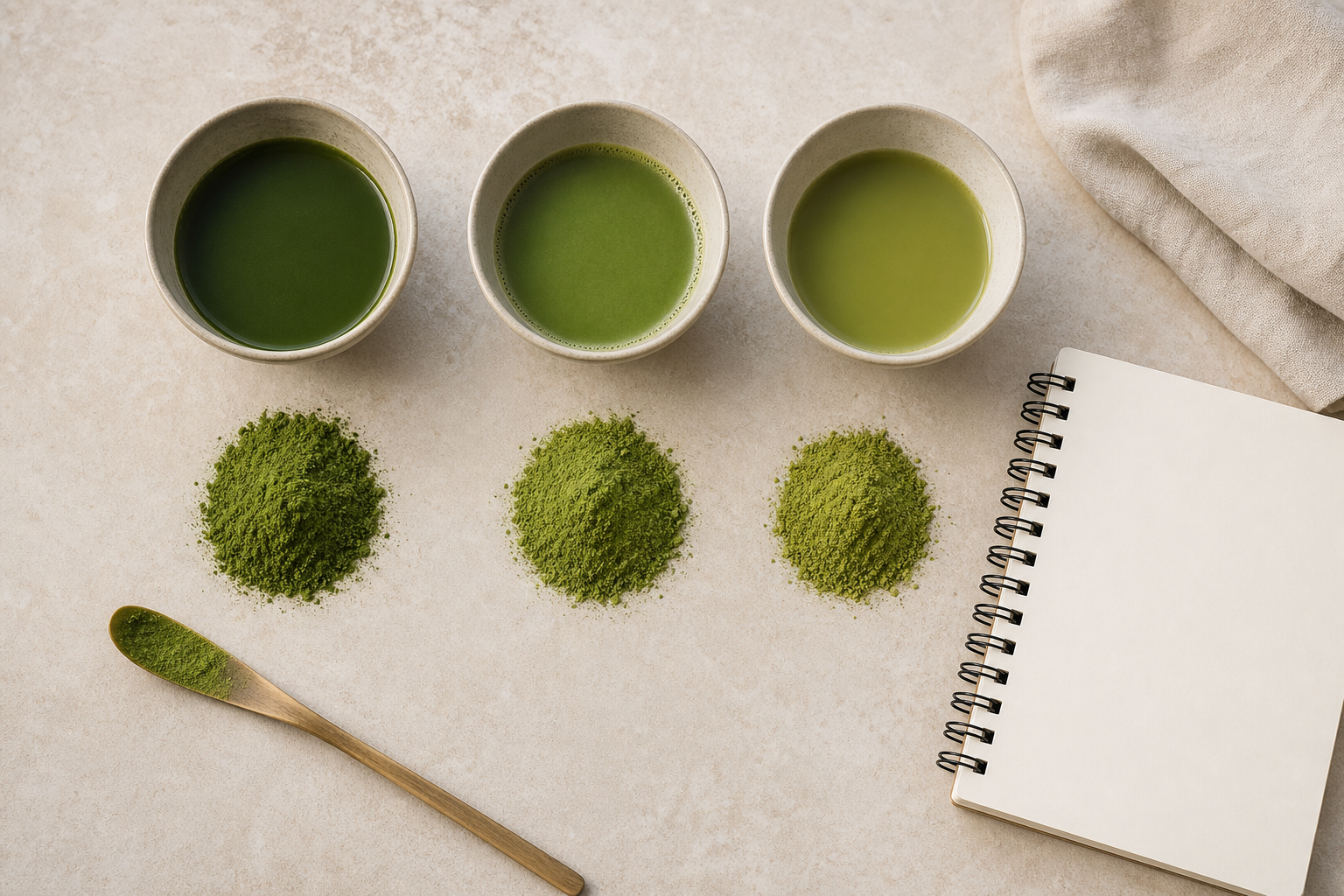
The short answer: what flavor is matcha?
- Umami: a savory, broth-like depth rather than sweetness or saltiness.
- Vegetal character: impressions such as tender greens, peas, spinach or fresh grass.
- Sweetness: usually subtle and intrinsic, not comparable with a sweetened latte.
- Bitterness: a basic taste that may add structure when controlled but becomes harsh when dominant.
- Astringency: the drying, puckering sensation on the tongue and cheeks. It is a mouthfeel, not the same thing as bitterness.
- Aroma: fresh green, marine, nutty, floral or cooked-vegetable notes may appear depending on the sample and the taster.
A balanced drinking matcha often combines umami, mild sweetness and fresh vegetal notes with controlled bitterness and little roughness. A powder intended for a latte or bakery may deliberately taste more forceful because milk, sugar, fat and flour mute subtle notes. Strong is not automatically poor, and delicate is not automatically suitable for every recipe.
Bitterness and astringency are different
People often use “bitter” for two separate experiences. Bitterness is a taste, like the edge of unsweetened cocoa or tonic water. Astringency is the physical drying or tightening sensation produced in the mouth. A cup can be bitter without being strongly astringent, or drying without an intense bitter taste.
Research on matcha composition connects catechins with bitterness and astringency, caffeine with bitterness, and free amino acids with mellow and umami impressions. Those relationships are useful, but a chemical result cannot fully predict whether a café customer will enjoy the finished drink. Aroma, particle size, recipe and expectation also influence the experience.
Why two matchas can taste completely different
| Variable | Possible sensory effect | Buyer’s check |
|---|---|---|
| Leaf material and harvest | Changes the balance of amino acids, polyphenols, aroma and fiber | Compare samples, not just harvest language |
| Cultivar and growing region | Can shift aroma, umami, bitterness and aftertaste | Do not assume origin alone predicts preference |
| Shading and field practice | Influence chlorophyll and taste-active compounds | Request truthful product information; avoid inferring from color alone |
| Processing and milling | Affect aroma retention, particle size, suspension and mouthfeel | Check smoothness and sediment in the intended preparation |
| Age, oxygen, heat and light | Can flatten aroma and dull color over time | Compare fresh, properly stored samples |
| Dose and water | Change concentration and extraction immediately | Weigh powder and control water temperature and volume |
| Milk, sweetener and flavoring | Mask subtle notes and soften or redirect bitterness | Run a finished-recipe test, not water-only tasting alone |
A 2022 technical paper on sensory evaluation of matcha describes assessing color, particle size, foaming, foam color and taste. Its tasting procedure uses 2 g powder and 100 mL hot water. That does not have to become your café recipe; its value is standardization. If every sample is prepared differently, the comparison says more about the preparation than the powder.
Does matcha taste like grass or seaweed?
“Grassy” is a common shorthand for green, leafy or freshly cut vegetal aroma. Some tasters use “seaweed” for a marine or savory aroma associated with strong umami. These are analogies, not ingredients: pure matcha is powdered tea leaf, not grass or seaweed.
A mild fresh-green note can be normal. A stale, musty, smoky, rancid or unusually fishy odor deserves a different response: check storage, water, equipment cleanliness, milk and the sample itself. Do not disguise an obvious off-odor with syrup before identifying its source.
What does a matcha latte taste like?
A matcha latte is not simply diluted straight matcha. Milk adds sweetness, fat, protein and aroma; plant beverages add their own cereal, nutty or legume notes; syrup changes the balance again. The result is usually creamier, sweeter and less astringent than matcha with water. It can also become bland if the powder is too delicate or the dose is too low.
That is why a powder that is beautiful in a small water bowl may disappear in a 12- or 16-ounce latte, while a more assertive café grade can perform better. Use the hot and iced matcha latte formulas to hold preparation constant, then change one variable at a time.
How to make matcha taste better before blaming the powder
- Weigh the dose. A heaped spoon is not reproducible. Sailtik’s general testing range is 1.5–3 g per cup.
- Use fresh water. Strong chlorine, mineral imbalance or stale reheated water can distort taste.
- Avoid boiling water for the first comparison. Start around 70–80°C, then test deliberately rather than assuming hotter is better.
- Sift or disperse lumps. Dry pockets produce sudden harshness and a gritty impression.
- Whisk consistently. Keep time, water volume and tool constant across samples.
- Clean the equipment. Old milk fat, detergent or odors in a bottle or whisk can be blamed on matcha.
- Taste before and after additions. Record the water-only cup, then the exact milk and sweetener recipe.
For more detail, see the water-temperature and frothing guide. If lowering temperature and controlling dose makes the cup balanced, the original problem was at least partly preparation.
A repeatable three-cup tasting protocol
Use coded cups so price and grade names do not bias the first impression. Prepare all samples with the same powder mass, water mass, temperature, whisking time and bowl shape. Taste in a randomized order and repeat on another day if the decision matters commercially.
| Attribute | What to record | Simple scale |
|---|---|---|
| Aroma | Fresh green, marine, nutty, floral, cooked, stale or other | Low / medium / high intensity |
| Umami | Savory depth and length | 1–5 |
| Bitterness | Basic bitter taste | 1–5 |
| Astringency | Drying or puckering sensation | 1–5 |
| Sweetness | Natural sweet impression before sugar | 1–5 |
| Mouthfeel | Thin, rounded, creamy, chalky or gritty | Notes plus 1–5 |
| Finish | Clean, lingering, harsh, flat or off-note | Notes plus duration |
Then repeat the comparison in the intended product: unsweetened milk, the final sweetened latte, soft-serve base, cake batter or another application. A sample wins only if it meets the recipe, price and customer target—not because it scored highest in water.
Can color tell you how matcha will taste?
Color is useful, but it is not a complete sensory certificate. Lighting, camera processing, screen settings, powder depth and moisture can change what a photograph shows. Chlorophyll and storage matter, yet two similarly green powders can still differ in aroma, bitterness, texture and performance with milk.
Use photographs for initial screening only. Evaluate a physical sample under consistent neutral light and then taste it. A bright image should never substitute for a representative sample, a specification or lot-appropriate documentation.
How Sailtik approaches grade and sample selection
Sailtik sources matcha from Guizhou and Zhejiang, China. Its commercial range runs from 1A for culinary and industrial baking through café and premium-drink grades to 7A for top ceremonial and luxury-gifting positioning. These are Sailtik’s commercial grade designations, not a claim that a universal international grading law uses the same scale.
Each grade can include three internal models from the available production origins, with different color and taste profiles. Those internal model codes are not published because the useful decision is not the code—it is whether the sample works in the buyer’s product. Sailtik does not automatically send every model. Carol first considers the customer’s business model, application and price position, then recommends suitable grades and 10 g samples from selected models.
This curated approach keeps testing focused, but the customer makes the final sensory judgment. Taste is subjective, and preliminary internal tasting notes cannot replace the buyer’s own panel, water, milk, recipe and market. Review the matcha grade guide, then contact Carol with your drink format, serving size, target price and preferred balance of umami, bitterness, color and milk-cutting strength.
Frequently asked questions
Is matcha supposed to be bitter?
Some bitterness is normal. The practical question is whether it is balanced by aroma, umami, sweetness and a clean finish. Excessive dose, very hot water, stale powder or an application-mismatched grade can make bitterness dominate.
Does matcha taste like regular green tea?
They share green-tea character, but matcha is a suspension of finely powdered leaf rather than a filtered infusion. It normally feels fuller-bodied and more concentrated, with more pronounced vegetal, umami, bitter and astringent dimensions.
Does better matcha always taste sweeter?
No single descriptor proves quality. Premium drinking styles often emphasize mellow umami and lower harshness, but cultivar, origin, blend and personal preference matter. For a latte, sufficient intensity after milk may be more valuable than delicacy in water.
Can a supplier guarantee that I will like a sample?
No responsible supplier can guarantee a subjective preference. A supplier can narrow the choices, provide consistent preparation guidance and discuss specifications; the buyer should validate the sample in the actual recipe and packaging workflow.