
To make a smooth matcha latte, sift 1.5–3 g matcha, whisk it with 30–50 ml warm water into a uniform concentrate, then add hot or cold milk. For an iced latte, pour that concentrate over milk and ice; do not expect dry matcha to dissolve cleanly when dropped straight into cold milk.
The best recipe is not one universal ratio. Cup size, ice, milk, sweetness, matcha grade and target cost all change the result. The formulas below are controlled starting points for home testing and café menu development, with every key amount stated by weight or volume.
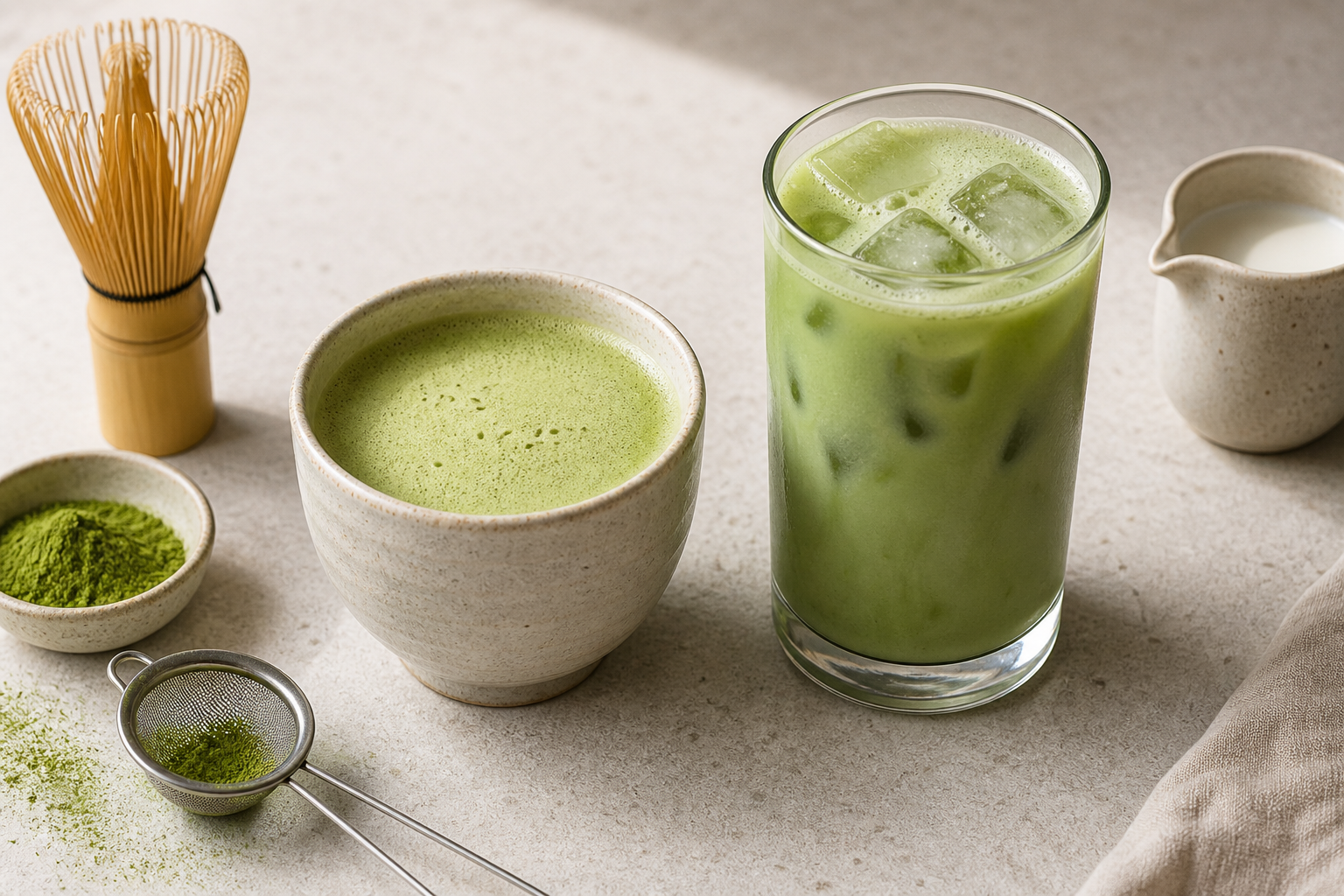
Quick hot and iced matcha latte recipes
| Ingredient | Hot latte starting formula | Iced latte starting formula |
|---|---|---|
| Finished serving | About 240 ml / 8 fl oz | About 355 ml / 12 fl oz including ice |
| Matcha | 2 g | 2.5 g |
| Warm water | 40 ml at roughly 70–80°C / 158–176°F | 40 ml at roughly 70–80°C / 158–176°F |
| Milk | 180 ml, warmed | 180 ml, cold |
| Sweetener | 0–10 g, to target | 0–15 g, to target |
| Ice | None | Fill the service glass; weigh during development |
These sit inside Sailtik’s recommended 1.5–3 g per-cup test range. A first-page review found published latte formulas ranging from roughly 1 g to 4 g or more per drink, often without consistent cup sizes. That is why a weighed recipe and blind tasting are more useful than copying a teaspoon measure.
How to make a hot matcha latte
- Weigh and sift: place 2 g matcha through a fine-mesh sifter into a wide bowl or cup. Sifting breaks dry clumps before liquid is added.
- Add warm water: pour in 40 ml water at about 70–80°C / 158–176°F. Avoid boiling water during the first trial because it can emphasize harshness.
- Disperse: whisk rapidly for 15–20 seconds with a bamboo whisk, handheld frother or small electric whisk. Scrape any dry powder from the edge.
- Heat the milk: warm 180 ml milk to the temperature appropriate for that milk and your equipment. Do not scorch it.
- Combine: add any measured sweetener to the matcha base, pour in the milk and stir once for uniformity.
- Record: taste immediately and score matcha strength, sweetness, bitterness, aroma, texture, color and aftertaste.
How to make an iced matcha latte
- Sift 2.5 g matcha into a bowl, shaker cup or small pitcher.
- Add 40 ml warm water and whisk until no dry pockets remain. Matcha disperses; it does not truly dissolve like sugar.
- Add measured sweetener while the base is still warm if your sweetener dissolves better that way.
- Fill a 355 ml / 12 fl oz glass with a repeatable amount of ice. Weigh the ice during development so dilution is not a hidden variable.
- Add 180 ml cold milk, then pour in the matcha concentrate.
- Stir or shake before service. A layered photograph is attractive, but a uniform drink gives the customer the intended first sip.
For a stronger drink, move toward 3 g before changing several variables at once. For a smaller or lightly flavored drink, test 1.5–2 g. Read the full matcha-per-cup testing guide for yield and cost calculations.
Scale the recipe for a café trial
| Component | 1 iced drink | 10 iced drinks | 50 iced drinks |
|---|---|---|---|
| Matcha at 2.5 g | 2.5 g | 25 g | 125 g |
| Warm water at 40 ml | 40 ml | 400 ml | 2,000 ml |
| Milk at 180 ml | 180 ml | 1,800 ml | 9,000 ml |
| Sweetener at 10 g | 10 g | 100 g | 500 g |
The multiplication is planning arithmetic, not permission to hold a 50-drink matcha suspension all day. Matcha settles, and prepared dairy or plant-milk drinks introduce their own time and temperature controls. For service, decide whether staff will whisk to order, use short production windows or prepare a controlled matcha base. See the batch and concentrate workflow.
A six-cup test that identifies the right matcha
Test two powders at three doses while keeping everything else constant:
| Cup | Powder | Dose | Milk, water, sweetener and ice |
|---|---|---|---|
| 1 | Sample A | 1.5 g | Fixed recipe |
| 2 | Sample A | 2.25 g | Fixed recipe |
| 3 | Sample A | 3 g | Fixed recipe |
| 4 | Sample B | 1.5 g | Fixed recipe |
| 5 | Sample B | 2.25 g | Fixed recipe |
| 6 | Sample B | 3 g | Fixed recipe |
Code the cups so tasters do not know the powder or dose. Score green color through milk, tea aroma, first-sip flavor, bitterness, astringency, texture, sweetness balance and finish. The winner is the lowest practical dose that consistently meets the menu target—not automatically the most expensive dry powder.
Which matcha grade works in a latte?
Grade names are not standardized across suppliers. Within Sailtik’s internal application framework:
- 3A: a practical starting point for everyday café drinks where milk and sweetener are present.
- 4A: positioned for premium café drinks and a stronger sensory/visual target.
- 5A: suited to high-end drinks where refinement and color can justify the higher ingredient cost.
- 6A–7A: primarily premium ceremonial and gifting positions; test carefully before paying for qualities that milk may mask.
Each Sailtik grade has three internal origin/model options with different color and sensory characteristics. Those internal codes are not published. Samples are selected according to the customer’s business model rather than sending every model. Read how the grade system works.
Milk and sweetener testing
Milk changes perceived bitterness, body, aroma and color. Whole dairy milk can add roundness; barista oat milk often adds sweetness and body; soy can contribute protein-driven texture and a distinct flavor; almond and coconut can dominate delicate matcha. These are tendencies, not guarantees—brands and formulations differ.
Run milk trials at the same matcha dose. Then test sweetener separately, preferably at zero, medium and menu-target levels. Record the exact product brand and lot because switching milks can change a recipe more than a small change in matcha dose.
Troubleshooting a matcha latte
| Problem | Likely causes | Controlled fix |
|---|---|---|
| Dry clumps | Unsifted powder or liquid added unevenly | Sift first; whisk a small warm-water base before milk |
| Weak flavor | Low dose, large cup, too much milk, strong sweetener or melting ice | Increase matcha within 1.5–3 g or reduce dilution one variable at a time |
| Too bitter | Powder mismatch, high dose, very hot water or low sweetness | Lower water temperature or dose; compare a latte-suited sample |
| Dull color | Powder, age, storage, lighting, milk ratio or oxidation | Compare fresh samples in identical recipes and lighting |
| Gritty texture | Poor dispersion, particle behavior or too much powder for the liquid | Sift, improve mixing and compare samples blind |
| Fast settling | Normal suspension behavior made worse by long holding | Mix closer to service and define a re-agitation SOP |
| Inconsistent drinks | Teaspoon dosing, variable ice or unmeasured syrup | Use gram scales, marked pitchers and a written recipe card |
Calculate matcha cost per latte
Use this simple formula:
Matcha cost per cup = delivered price per kg × dose in grams ÷ 1,000
If delivered powder costs $60/kg, a 2.5 g dose costs $0.15 before normal preparation loss. At $100/kg, the same dose costs $0.25. Compare the full drink economics: a more expressive powder may meet the target at a lower dose, while a lower-priced powder may need more grams or sweetener.
Frequently asked questions
Can I make an iced matcha latte with cold water only?
Yes, especially with a sealed shaker or strong frother, but a small warm-water concentrate is usually easier to make smooth. Keep the method fixed when comparing powders.
Do I need ceremonial-grade matcha for a latte?
No universal grade rule requires it. Choose a product that performs at the intended milk, sweetness, dose and selling price. Supplier grade names are not directly comparable.
Can I use a milk frother instead of a bamboo whisk?
Yes. A bamboo whisk, handheld frother, shaker or suitable electric mixer can disperse matcha. Method, vessel shape and batch size affect foam and texture, so write one repeatable SOP for staff.
How many lattes can 1 kg of matcha make?
At 1.5 g per cup, about 666 theoretical drinks; at 2 g, 500; at 2.5 g, 400; and at 3 g, about 333. Budget separately for spills, calibration and staff training.
Build the recipe around a sample, not a label
Sailtik’s standard bulk formats are 1 kg, 5 kg and 10 kg aluminum-foil bags. There is no fixed minimum for standard bulk matcha, although larger quantities usually improve freight efficiency. Selected samples contain 10 g per recommended model—enough for several controlled latte tests at 1.5–3 g. Contact Carol with cup size, milk, sweetness, monthly volume, target color and price position so the sample recommendation begins with the real menu.