
For most matcha, 70–80°C (158–176°F) is a practical starting range. Use cooler water if the cup tastes too bitter or sharp; test slightly warmer water if the result seems flat in a latte. The best setting depends on the powder, dose, water chemistry, volume, tool and final drink—not on one universal number.
Matcha does not truly dissolve. Fine leaf particles are dispersed through the liquid, and foam is air incorporated into that suspension. Sifting, hydration and mixing geometry therefore matter as much as temperature.
Quick starting recipes
| Drink | Matcha | Water for dispersion | Starting temperature | Finish |
|---|---|---|---|---|
| Straight thin matcha | About 2 g | 50–70 ml | 70–80°C / 158–176°F | Whisk and drink promptly |
| Hot café latte | 1.5–3 g | 30–50 ml | 70–80°C / 158–176°F | Add steamed milk and sweetener as required |
| Iced café latte | 1.5–3 g | 25–40 ml | Cool, room-temperature or warm test | Add cold milk and ice; compare dilution |
| Cold shaken matcha | 1.5–2 g | 150–250 ml | Cold | Shake hard in a sealed bottle and drink before settling |
These are test baselines, not rigid standards. The Kyoto Prefectural Tea Industry Chamber describes approximately 2 g matcha with hot water around 80°C for a traditionally whisked bowl. Sailtik’s broader café recommendation is 1.5–3 g per cup because milk, sweetness, cup size and target strength vary.
How temperature changes the experience
| Temperature zone | Likely practical effect | When to test it |
|---|---|---|
| Cold to room temperature | Can taste softer but may take more mixing to wet and disperse; useful for iced service | When avoiding a hot preparation step or reducing ice melt |
| 60–70°C / 140–158°F | Often emphasizes a gentler cup | When a straight matcha tastes too sharp at a warmer setting |
| 70–80°C / 158–176°F | Reliable starting window for aroma, dispersion and balanced taste | First controlled test for straight matcha or latte concentrate |
| Above 80°C / 176°F | May make bitterness or cooked notes more obvious in some products | Only as a deliberate comparison, not an automatic default |
| Boiling | High risk of a harsh result and inconsistent service as the vessel cools | Generally cool the water before whisking |
Temperature is only one variable. Hardness, chlorine, pH and dissolved minerals can change flavor and foam. If two locations use the same powder and recipe but get different results, compare water as well as staff technique.
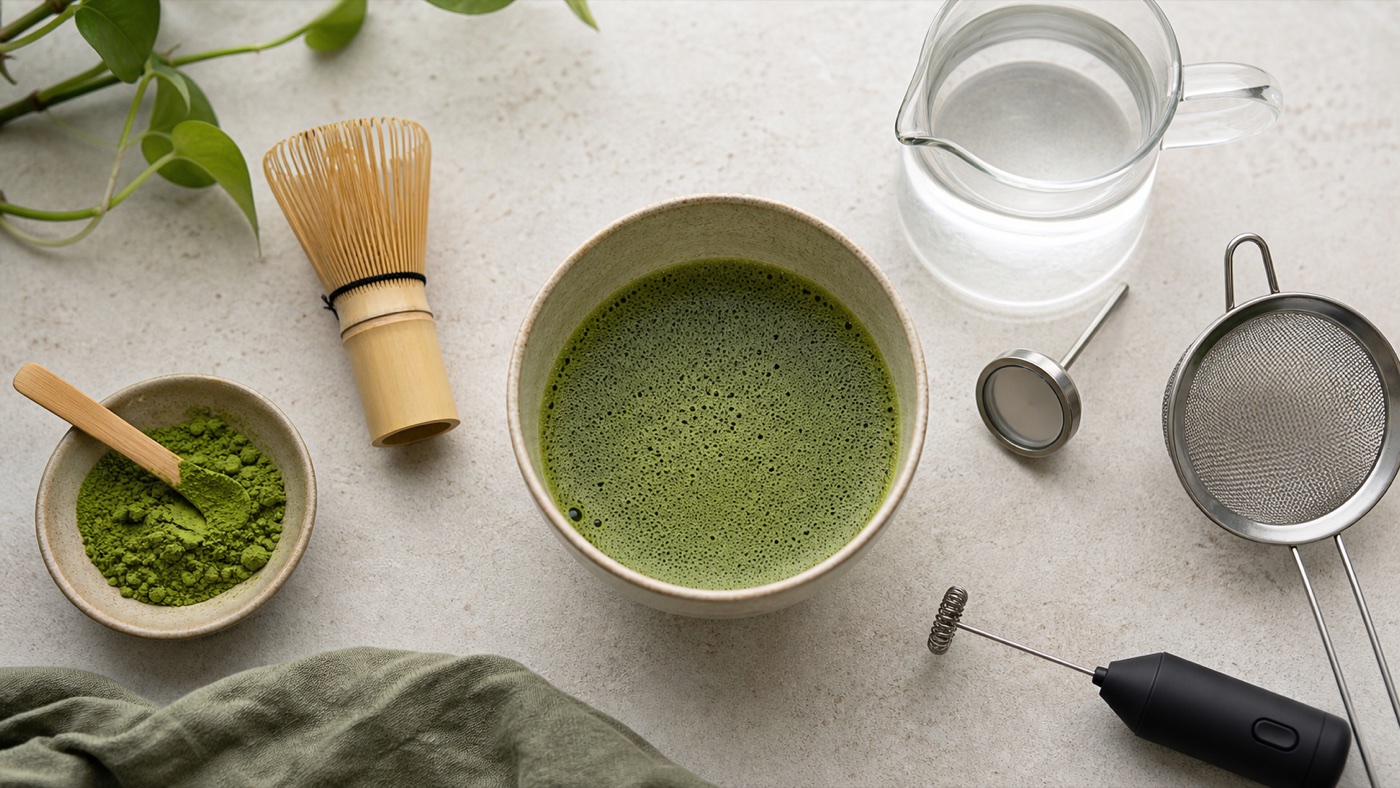
How to froth matcha with a bamboo whisk
- Measure. Weigh the matcha and water rather than estimating during recipe development.
- Sift. Push the powder through a fine, dry sifter to break compacted clumps.
- Pre-warm and soften. Rinse the bowl and bamboo whisk with warm water, then empty and dry the bowl.
- Wet the powder. Add a small portion of the measured water and mix slowly until no dry pockets remain.
- Add the rest. Keep enough depth for the whisk tips to move without striking the bottom hard.
- Whisk from the wrist. Use quick back-and-forth M or W movements rather than slow circles. Keep the whisk mostly vertical.
- Refine the surface. Reduce the motion near the top to break larger bubbles, then lift the whisk cleanly.
- Serve promptly. The particles and foam will not remain unchanged indefinitely.
More foam is not always better. Thick tea styles may intentionally have little foam, and a latte may obtain most of its visible texture from the milk. Judge clumps, smoothness, taste and recipe integration—not just the height of the green foam.
How to use an electric frother
- Sift the matcha into a tall, narrow vessel to contain splashes.
- Add a small amount of water and mix at low speed to wet the powder.
- Add the remaining measured water.
- Hold the frother head below the surface to disperse; raise it slightly only when you want to incorporate air.
- Stop before large bubbles dominate or the mixture splashes and cools excessively.
- Clean the frother immediately, especially if it touches milk or sweetener.
An electric frother is fast and easy to standardize in a café. A bamboo whisk offers control and traditional presentation. A sealed shaker works for cold service. A spoon can wet powder but is usually less effective at breaking clumps and creating fine foam.
Frothing matcha is different from frothing milk
When you whisk matcha, you are dispersing leaf particles and incorporating air into water. When you steam or froth milk, proteins and fats help create and stabilize a different foam structure. For a latte, prepare a smooth matcha base and the milk texture separately, then combine them. Do not expect green matcha foam alone to behave like microfoamed dairy milk.
For iced drinks, choose whether to cold-mix the matcha or make a small warm concentrate. Warm water can make wetting easier; cold preparation can reduce heat and ice dilution. Test both with the same dose, liquid volume and final cup weight.
Why matcha will not froth: troubleshooting
| Problem | Likely cause | Adjustment |
|---|---|---|
| Dry clumps remain | Compacted powder, powder added after water, or insufficient wetting | Sift first and make a smooth initial slurry |
| Large soap-like bubbles | Frother or whisk too close to the surface | Disperse below the surface, then finish with shallower movement |
| Little foam | Very deep/narrow vessel, insufficient speed, unsuitable whisk angle or product differences | Use a wider bowl, correct the tool position and compare technique |
| Gritty drink | Clumps, settling, high powder-to-water ratio or particle characteristics | Sift, increase dispersion water or test another product |
| Bitter or harsh | Water too hot for that powder, excessive dose or long holding | Lower temperature, retest the dose and serve sooner |
| Weak in milk | Insufficient dose, too much milk, strong sweetener or application mismatch | Test 1.5–3 g systematically and compare a café-positioned grade |
Run a three-temperature test instead of debating one number
- Choose one matcha, water and recipe.
- Prepare three coded cups at 65°C, 75°C and 85°C (149°F, 167°F and 185°F).
- Keep powder dose, water volume, vessel and whisk time identical.
- Score aroma, bitterness, umami, smoothness, foam and final application fit.
- Repeat on another day or with another staff member.
- Choose the temperature with the best repeatable result, not the most dramatic foam.
For a milk drink, conduct the same test in the finished latte. A temperature preferred in water may not be the winner after milk and sweetener are added.
A café SOP for repeatable matcha
- Matcha product and approved lot reference.
- Powder dose in grams.
- Dispersion-water volume and target temperature range.
- Tool, vessel and mixing time.
- Milk, sweetener, ice and final drink weight.
- Acceptable clump, color and taste checks.
- Maximum holding time if a concentrate is prepared.
- Cleaning procedure for whisk, frother and container.
If you prepare larger quantities, read Can You Make Matcha Ahead of Time? For dose and cost calculations, use How Much Matcha Per Cup?
Frequently asked questions
Can I make matcha with boiling water?
You can, but boiling water often produces a harsher result and removes a useful control point. Start around 70–80°C and compare by taste.
Can matcha be made with cold water?
Yes. Sift it, use vigorous whisking or shaking and drink before settling becomes obvious. Compare cold preparation with a small warm concentrate for your iced recipe.
Does matcha dissolve completely?
No. It is a suspension of fine tea particles. Good preparation disperses those particles evenly, but settling can still occur.
Choose a temperature by controlled tasting
Contact Carol at Sailtik with your drink style, serving size, milk and target dose. Selected 10 g samples can be recommended for your business so you can test temperature, frothing and recipe fit before ordering.