
Matcha is not universally healthier than coffee. Both can fit a healthy diet, and neither beverage guarantees a health outcome. The better choice depends on the actual dose and recipe, added sugar, caffeine tolerance, medical circumstances and what outcome is being compared. Coffee has a much larger body of long-term human research; matcha contains characteristic tea compounds, but matcha-specific clinical evidence remains limited.
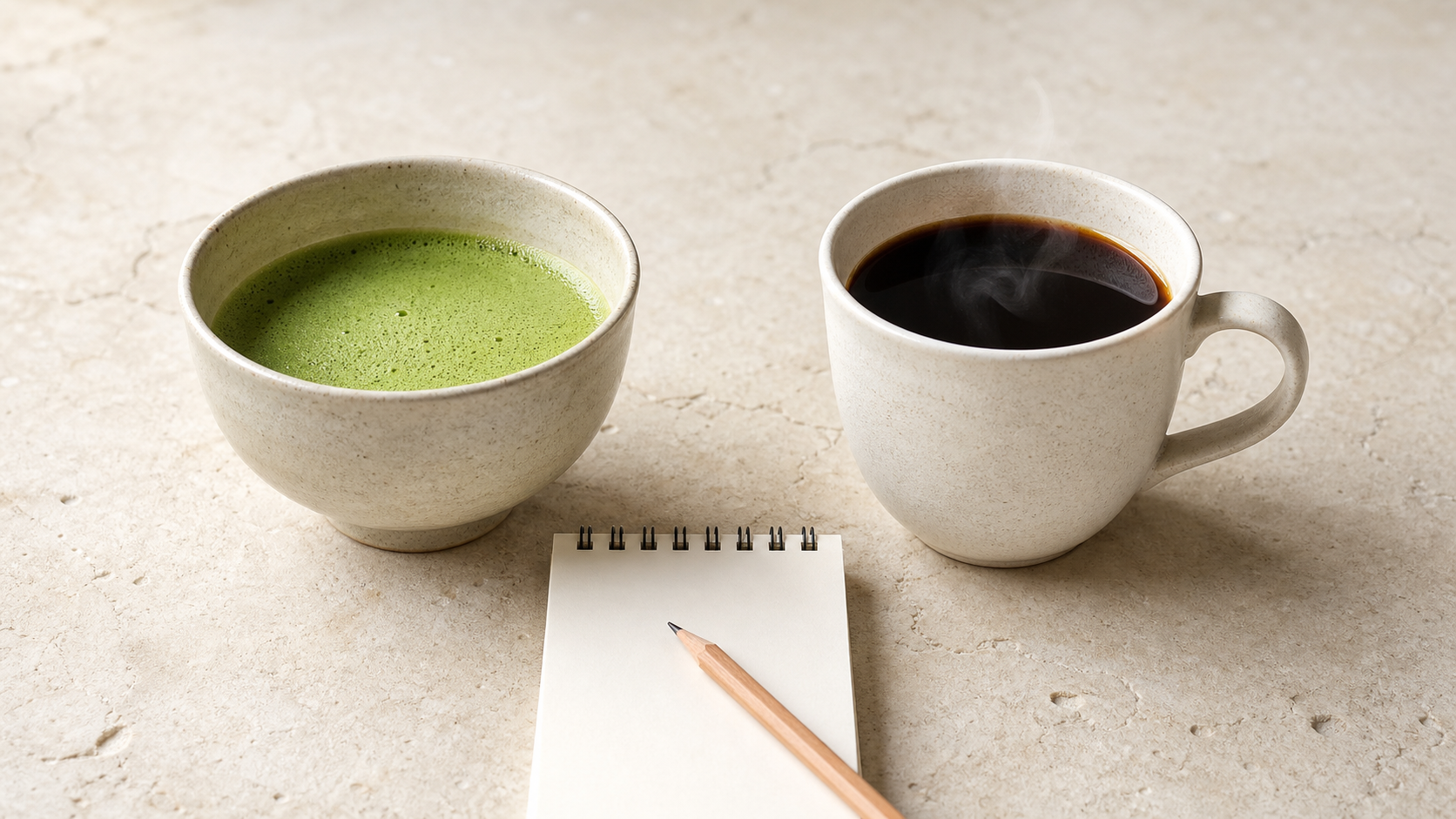
Matcha versus coffee: the useful answer
| Question | Matcha | Coffee |
|---|---|---|
| What is consumed? | Finely ground green tea leaf dispersed in water | Water-soluble compounds extracted from roasted coffee |
| Caffeine | Varies with powder composition and grams used | Varies with bean, dose, method and serving size |
| Characteristic compounds | Tea catechins and L-theanine, among others | Chlorogenic acids and other coffee compounds |
| Long-term health evidence | Matcha-specific human evidence is comparatively limited | Large observational literature and many meta-analyses, still not proof that coffee causes the associations |
| Plain beverage | Little energy and no added sugar unless included in the recipe | Little energy and no added sugar unless included in the recipe |
| Latte reality | Milk, sweetener, syrup and portion can dominate nutrition | The same is true for coffee drinks |
Why “healthier” needs a specific outcome
A person may mean lower caffeine, fewer calories, less added sugar, better sleep, lower disease risk or fewer unpleasant symptoms. Those are separate questions. Plain matcha can have less caffeine than a large brewed coffee, yet a strong matcha dose can overlap with a small or weak coffee. An unsweetened black coffee can contain less sugar than a sweetened matcha latte. The category name alone cannot settle the comparison.
Start with the full recipe: grams of matcha or coffee, brewed output, finished size, milk, syrup and toppings. For a commercial drink, use supplier or laboratory data where available rather than a fixed number copied from another product.
Caffeine: neither drink has one fixed amount
The U.S. Food and Drug Administration says 400 mg of caffeine per day is an amount not generally associated with negative effects for most adults, while emphasizing that sensitivity varies. The FDA also notes that the body handles naturally occurring caffeine in coffee and tea the same way; the source does not make excessive caffeine harmless.
A published review reported approximately 18.9–44.4 mg of caffeine per gram of matcha. On that range, 1.5 g would calculate to about 28–67 mg and 3 g to about 57–133 mg before any coffee is added. Coffee ranges widely with its dose and brewing method. See the matcha caffeine calculation guide for the assumptions behind a recipe comparison.
Choosing matcha may reduce caffeine if the actual matcha recipe contains less than the coffee it replaces. It is not a caffeine-free alternative. People who experience insomnia, anxiety, palpitations or other symptoms should consider total intake from all sources and seek individualized medical advice where appropriate.
What the health research can and cannot show
A 2023 critical review of matcha research described potentially relevant compounds and emerging findings, but also highlighted the need for more well-designed clinical work. Evidence about brewed green tea, isolated catechins or concentrated extracts cannot automatically be converted into a guaranteed effect from one matcha latte.
Coffee has been studied far more extensively. A BMJ umbrella review found coffee consumption was more often associated with benefit than harm across the outcomes reviewed, with the largest relative risk reductions often observed around three to four cups per day. Most included evidence was observational, however, so it cannot prove that coffee itself caused every association. The review also identified situations requiring caution, including pregnancy and possible fracture risk in women at higher intake.
This creates an important evidence asymmetry: “matcha contains interesting compounds” is not the same as “matcha has proved superior to coffee.” Coffee’s larger research base also does not mean every sweet coffee beverage is healthy or that coffee suits every person.
Catechins and L-theanine do not make an automatic winner
Matcha contains catechins and L-theanine as well as caffeine. Controlled studies have examined attention and related outcomes, but product composition, dose and study design vary. Marketing phrases such as “calm energy,” “no jitters” and “no crash” are not universal physiological guarantees. A caffeine-sensitive person can still feel adverse effects after matcha.
Likewise, describing one drink as having “more antioxidants” does not establish better overall health. Laboratory antioxidant capacity is not a clinical ranking system, and human outcomes depend on absorption, dose, habitual diet and many other variables.
Added sugar can reverse the comparison
Plain matcha powder and black coffee contain no added sugar. Café versions may include presweetened powder, syrup, sweetened milk, cold foam or toppings. A large matcha latte can therefore contain much more added sugar and energy than black coffee; a flavored coffee drink can contain much more than plain matcha. Compare the complete ingredient list and nutrition information at the actual serving size.
The distinction also matters in product sourcing. “Matcha powder” can mean pure ground tea or a drink mix in which sugar is the first ingredient. Read the ingredient statement before making a health or cost comparison. The matcha nutrition guide separates the powder from the finished beverage.
Which one should you choose?
- Choose by measured caffeine if reducing intake is the goal; do not choose by beverage name.
- Choose the unsweetened or less-sweet recipe if added sugar is the main concern.
- Choose by tolerance if one drink reliably causes symptoms, while discussing persistent concerns with a qualified clinician.
- Choose by taste and habit when both versions fit your dietary needs; neither requires a health halo.
- Account for pregnancy, medicines and health conditions with advice specific to the individual rather than a general comparison article.
Is matcha a healthy alternative to coffee?
It can be a reasonable alternative when a person enjoys it and the recipe fits their needs. Replacing a sweet coffee drink with an equally sweet matcha drink does not necessarily improve nutrition. Replacing a high-caffeine coffee with a measured lower-caffeine matcha may reduce caffeine, but only if the actual amounts support that conclusion.
Matcha is also not coffee. Its vegetal, umami, bitter and astringent profile needs to be evaluated on its own terms. For a broader sensory and café comparison, see matcha versus coffee versus chai.
A note for cafés and product developers
A responsible menu should avoid promising weight loss, detoxification, disease prevention or guaranteed calm. Record the matcha dose, complete recipe, serving size and added sugars. If publishing caffeine values, use product-specific analytical data or label a calculation transparently.
Sailtik supplies Chinese-origin matcha from Guizhou or Zhejiang for café and private-label evaluation. It generally recommends testing 1.5–3 g per cup. Ten-gram samples are selected from suitable internal models after the application, recipe, target price and expected volume are understood; not every model is sent automatically. Contact Carol with those details for a sample recommendation.
Frequently asked questions
Which is healthier, coffee or matcha?
Neither is universally healthier. Compare the full recipe, caffeine dose, added sugar, individual tolerance and the specific outcome. Coffee currently has much more long-term human research than matcha.
Is matcha healthier for you than coffee?
Possibly for a particular person and recipe, but not as a category-wide rule. A lower-caffeine unsweetened matcha may suit one person; another may tolerate black coffee well and prefer its stronger evidence base.
Is matcha coffee healthy?
A drink combining matcha and coffee contains caffeine from both. Its nutrition depends on the doses, milk, sugar and toppings. The combination does not inherit automatic health benefits from either ingredient.
This article is general educational information, not medical advice.