
Matcha, powdered sencha and hojicha powder are not three grades of the same ingredient. They begin with different raw-material and processing choices, produce different colors and flavors, and should be specified, sampled and labeled separately.
Sailtik disclosure: Sailtik’s confirmed offering is matcha powder from Guizhou or Zhejiang, China. Sailtik has not confirmed sencha powder or hojicha powder supply, Japanese origin for any product, or organic hojicha certification. Those adjacent categories are covered objectively for buyers building café and food menus.
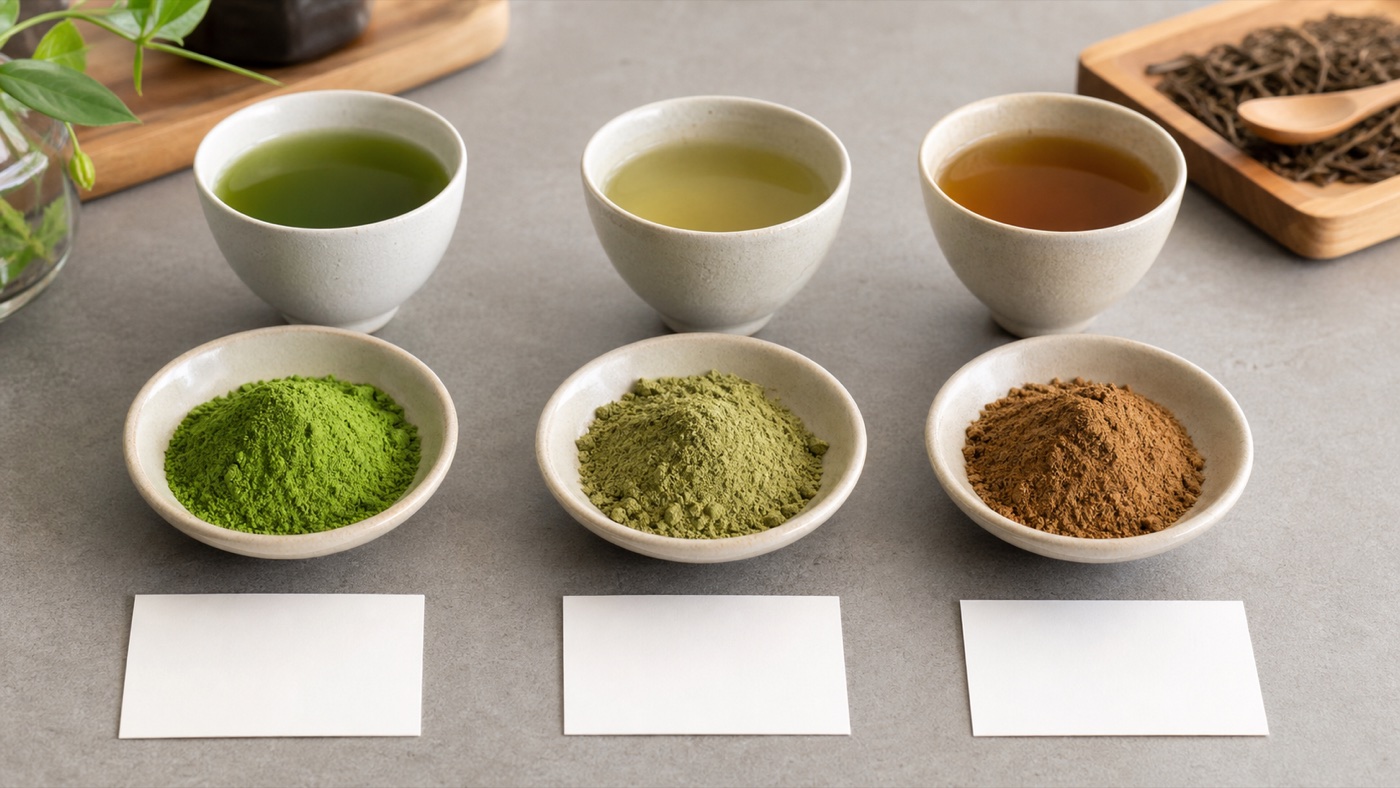
Quick comparison
| Powder | Basic identity | Typical sensory direction | Common applications |
|---|---|---|---|
| Matcha | Finely ground tea made from tencha under the definition used by Japanese official sources; other origins must be labeled accurately | Green, vegetal, umami, sweet-to-bitter depending on product | Straight tea, latte, ice cream, bakery, confectionery |
| Powdered sencha | Sencha tea leaf milled into powder; not automatically matcha | Green, fresh, brisk or astringent, product-dependent | Drinks, food, supplements or blends where sencha identity is intended |
| Hojicha powder | Roasted green tea material milled into powder | Brown, roasted, nutty, cereal, caramel-like or woody | Lattes, ice cream, bakery, chocolate and desserts |
Japan’s Ministry of Agriculture, Forestry and Fisheries describes matcha as tencha ground into powder and contrasts it with leaf tea prepared by extraction. That distinction is useful for product identity. It does not mean only Japanese powder can be discussed commercially; it means the buyer must state origin and manufacturing identity truthfully.
What is powdered sencha?
Sencha is ordinarily a rolled, steamed green tea brewed as leaf tea. When sencha is milled, the resulting powdered sencha allows more or all of the leaf material to enter the finished food or drink. It can be useful, but the process does not turn it into matcha.
Search terms such as “sencha tea powder,” “sencha powder,” “powdered sencha,” “sencha green tea powder,” “sencha matcha powder” and “sen cha matcha powder” are often mixed together. A purchase order should replace that ambiguity with a product identity statement: raw tea type, cultivation/processing, origin, ingredient declaration, particle specification and intended application.
What is hojicha powder?
Hojicha is green tea that has been roasted, creating a brown color and roasted aromatic profile. It may use leaf, stem or a blend depending on the product. Ground hojicha is milled for direct use in drinks and foods. It is not “brown matcha,” and a café should name it hojicha rather than borrowing matcha’s identity.
The common search typo “hochija powder” usually means hojicha powder. “Organic hojicha powder” adds a separate regulated claim: verify the certified operation, program, scope and lot rather than assuming a brown tea powder is organic. Sailtik has not documented such an offering.
Is black matcha hojicha?
“Black matcha” has no single reliable product definition. A seller may use it for hojicha powder, a dark tea blend, a product colored with black sesame or charcoal, or simply a marketing name. Ask for the complete ingredient list and exact tea identity. Do not assume it is matcha, hojicha or black tea from the name alone.
| Listing phrase | Question to ask | Do not assume |
|---|---|---|
| Black matcha | What tea and other ingredients create the color? | That it is pure matcha or pure hojicha |
| Sencha matcha powder | Is it matcha, powdered sencha or a blend? | That the words are interchangeable |
| Organic hojicha powder | Which operation, certificate, program and lot support organic status? | That “natural” or roasted means organic |
| Green tea powder | Which tea, processing method and origin? | That every green tea powder is matcha |
| Premium tea powder | What specification and application define premium? | That it is a regulated grade |
Compare powder behavior in the actual recipe
All three powders can suspend and settle rather than truly dissolve. Particle size, agglomeration, milk, fat, sugar, temperature and mixing method affect the cup. A powder advertised as “instant” or “dissolving” may include soluble tea solids or carriers, so inspect ingredients before comparing it with a pure milled leaf.
- Weigh the same candidate dose or use a planned dose matrix.
- Sift or premix consistently.
- Use the same water, milk, sweetener and mixing tool.
- Record dispersion time, foam, residue and settling.
- Score color under controlled light.
- Score aroma, taste, mouthfeel and aftertaste blind.
- Recheck after the holding time expected in service.
- Calculate cost per accepted serving.
A café should not expect hojicha to remain vivid green or taste like matcha. Its commercial value is its roasted identity. Powdered sencha may provide a different fresh-green profile, while matcha can be selected for stronger visual and umami expectations. Menu architecture should make those differences understandable.
Do not generalize caffeine from the category name
Search results often state that hojicha always has a fixed low caffeine value and matcha always has a fixed high value. Raw material, leaf/stem proportion, dose, cultivation, process and serving size can change exposure. Powder preparation may consume more leaf solids than a strained infusion. Use product-specific data or finished-serving testing when caffeine matters to formulation or labeling.
The same caution applies to catechins, amino acids and other constituents. Do not copy a study or competitor’s value onto an unrelated powder. Product identity and lot evidence come first.
Wholesale RFQ for adjacent tea powders
- Exact product identity: matcha, powdered sencha, hojicha powder or blend.
- Country and region of origin without implied substitution.
- Leaf/stem/raw-material description and processing.
- Pure powder or formulated mix; complete ingredients.
- Particle or sieve method relevant to the application.
- Color, sensory and recipe acceptance method.
- Caffeine or constituent requirement if commercially relevant.
- Allergen, contaminant and microbiological specification.
- Organic or other certification scope when claimed.
- Pack size, storage, shelf life, MOQ, forecast and Incoterm.
- Change control for raw material, blend, process and origin.
Matcha documentation cannot be reused for another powder
A CoA, test report, organic certificate or specification for one matcha product cannot automatically support powdered sencha or hojicha. Match document names, product codes, lots and production sites. For a broader review, use the Matcha Certifications and Documents Guide.
When Sailtik matcha is relevant
Sailtik supplies China-origin matcha from Guizhou or Zhejiang in grades 1A–7A, with three private internal options per grade. It does not claim these are sencha or hojicha. Selected 10 g samples can be recommended for the intended café, baking, ice-cream or private-label use.
Standard bulk formats are 1 kg, 5 kg and 10 kg aluminum-foil bags with no fixed bulk MOQ; larger orders generally improve freight economics. If a menu needs hojicha or sencha powder as well, qualify those products independently and do not extend Sailtik matcha documents to them.
Frequently asked questions
Is powdered sencha the same as matcha?
No. Powdered sencha is milled sencha. Matcha has a different raw-material and processing identity. Ask the supplier to specify the product rather than using the terms interchangeably.
Does hojicha powder dissolve?
Pure milled leaf material generally forms a suspension and can settle. Products formulated with soluble solids or carriers may behave differently, so inspect the ingredients and run a holding test.
Can Sailtik supply organic hojicha powder?
No such capability or certification has been confirmed. Sailtik’s documented focus here is China-origin matcha.
Name and test the right powder
Choose matcha for a matcha identity, powdered sencha for a sencha identity and hojicha powder for a roasted-tea identity. To test Sailtik’s China-origin matcha specifically, contact Carol with the recipe, dose, volume and destination for a focused sample recommendation.