
The best place to buy matcha depends on what you are buying it for. A first-time home buyer may need a small fresh tin and clear directions; a café needs repeatable lots, cost per cup and reliable replenishment; a food manufacturer needs specifications, documents and scalable supply.
“Where can I buy matcha?” and “matcha wholesale near me” are location-sensitive searches. This guide does not invent a current local store list. Instead, it gives a fast method for checking nearby retailers, online sellers, Japanese shops and wholesale suppliers against the same evidence.
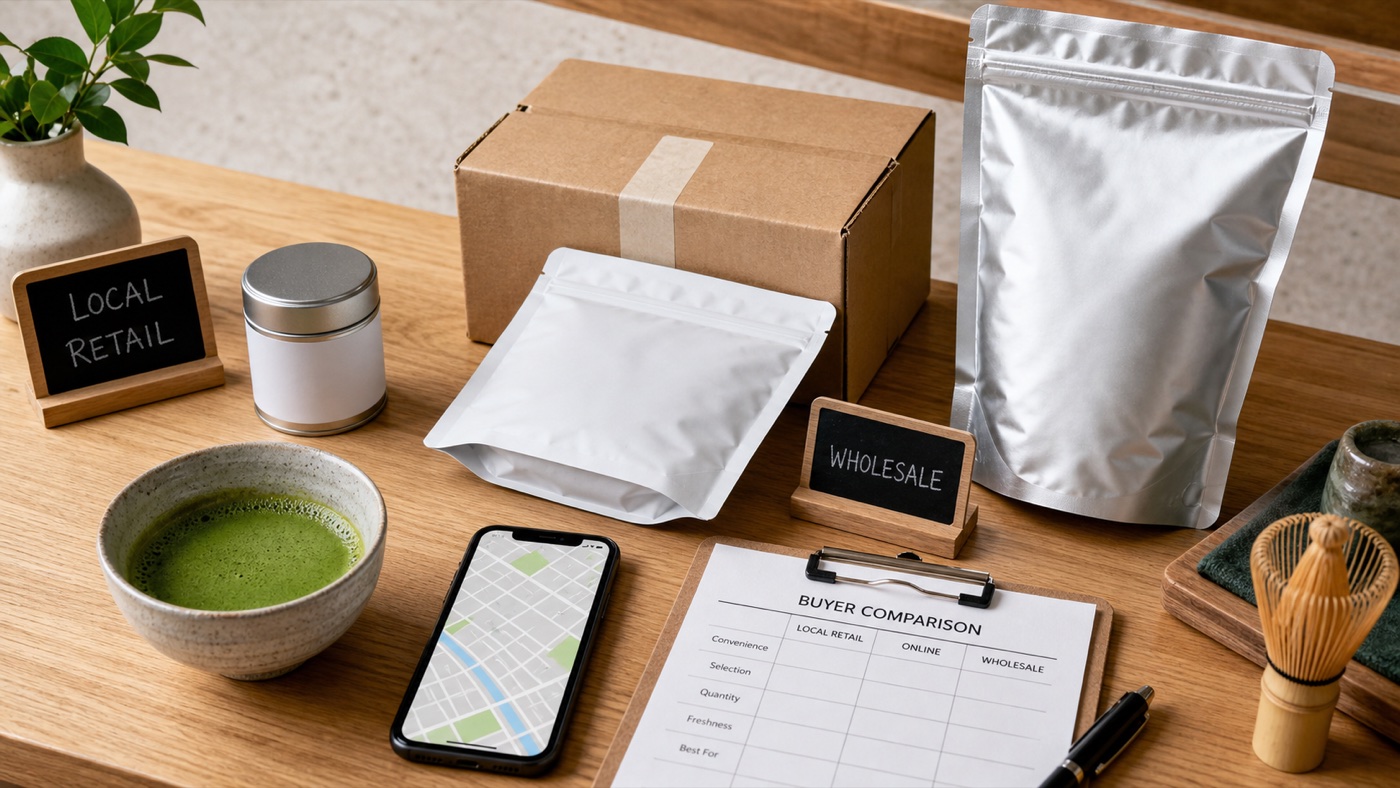
Choose the purchase route by use and quantity
| Buyer | Likely starting route | What matters most |
|---|---|---|
| First-time home user | Specialty tea shop or reputable online retailer | Small pack, fresh stock, clear origin and preparation instructions |
| Regular home latte drinker | Online direct or local specialty retailer | Repeatability, price per serving and storage |
| Café testing a menu item | Foodservice supplier or flexible matcha wholesaler | Application samples, 1–5 kg path, documents and reorder continuity |
| Established café group | Qualified importer/distributor or direct supplier | Lot consistency, forecast, landed cost and delivery plan |
| Bakery or ice-cream producer | Ingredient wholesaler | Process performance, bulk packs and compliance documents |
| Private-label brand | Supplier with verified packing options | Artwork, MOQ, origin, claims, shelf life and finished-pack control |
Where to buy matcha nearby
For “matcha near me,” search current map results for specialty tea shops, Japanese or Asian grocery stores, natural-food retailers and restaurant-supply stores. Then call before traveling. A café serving matcha may not sell powder, and an online inventory page may not reflect the shelf in a specific branch.
- Ask whether the product is pure matcha or a sweetened latte mix.
- Confirm net weight, ingredients, origin and best-before information.
- Check that the package is sealed and protected from heat, light and moisture.
- Look for a lot code and responsible business identity.
- Ask when stock arrived and how unopened inventory is stored.
- For a first purchase, choose a size you can finish while quality remains acceptable after opening.
A local shop is useful when you need a small quantity immediately or want staff guidance. It is not automatically a wholesale solution. Retail shelf price, pack size and availability may be unsuitable for a café using 10–50 kg.
Where to buy matcha online
An online seller should identify the exact product, net weight, ingredients, origin, storage, responsible business and shipping terms. Product photographs should show the current label rather than only lifestyle images. Be cautious when a listing combines “ceremonial,” “premium,” “organic,” “Uji” and “lead free” without product-specific evidence.
| Online check | Good evidence | Warning sign |
|---|---|---|
| Seller identity | Legal business/contact and clear return route | Anonymous marketplace account |
| Product identity | Exact SKU, ingredient and origin | Generic powder reused across listings |
| Freshness | Lot/best-before information available | No date or code visible after delivery |
| Claims | Current certificate or test linked to relevant product | Logo collage with no scope |
| Shipping | Transit estimate and package protection | Long uncontrolled route with no disclosure |
| Review usefulness | Verified context, recipe and date | Color-only praise with no product code |
Use reviews to identify questions, not as a substitute for evidence. The same matcha can taste different with dose, water, milk and sweetener, and listings can change while old reviews remain.
Where to buy good matcha
“Good” must be translated into an application. For straight tea, buyers may prioritize aroma, umami, smooth mouthfeel and low harshness. For a milk latte, visibility through milk, balanced bitterness and cost per cup may matter more. For baking, heat and ingredient interactions can make an expensive straight-drinking powder unnecessary.
- Write the recipe and use before choosing a grade.
- Set a target dose; Sailtik’s general range is 1.5–3 g per cup.
- Buy or request two or more traceable samples.
- Code them and test blind under the same preparation.
- Score color, aroma, taste, mouthfeel and aftertaste.
- Calculate cost per accepted serving.
- Confirm the commercial lot can match the approved product.
See Matcha Grades Explained and How Much Matcha per Cup.
Where to buy matcha wholesale
A wholesale buyer is not only buying a larger bag. The supplier should convert an application into a sample recommendation, state the exact origin and product, explain pack options, provide available documents and quote the same trade basis. For cafés in the 10–50 kg range, freight, lot planning and reorder timing can affect the real cost more than a small price-per-kilogram difference.
- Application, recipe and matcha dose.
- Trial, monthly and annual quantity.
- Destination and importer.
- Required origin and label claims.
- Product specification and sample code.
- CoA and risk-based test requirements.
- Bulk or private-label packaging.
- Incoterm, freight mode and delivery address.
- Quote validity, production timing and change control.
Use the Matcha Supplier Due-Diligence Checklist before approving a source. “Near me” can reduce local delivery time, but proximity cannot replace traceability, storage or sample performance.
Where to buy matcha in Japan
Current search results commonly point travelers to specialist tea shops, department-store food halls, tea-producing regions and official brand stores. Availability can change rapidly, and some premium products may have purchase limits. Check official opening hours and stock near the visit date rather than relying on an old travel list.
For a personal purchase, ask staff whether the powder is intended for usucha, koicha, latte or cooking and note the storage guidance. For commercial buying, a tourist retail purchase is not a substitute for an export-capable supplier, invoice trail, origin evidence, import documentation and repeatable allocation.
If Japanese or Uji origin is mandatory, use the Japanese and Uji Matcha Wholesale Guide. Sailtik’s confirmed matcha origins are Guizhou and Zhejiang, China; it must not be sold as Japanese or Uji matcha.
When buying direct from Sailtik fits
Sailtik is relevant to cafés, food businesses and private-label buyers seeking flexible China-origin supply rather than a local retail tin. Grades 1A–7A cover application positions from culinary use to high-end drinking and gifting. Each grade has three private internal options with different color and sensory profiles; internal model codes are not published.
There is no fixed bulk MOQ. Selected samples are 10 g per recommended model, and not every model is sent automatically. Standard bulk formats are 1 kg, 5 kg and 10 kg aluminum-foil bags; larger orders generally improve freight economics.
For private label, Sailtik generally recommends 5A, 6A or 7A. Confirmed formats are 30 g, 50 g and 80 g tins at 200 units, and printed stand-up pouches from 100 g to 1 kg at 300 units. Destination, artwork, documents, freight and current production timing must still be confirmed for the project.
A five-minute purchase check
- Is it pure matcha or a formulated mix?
- Is the origin stated precisely and consistently?
- Can the exact pack be linked to a lot and responsible seller?
- Does the intended use match the product position?
- Are organic, regional or safety claims supported?
- Will the pack be consumed and stored appropriately after opening?
- For wholesale, can the supplier repeat the approved product and documents?
Frequently asked questions
Where do I buy matcha powder for the first time?
Choose a small sealed pack from a reputable specialty retailer or direct seller with clear ingredients, origin, lot/date and preparation guidance. Test it before buying more.
Is bulk matcha near me always cheaper?
No. Compare delivered cost for the same accepted quality, pack size, documents and quantity. A distant direct source can be economical at volume, while local stock can be better for urgent small replenishment.
Can consumers buy directly from Sailtik?
Sailtik is positioned for B2B ingredient and private-label inquiries. Consumers looking for one small retail tin may be better served by a reputable local or online retailer.
Buy for the real use
Start with the product use, quantity and evidence you need; then choose local, online, Japanese retail or wholesale supply. For a B2B China-origin matcha inquiry, contact Carol at Sailtik with the recipe, dose, monthly volume, destination and required documents so a focused sample set can be recommended.