
Barista matcha is matcha selected for repeatable café drinks—not a regulated grade and not automatically ceremonial matcha. The right choice should remain recognizable in milk, look appropriate in the finished cup, fit the target cost per drink and produce consistent results across baristas and reorders.
Choose it through a controlled menu test, not from the color of dry powder alone. A café should compare candidates in its actual hot and iced recipes, using the same dose, milk, water, ice, sweetener and preparation method.
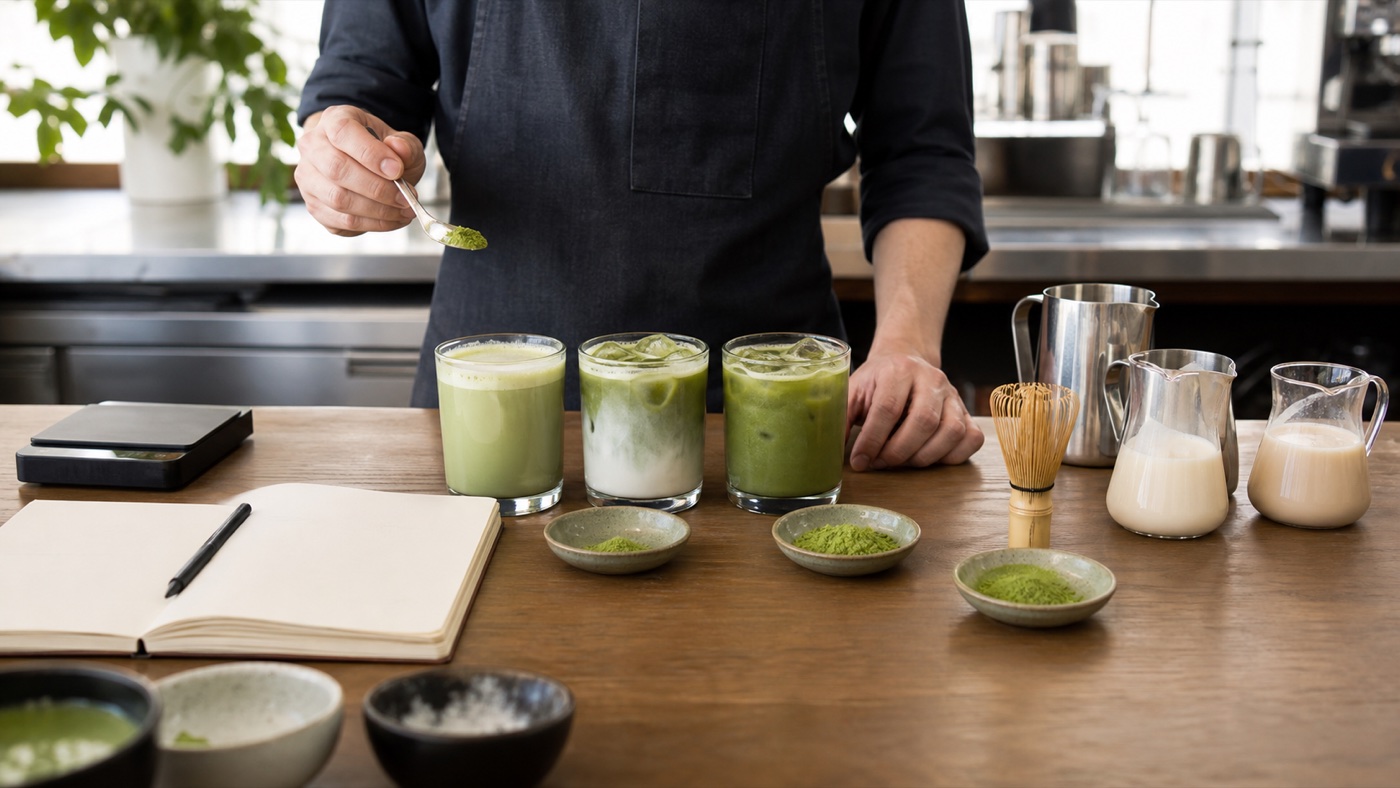
What cafés should expect from barista matcha
| Requirement | How to evaluate it | Common mistake |
|---|---|---|
| Flavor through milk | Taste in the exact dairy or plant milk used on the menu | Tasting only in water |
| Finished color | Photograph the complete drink under consistent light | Judging dry powder alone |
| Texture | Check clumping, mouthfeel and settling after normal service time | Using a different preparation method for each sample |
| Cost control | Calculate the accepted dose and landed cost per drink | Comparing price per kilogram without dose |
| Repeatability | Have more than one barista make the recipe from a written card | Relying on one skilled tester |
| Supply fit | Review packaging, documents, freight and reorder planning | Choosing on taste before checking commercial requirements |
Is barista grade the same as ceremonial grade?
No universal authority defines “barista grade,” and ceremonial, premium, latte and culinary labels vary among suppliers. Ceremonial-positioned matcha is generally intended for straight preparation or premium presentation. A café latte needs a different balance: the tea must work with dilution, milk, sweetness and the selling price.
An expensive ceremonial matcha may be excellent in water but commercially unnecessary in a flavored latte. A lower-positioned product may have stronger presence but more astringency. Neither name answers the café’s real question: does the finished drink meet the menu brief?
See the broader matcha grades guide for why grade names should be treated as selection shortcuts rather than universal specifications.
Which Sailtik grades should a café test?
| Starting grade | Positioning | Useful comparison |
|---|---|---|
| 3A | Standard café drinks and premium baking | Start here for a mainstream café latte and cost-performance test |
| 4A | Premium café drinks and high-end baking | Compare when visual presentation or a higher menu position matters |
| 5A | High-end drinks, ceremonial use and ice cream | Test for a flagship beverage or premium price point |
| 2A | Budget milk tea and daily baking | Consider for sweeter or cost-sensitive drinks, then verify aftertaste and color |
Each public grade has three internal origin/model options from Guizhou or Zhejiang with different color and sensory characteristics. Internal model codes are not published. Sailtik selects relevant 10 g samples after reviewing the café’s concept, recipe, position and target cost instead of sending every available model.
Use a four-drink test matrix
For each sample, make the same four drinks if they are relevant to the menu:
- Hot dairy latte: exposes aroma, bitterness and interaction with heated milk.
- Iced dairy latte: tests dilution, visual layering and flavor at a colder temperature.
- Hot plant-milk latte: shows how the milk’s sweetness, color and formulation change the result.
- Iced plant-milk latte: combines dilution and plant-milk effects.
Use a digital scale and begin within Sailtik’s general 1.5–3 g range. A 2 g starting point is practical for many standard lattes, but cup size and recipe determine the final dose. Keep everything else fixed during the first comparison.
| Score | Color | Flavor presence | Astringency | Texture |
|---|---|---|---|---|
| 1 | Does not meet the menu brief | Disappears in the recipe | Distracting | Clearly unacceptable |
| 3 | Acceptable | Recognizable | Manageable | Acceptable |
| 5 | Strong fit | Clear and balanced | Appropriate for the concept | Smooth for the intended process |
Have at least two people score samples without seeing the model identity. Repeat the best candidates on another day. Subjective preference remains important, but a fixed scorecard makes the decision traceable.
Calculate cost per accepted drink
Matcha cost per drink = landed cost per kg ÷ 1,000 × grams used
The cheapest matcha per kilogram may not be the cheapest in use. If it needs a larger dose or creates more remakes, its accepted-drink cost can exceed a stronger candidate used at a lower dose. Include freight in landed cost and record waste from recipe testing, spills and over-portioning.
For detailed yield tables, use the café matcha dosing and cost guide.
Forecast monthly demand and a sensible first order
Monthly kg = drinks per day × operating days × grams per drink ÷ 1,000
| Daily matcha drinks | 30 days at 2 g | Planning interpretation |
|---|---|---|
| 50 | 3 kg | Use a small initial order while measuring adoption |
| 100 | 6 kg | Compare 1 kg and 5 kg inner-pack handling |
| 250 | 15 kg | A 10–50 kg buying pattern may become practical |
| 500 | 30 kg | Formalize reorder points and multi-location allocation |
Many Sailtik café customers purchase in the 10–50 kg range, but standard bulk matcha has no fixed minimum order. Larger quantities generally improve freight economics. The correct first order still depends on demonstrated sales, destination, shipping plan and how quickly the café can use its stock.
Packaging, storage and bar workflow
Standard bulk packaging is available in 1 kg, 5 kg and 10 kg aluminum-foil bags. A multi-location business should decide whether packs are opened centrally or allocated unopened to each store. After opening, reseal promptly and protect matcha from moisture, light, heat and odors.
The general shelf-life reference is 18 months, subject to the exact product, batch and package label. That unopened reference does not define how long an opened bag will maintain the café’s preferred color and aroma. Track open dates and choose an inner-pack size the store can use efficiently.
Documents to request before repeat purchasing
Available Sailtik materials include an Allergen Declaration, CoA, Food Safety Management System Certificate, Halal Certificate, Heavy Metals Test Report, Non-GMO Declaration, Pesticide / Mycotoxin Residue Test Report and SDS. Confirm which document applies to the selected product or batch and which records your market requires.
Frequently asked questions
What is the best matcha for a café latte?
There is no universal best grade. For Sailtik, 3A, 4A and 5A are useful comparisons from standard café to high-end drinks. Test the candidates in the exact milk, sweetener, cup size and service method.
Should a café buy sweetened matcha powder?
Sweetened premixes can simplify preparation, but they reduce control over matcha dose and sugar. Pure matcha lets the café adjust sweetness separately. Check the ingredient statement before comparing prices or recipes.
How much should a café sample?
Sailtik’s selected samples are generally 10 g per model, enough for about three to six controlled drinks at a 1.5–3 g dose. Use them for screening; confirm the finalist again before committing to a larger order.
Choose the recipe and supply system together
A café is not buying color in a bag. It is buying repeatable drinks, manageable inventory and a margin. Define the menu brief, test blind in the final recipes, calculate accepted-drink cost, review documentation and then scale the order from actual sales.
Contact Carol at Sailtik with your cup size, milk, sweetness level, daily drink estimate, destination and target menu position for a focused sample recommendation.