
A commercial lavender matcha latte should taste like matcha first, with a controlled floral top note—not perfume. The easiest café system is a measured food-use lavender syrup, a standardized matcha base, milk and ice or steamed milk. Start low on lavender, test by weight and document the winning recipe.
Lavender is listed in the U.S. FDA food-substance inventory for use as a flavoring agent or adjuvant, but that does not mean every lavender product is suitable for a beverage. Buy an ingredient made and labeled for food use, follow its conditions and local rules, and do not substitute an aromatherapy or cosmetic oil.
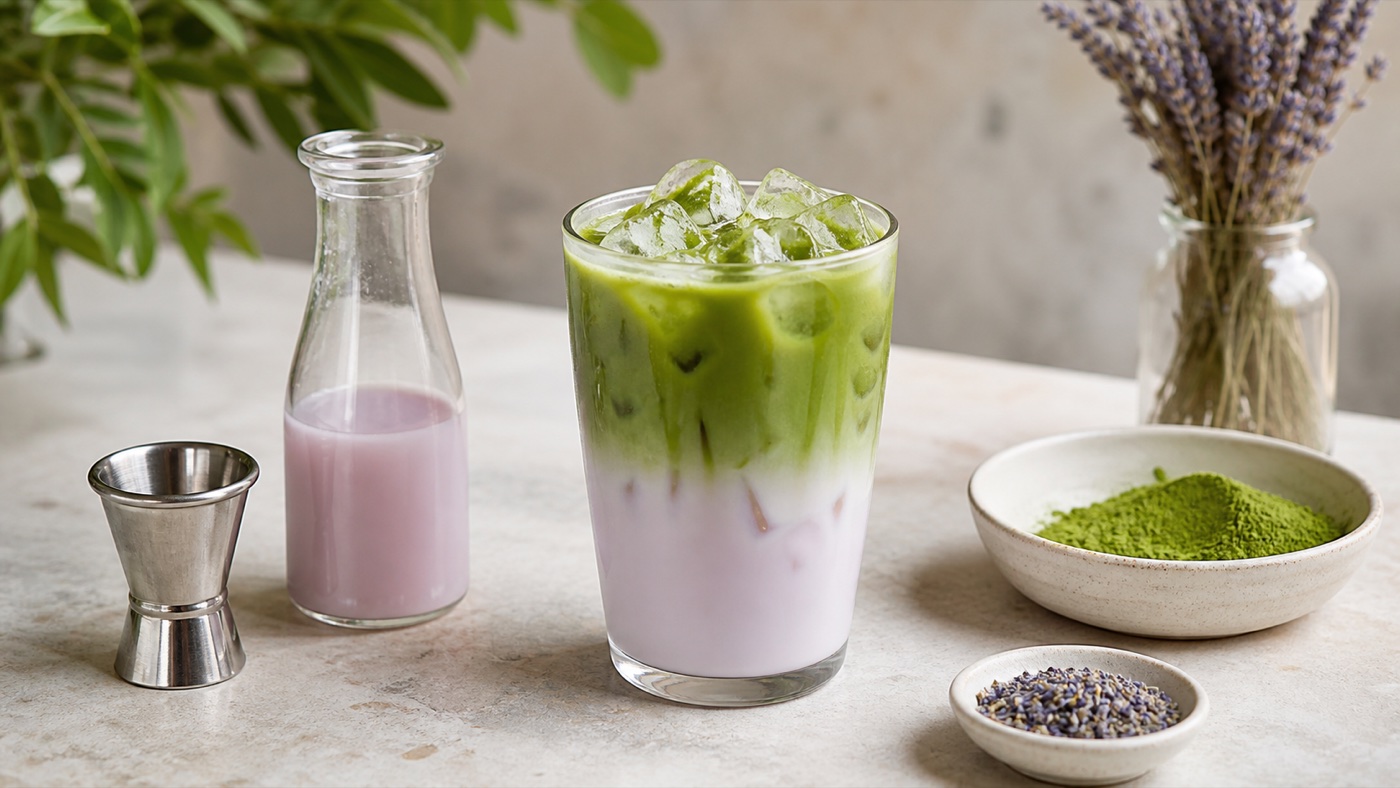
12 oz iced lavender matcha latte: starting recipe
- Matcha: 2 g
- Water for matcha: 30–40 g at approximately 70–80°C / 158–176°F
- Food-use lavender syrup: 10–15 g, adjusted to supplier concentration
- Milk: 170–190 g
- Ice: enough to reach the café’s defined final cup weight
- Sift the matcha and whisk or froth it into the measured water.
- Add the lavender syrup to the milk for an even drink, or place it in the glass if a layered presentation is being tested.
- Add ice and milk to the cup.
- Pour the matcha base over the drink.
- Record the final weight, stir and evaluate the complete flavor—not only the first layered sip.
For a 16 oz drink, begin around 2.5–3 g matcha and increase milk and syrup proportionally only as a first trial. Retest because extra ice and milk can weaken both the matcha and lavender.
Hot lavender matcha latte: starting recipe
- Matcha: 2 g
- Water: 35–45 g
- Lavender syrup: 8–12 g
- Steamed milk: 170–210 g, according to cup size
Mix matcha and water into a smooth base, add the measured syrup and finish with textured milk. Heat can make aroma more noticeable, so the hot version may need less lavender syrup than the iced version. Treat that as a test hypothesis, not a fixed rule.
Choose the lavender format deliberately
| Format | Advantages | Controls required |
|---|---|---|
| Commercial foodservice syrup | Fast, consistent, easy to pump and cost | Concentration, sugar, color, allergens, label, storage and opened shelf life |
| Food-grade natural flavor | Low use level and scalable | Food-use status, dosage accuracy, carrier, declaration and local requirements |
| Culinary lavender infusion | Ingredient story and adjustable aroma | Approved culinary material, filtration, batch recipe, sanitation and short refrigerated handling |
| Lavender cold foam | Premium visual layer and aroma at first sip | Milk allergens, foam stability, hold time and extra labor |
| Aromatherapy/cosmetic oil | Not an appropriate café shortcut | Do not use unless the exact product is explicitly approved and labeled for the intended food use |
Do not assume “natural,” “organic” or “essential oil” means a product is safe or legally suitable for beverage use. Ingredient identity, specifications, intended use and dosage matter.
Do not use purple color as proof of lavender
A lavender infusion or syrup may be pale, amber, grayish or nearly colorless rather than vivid purple. A lilac drink usually reflects an added permitted color or another colored ingredient. If color is used, confirm its suitability for the market and declare it correctly. Do not imply that bright purple proves more lavender or better quality.
For photography, the green-and-lilac contrast is useful, but the mixed drink may become muted. Decide whether the menu promise is a layered visual, a botanical flavor or both.
Which Sailtik matcha grade should a café test?
Sailtik 3A is positioned for café drinks and can be the cost-focused baseline. Sailtik 4A is positioned for premium café drinks and is a strong starting point when the menu needs a brighter or more refined matcha presence. Compare 5A only if the higher-end drink position and recipe justify it.
Lavender and sweetener can mask subtle differences, so test matcha in the finished recipe. Sailtik generally recommends 1.5–3 g per cup. Each grade has three internal Guizhou or Zhejiang options with different color and sensory characteristics; selected 10 g samples are recommended for the buyer’s business rather than every internal model being sent.
A six-cup lavender test that finds the threshold
| Cup | Matcha | Lavender syrup | Purpose |
|---|---|---|---|
| A | 2 g | 0 g | Control: understand the base latte |
| B | 2 g | 5 g | Detectable floral threshold |
| C | 2 g | 10 g | Low commercial level |
| D | 2 g | 15 g | Medium commercial level |
| E | 2.5 g | 10 g | Test stronger matcha identity |
| F | 2.5 g | 15 g | Test whether both can remain distinct |
Use the same syrup batch, milk, ice, water, final weight and mixing method. Score matcha identity, floral aroma, sweetness, perfume/soap character, texture, aftertaste, color and purchase intent. The right level is often just above clearly detectable and below perfumed.
Milk, sweetness and flavor balance
| Component | What it changes | Test note |
|---|---|---|
| Dairy milk | Body and familiar latte sweetness | Declare milk allergen as required |
| Oat or other plant beverage | Own sweetness, cereal/nut notes and foam behavior | Check allergens, formulation and local labeling |
| Vanilla | Rounds floral and vegetal edges | Can make lavender easier but less distinctive |
| Lemon | Adds brightness | Acidity can affect milk stability; bench-test before service |
| Cold foam | Concentrates aroma at the surface | Adds labor, ingredient cost and hold-time controls |
Food-safety and labeling controls
- Buy lavender ingredients specifically intended for food use.
- Keep the supplier specification, ingredient list, lot and use instructions.
- Follow label storage and opened-use directions for commercial syrup.
- If making syrup in-house, use a written batch recipe, sanitation controls, date marking and a shelf-life policy approved for the operation.
- Do not use decorative flowers unless they are supplied for culinary use.
- Include milk, plant-beverage or syrup allergens in the café’s allergen controls.
- Declare colors, flavors and sweeteners as required for packaged products.
- Avoid sleep, anxiety, relaxation or therapeutic promises unless independently substantiated and legally reviewed.
Calculate menu cost per drink
Ingredient cost = matcha + lavender system + milk + sweetener + ice + cup/lid + expected waste
Matcha cost per cup equals landed cost per kg ÷ 1,000 × grams used. Syrup cost equals landed bottle cost ÷ usable grams × grams dispensed. Calibrate pumps by weighing ten dispenses; do not assume every pump delivers the label’s nominal volume.
Include cold-foam labor, garnish waste and a second syrup bottle at each station if the concept requires them. A photogenic recipe can still fail commercially when slow assembly or inconsistent pumps erase the margin.
One-page café SOP
- Approved matcha and lavender ingredient.
- Matcha, water, syrup, milk and ice weights.
- Water temperature and mixing tool.
- Assembly order for mixed or layered service.
- Final cup weight and acceptable visual standard.
- Syrup storage, date marking and pump calibration.
- Allergen communication.
- Discard and remake criteria.
For the base preparation, use Best Water Temperature for Matcha and How to Froth It. For product selection, see Barista Matcha for Cafés.
Frequently asked questions
Can a café use lavender essential oil?
Do not use an aromatherapy or cosmetic product. Use only an ingredient explicitly supplied and labeled for the intended food or beverage use, within its stated dosage and applicable local requirements.
Should lavender matcha be bright purple?
No. Natural lavender flavor does not guarantee purple color. If a permitted color or colored ingredient is added, treat it as a separate formulation and labeling decision.
Can lavender syrup be batched into matcha concentrate?
It can be tested, but separate components give better control over settling, sweetness, limited-time menu changes and customer customization. If batching, define mixing, cold holding, time limits and discard rules.
Develop flavor first, then order volume
Contact Carol at Sailtik with your cup size, milk, syrup concentration, target dose and expected sales. Sailtik can recommend selected matcha samples for your lavender recipe before you choose a 1 kg, 5 kg or 10 kg bulk format.