
A matcha pod is not simply a small bag of matcha placed in a coffee capsule. Matcha is a fine suspended powder, while many single-serve systems are designed to extract soluble material through a filter. A successful product must align formulation, pod structure, machine, beverage volume and consumer instructions.
Sailtik disclosure: Sailtik has not confirmed that it manufactures, fills or supplies finished matcha pods, K-Cup® pods or capsules. Its confirmed packaging covers bulk aluminum-foil bags, tins and printed stand-up pouches—not single-serve machine capsules. This guide is educational for brands evaluating an independent pod co-manufacturer.
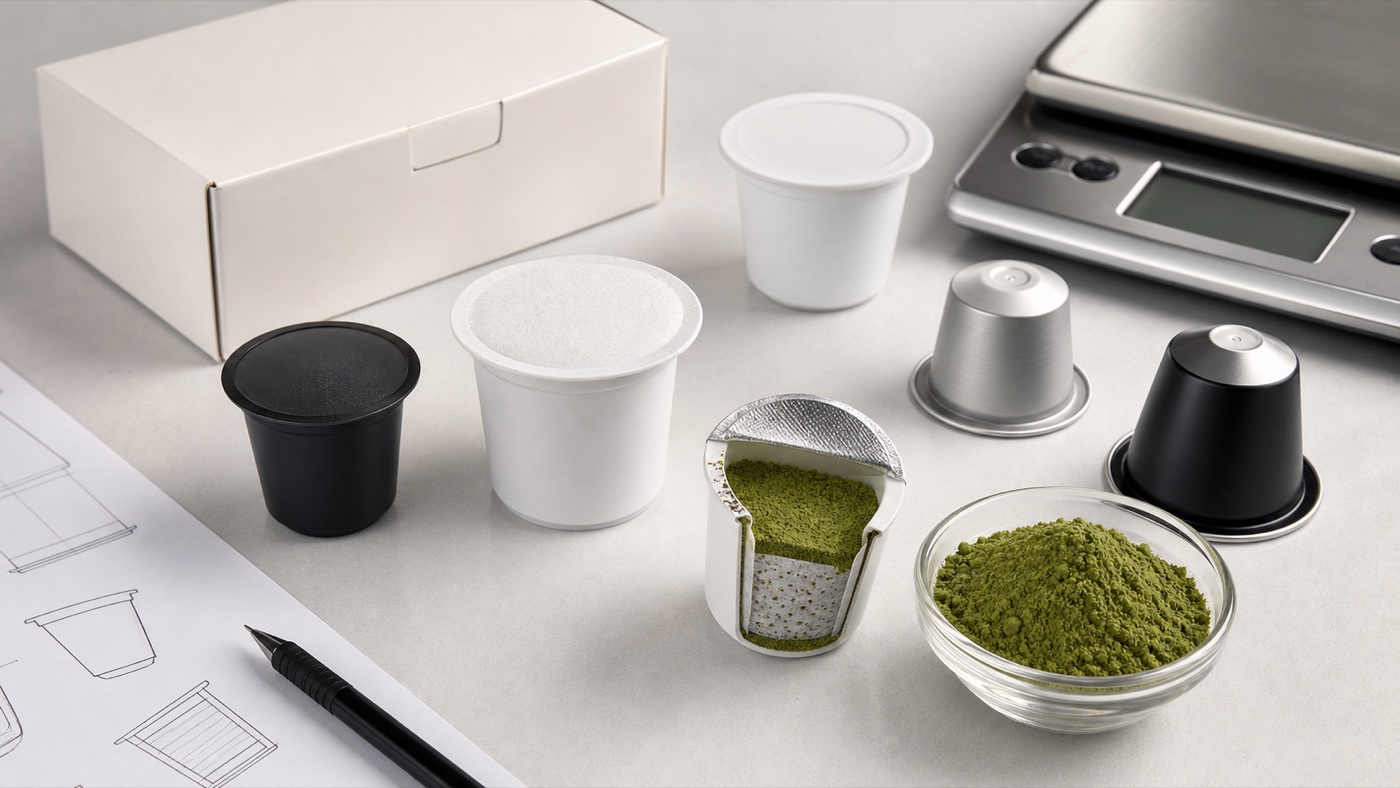
First define what “matcha pod” means
| Product concept | What may be inside | Main technical question |
|---|---|---|
| Brew-through tea pod | Tea leaf or coarser botanical material, sometimes with matcha | Will flavor extract while the filter retains solids? |
| Soluble matcha beverage pod | Matcha plus soluble tea, carrier, sugar or creamer | Will the formula disperse and exit the pod at the target volume? |
| Unsweetened matcha-style pod | Fine matcha or a matcha/soluble-tea system | How much powder reaches the cup versus staying in the pod? |
| Matcha latte pod | Sweetener, dairy or plant creamer, tea components and flavors | Flow, allergen control, emulsion, sweetness and residue |
| Capsule concentrate system | Dry or liquid proprietary concentrate | Seal, machine puncture, pressure, shelf life and beverage safety |
| Single-serve sachet | Premeasured powder emptied into a cup | Manual mixing, not machine compatibility |
These formats create different beverages. A listing called “matcha tea pod” may primarily brew green tea with a small matcha contribution; a “matcha latte K pod” may be a sweet instant mix. Read the ingredient list and preparation method before comparing price or sensory quality.
Why pure matcha behaves differently from coffee
With traditional matcha, the powder is dispersed into water and consumed. It is not normally brewed and discarded like coffee grounds or tea leaves. If fine matcha is placed above a pod filter, some powder may be retained, compact, channel, escape unpredictably or settle in the cup. The delivered matcha mass—not the filled mass—determines beverage strength and cost.
This is also why a reusable coffee filter should not be assumed suitable. Keurig’s current official page for the My K-Cup® Universal Reusable Coffee Filter says it is designed for ground coffee and that tea leaves, hot cocoa and other powdered beverages are not recommended. Follow the brewer and accessory manufacturer’s current instructions rather than improvising with loose matcha.
K-Cup® is a trademark; compatibility is a testable claim
K-Cup® and Keurig® are trademarks associated with Keurig’s system. A third-party product should use trademark and compatibility language only after legal review and physical validation. “K-cup,” “matcha k cups,” “matcha k pods” and “Keurig matcha pods” may be common search phrases, but they do not define a technical specification.
Name the exact brewer families and models the co-manufacturer will support. Pod geometry, lid puncture, filter construction, pressure/flow behavior and machine generations can differ. Test the production-equivalent pod across all claimed machines, brew sizes and relevant settings. A fit in one household brewer does not establish universal compatibility or suitability for commercial machines.
Build a product brief before requesting a quote
- Target consumer and use occasion.
- Unsweetened matcha, sweet matcha or complete latte.
- Required machine system, exact models and brew size.
- Target delivered matcha mass and total beverage solids.
- Target cup volume, sweetness, milk/creamer system and flavor.
- Allowed sediment, foam, color and aftertaste.
- Ingredient, allergen, nutrition and claim requirements.
- Pod, lid, filter and carton material requirements.
- Target shelf life and storage conditions.
- Trial quantity, launch forecast and destination markets.
- Trademark, recycling and disposal language requiring review.
Sailtik’s usual café recommendation is 1.5–3 g matcha per cup, but a pod’s fill weight may need to account for the formulation and how much material actually reaches the beverage. Do not copy the café dose directly into a capsule without a mass-balance and sensory trial.
Prototype test matrix
| Test | Measure | Failure example |
|---|---|---|
| Machine fit | Insertion, closure, puncture and ejection | Pod jams, deforms or cannot be removed safely |
| Brew flow | Time, output mass and interruptions | Short cup, overflow or blocked needle/filter |
| Delivery | Pod input versus residue and cup solids | Most matcha remains in pod |
| Dispersion | Lumps, floating islands and sediment over time | Dry clumps or unacceptable sludge |
| Sensory | Color, aroma, sweetness, bitterness, texture | Weak tea, chalkiness or excessive sweetness |
| Temperature | Delivered beverage temperature by setting | Scalding instruction risk or poor dissolution |
| Seal integrity | Leaks, burst, oxygen/moisture protection | Powder ingress, aroma loss or premature color change |
| Consumer handling | Instructions and misuse scenarios | Opening a hot pod or using an incompatible machine |
Use multiple pods from pilot and production runs, not one demonstration sample. Record machine serial/model, water, brew selection, output mass and result. Keep retained pods and beverage photos so a formula change, filter change or complaint can be investigated.
Pure matcha, instant tea and latte mix are not interchangeable
Instant green-tea solids dissolve differently from whole-leaf matcha. A carrier can improve powder flow; sugar and creamer change bulk density, water demand and residue. These changes may make a pod easier to operate but also change the ingredient declaration, nutrition, allergen status, sensory profile and meaning of the product name.
Ask the formulator to state every ingredient and its purpose. If “matcha” is emphasized on the front, review whether the formula and presentation could mislead consumers about the amount or nature of matcha. Never use a photo of pure powder to disguise a product that is mostly sweetener or creamer.
Shelf life must be validated in the final pod
Matcha is sensitive to oxygen, moisture, heat and light. A small pod has a high packaging-area-to-product ratio and multiple interfaces: cup, filter, lid seal and carton. The bulk powder’s shelf life cannot simply be transferred to a new pod format.
- Define incoming ingredient limits and storage.
- Measure fill-weight control and seal quality.
- Assess package oxygen/moisture barrier appropriate to the formula.
- Run real-time stability in the intended final pack.
- Use justified accelerated work only as supporting evidence.
- Test color, aroma, taste, flow, caking, microbiology and package integrity as applicable.
- Confirm distribution conditions and consumer storage statement.
- Assign the finished-pod shelf life from evidence, not the ingredient label alone.
Co-manufacturer qualification questions
- Which pod systems and machine models have you validated?
- Do you formulate, blend, fill, seal, cartoning and test in-house?
- How do you control fine green powder, dust and cross-contact?
- Which food-safety system covers the production site and product scope?
- How are allergens segregated and labels reconciled?
- What are pilot, stock-component and custom-component minimums?
- Who owns the formula, tooling, artwork and test data?
- What seal-integrity, compatibility and shelf-life evidence is supplied?
- How are material or component changes approved?
- What happens to obsolete printed pods and cartons?
A search result from a pod manufacturer can establish that the category exists, but its advertised capabilities and minimums belong to that manufacturer. They must not be presented as Sailtik capabilities or universal market terms.
Alternative single-serve formats
If machine compatibility creates too much technical risk, a premeasured sachet may be more honest and easier to validate. The consumer empties it into a cup and whisks or shakes it, allowing the whole matcha dose to be consumed. Stick packs, sachets and liquid concentrates still require qualified manufacturing, packaging and shelf-life work, but they avoid pretending that matcha behaves like filter coffee.
For broader packaging decisions, see Matcha Packaging Formats and Private Label Matcha.
Frequently asked questions
Can I put pure matcha in a reusable K-Cup filter?
Keurig’s official My K-Cup® guidance says the reusable filter is for ground coffee and does not recommend tea leaves, hot cocoa or other powdered beverages. Follow the current manufacturer instructions and do not assume loose matcha is suitable.
Are matcha pods the same as matcha?
Not necessarily. Some contain matcha, some combine it with soluble tea, and latte versions may contain sweetener, creamer and flavors. Check ingredients and delivered dose.
Does Sailtik make matcha capsules?
Sailtik has not confirmed capsule manufacturing or filling. A brand would need an independently qualified pod co-manufacturer and a validated product brief.
Validate the beverage, not just the capsule fit
A pod project succeeds only when it fits, flows, delivers the intended formula, tastes acceptable and remains stable throughout shelf life. If you need China-origin matcha powder as a development input—not a finished pod—contact Carol at Sailtik with the formula concept, target dose, pilot quantity and destination. Final pod formulation and compatibility remain the co-manufacturer’s responsibility.