
Matcha gummies, bottled lattes and liquid concentrates are formulated foods—not ordinary matcha powder in a different package. Each format changes the ingredients, process, food-safety controls, sensory target, shelf-life evidence and label responsibilities.
Sailtik disclosure: Sailtik has not confirmed that it manufactures gummies, ready-to-drink beverages or shelf-stable liquid concentrates. Sailtik may supply China-origin matcha powder as an ingredient for development, while the buyer must qualify an appropriate food or beverage co-manufacturer and validate the finished product.
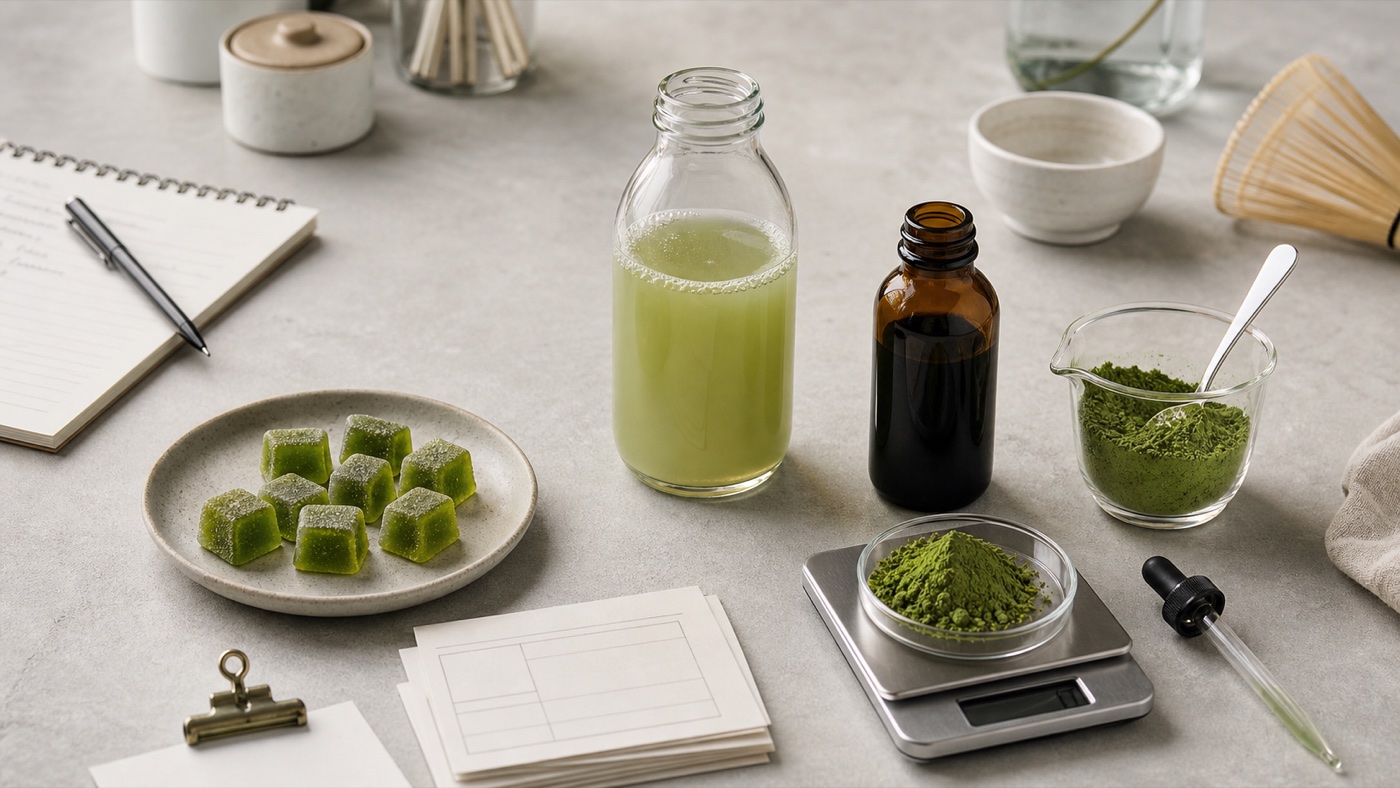
Three formats, three different development problems
| Format | Main consumer promise | Core technical risks |
|---|---|---|
| Matcha gummy | Portable chewable serving | Matcha dose, bitterness, texture, color change, moisture, claims and supplement/food classification |
| Bottled or canned matcha latte | Ready to drink with no preparation | Sedimentation, emulsion, heat process, dairy/plant allergens, color, flavor and package compatibility |
| Liquid matcha concentrate | Fast portioning into milk or water | Delivered dose, settling, preservation, dilution instructions, cold chain and opened-life control |
| Fresh café batch concentrate | Same-day service speed | Time control, refrigeration, agitation, staff dosing and waste |
A fresh café batch and a commercial bottled concentrate should never share an assumed shelf life. For a café workflow, use the separate Make-Ahead Matcha Concentrate Guide. The discussion below concerns commercially formulated products.
Start with a quantitative product brief
- Finished-product category and destination market.
- Matcha grams per serving and source specification.
- Serving size, pack size and expected consumption pattern.
- Sweetness, flavor, color, bitterness and texture targets.
- Dairy, plant base, gelatin, pectin or other structural system.
- Allergen, nutrition, organic, vegan and other proposed claims.
- Ambient, chilled or frozen distribution.
- Target unopened shelf life and instructions after opening.
- Required process and package format.
- Pilot quantity, launch forecast and target landed cost.
Do not begin with “add some ceremonial matcha.” The term ceremonial grade is not a universal formulation specification. A developer needs an exact powder code, dose, particle behavior, sensory profile and acceptance criteria.
Developing matcha gummies
A matcha gummy may be sold as confectionery, conventional food or a dietary supplement depending on formula, presentation and jurisdiction. That classification affects ingredient permissions, manufacturing controls, nutrition or supplement labeling and claims. Resolve the category with qualified regulatory advice before finalizing the formula or package.
Current retail results show that products called matcha gummies often contain sweeteners, gelling agents, acids, flavors and additional functional ingredients. The word matcha does not tell a buyer how much matcha is present. Specify matcha mass per serving and measure relevant caffeine or other declared constituents rather than borrowing values from generic tea references.
| Gummy variable | Development question |
|---|---|
| Gel system | Gelatin or pectin; what texture and claim implications follow? |
| Acid and heat | How do process conditions affect color, flavor and target constituents? |
| Powder distribution | Does matcha remain uniform from kettle to deposited pieces? |
| Dose uniformity | Does each serving deliver the intended, tested amount? |
| Water activity/moisture | Will pieces stick, dry, crystallize or support spoilage? |
| Packaging | Does the barrier protect texture, color and odor? |
| Claims | Does the evidence support every structure/function or marketing statement? |
Matcha can bring bitterness and a duller green after heat or storage. Flavor and color systems may be used, but the ingredient statement and front-of-pack presentation must remain truthful. A gummy containing a small amount of matcha should not be visually presented as equivalent to drinking a full prepared matcha serving.
Developing a bottled matcha latte
A bottled matcha latte can be refrigerated or commercially shelf-stable. Those routes involve different validated processes, packaging and distribution. Choose the process with a competent beverage manufacturer and process authority; a home or café recipe cannot establish commercial safety.
- Define dairy, oat, coconut or other beverage base and allergens.
- Set matcha, sugar and flavor levels by weighed bench trials.
- Evaluate dispersion, particle size, sediment and resuspension.
- Develop the stabilizer/emulsifier system if required and permitted.
- Choose the thermal or other validated process with the manufacturer.
- Confirm package compatibility, headspace and closure integrity.
- Evaluate the beverage immediately and through real-time shelf life.
- Validate nutrition, allergen and storage labeling for the final formula.
“Shake well” may be an honest instruction when normal sediment can be safely and acceptably resuspended; it is not a substitute for controlling severe separation, coagulation or package failure. Establish an objective limit for sediment height, redispersibility and appearance over time.
Developing liquid matcha concentrate
Liquid matcha and matcha concentrate search results include everything from a sweet café base to a multi-serving botanical drink. Define the concentrate by dilution ratio, matcha mass delivered per finished serving and required storage. “One pump” or “one cap” should be calibrated to a measurable volume and verified through the package’s dispensing range.
Matcha is a suspension, so settling is expected unless the formulation changes how particles behave. The developer must decide whether the product will be shaken, mixed, pumped or poured and how uniform the first and last servings remain. Test the actual bottle, cap, pump or bag-in-box through its full use cycle.
- Matcha grams and caffeine basis per diluted serving.
- Dilution medium, ratio and finished volume.
- Viscosity and pump/pour repeatability.
- Settling and redispersion after realistic storage.
- Microbiological and process controls.
- Unopened and opened storage instructions.
- Cleaning and handling for foodservice dispensers.
- Color, aroma and flavor through shelf life.
- Lot code and traceability from ingredient to finished container.
Caffeine and health claims need finished-product evidence
Do not calculate the label or marketing claim from a generic statement that matcha contains a certain amount of caffeine. Matcha source, dose, formula and serving size matter. Additional tea extracts, caffeine or vitamins can change both exposure and regulatory category. Test or calculate using an accepted, documented basis for the actual finished product and market.
Avoid promising “no crash,” “detox,” disease treatment, immunity, anxiety relief, weight loss or similar outcomes without the evidence and legal basis required in the destination. Product-development pages frequently repeat attractive wellness language; repetition does not make the claim substantiated.
Shelf-life program for formulated matcha
| Attribute | Gummy | Bottled drink | Concentrate |
|---|---|---|---|
| Safety/process | Validated cook/deposit and contamination controls | Validated beverage process and closure | Validated process plus opened-use control |
| Physical | Texture, sticking, crystallization | Sediment, emulsion, package integrity | Settling, viscosity, dispensing |
| Sensory | Bitterness, flavor, chew | Color, aroma, taste, mouthfeel | Color, aroma, diluted-cup performance |
| Chemical | Relevant declared constituents and oxidation indicators | Relevant formula and package indicators | Relevant formula and package indicators |
| Label | Serving, warnings and storage | Allergens, nutrition, shake/storage instructions | Dilution, opened life and refrigeration |
Run stability in the final production-equivalent package and process. Sailtik’s generally stated 18-month shelf life applies to its matcha powder subject to the exact product, batch and label; it cannot be transferred to a gummy, bottled latte or liquid concentrate.
Qualify the finished-product manufacturer
- Does the site’s food-safety system cover the intended category and process?
- Who owns formulation, process authority work and stability data?
- Which allergens and other products share the line?
- How are matcha dust, sediment and fill uniformity controlled?
- What pilot and commercial minimums apply?
- Who approves suppliers and incoming ingredient specifications?
- How are labels, claims and packaging revisions controlled?
- What retain samples, complaints and recall records are maintained?
- What changes require the brand owner’s written approval?
Choosing matcha powder for development
The best powder is the one that performs after the actual process, ingredients and shelf life. A bright straight-tea sample may change under acid, heat, dairy protein, plant base or prolonged storage. Screen several candidates in the finished matrix and compare cost per accepted serving.
Sailtik offers China-origin grades 1A–7A from Guizhou or Zhejiang, with three private internal options per grade. Selected 10 g samples may be recommended from the product brief rather than sending every model. Internal codes remain private, and finished-product validation remains the buyer’s and co-manufacturer’s responsibility.
Frequently asked questions
Is a matcha gummy equivalent to a cup of matcha?
Do not assume equivalence. Compare the actual matcha mass, tested constituents, complete ingredients and serving size.
Can I bottle a café matcha concentrate and sell it?
A fresh café recipe is not a validated commercial bottled product. Use a qualified manufacturer and appropriate process authority to develop safety, shelf life, packaging and labeling.
Does Sailtik manufacture finished gummies or drinks?
Sailtik has not confirmed those finished-product capabilities. It may be considered only as a matcha powder ingredient source, subject to sample approval and the co-manufacturer’s qualification.
Develop the final product, not a powder claim
Bring the co-manufacturer a quantified brief, then validate formula, process, package, claims and shelf life as one system. To discuss China-origin matcha powder samples for bench development, contact Carol at Sailtik with the product form, matcha dose, other ingredients, pilot quantity and destination.