
Plain matcha powder contributes calories, carbohydrate, protein and other components because the powdered leaf is consumed. But the amount in a 1.5–3 g drink is small compared with a 100 g laboratory or label basis. In most matcha lattes, the milk, sweetener, syrup and premix determine far more of the finished drink’s calories and sugar.
There is no responsible universal nutrition number for “a matcha.” Product composition, powder dose, serving size and additions vary. Use the actual product panel and recipe rather than copying a generic search result.
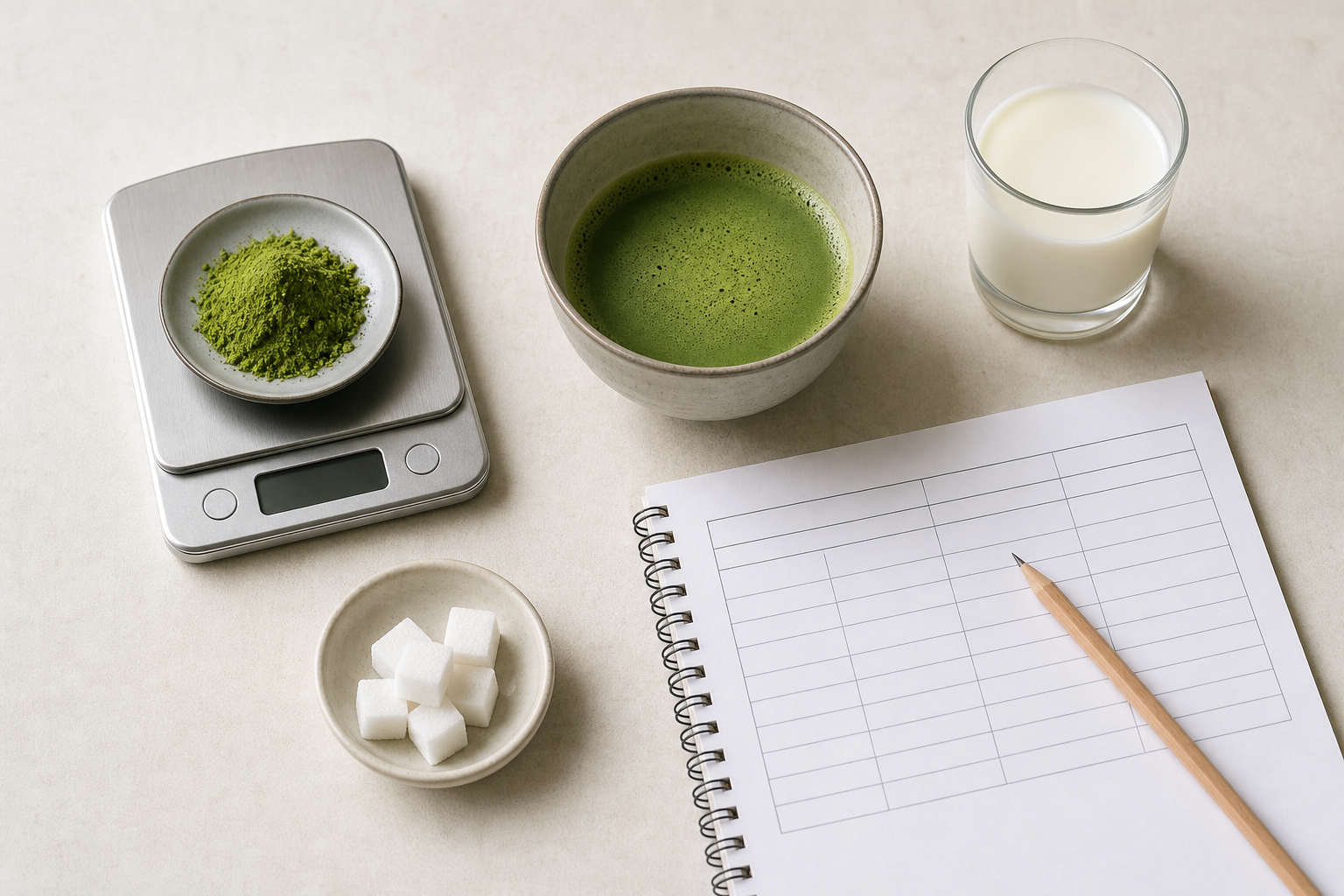
An example matcha nutrition calculation
An example Sailtik 5A reference panel supplied for commercial discussion lists, per 100 g: 1636 kJ energy, 29.5 g protein, 4.6 g fat, 56.7 g carbohydrate and 0 mg sodium. It does not separately list total sugars or dietary fiber. The following table is simple arithmetic from that example—not a universal specification, a U.S. Nutrition Facts panel, or a promise for every grade and lot.
| Powder dose | Energy | Protein | Fat | Total carbohydrate |
|---|---|---|---|---|
| 1.5 g | About 5.9 kcal | 0.44 g | 0.07 g | 0.85 g |
| 2 g | About 7.8 kcal | 0.59 g | 0.09 g | 1.13 g |
| 3 g | About 11.7 kcal | 0.89 g | 0.14 g | 1.70 g |
The calorie conversion uses 4.184 kJ per kcal. A market-ready label may apply jurisdiction-specific serving rules, required nutrients, analytical or database methods and rounding conventions. FDA emphasizes that nutrition information is tied to the labeled serving and that serving size describes amounts customarily consumed, not a recommendation to eat that amount.
Does matcha have calories?
Yes. Whole powdered leaf is not chemically identical to zero-calorie water. At the small dose used in a drink, a label may display a rounded value under applicable rules, but “rounds to zero” is not the same statement as “contains no energy.” For product development, retain the unrounded formulation calculation and build the final panel correctly.
A latte can be very different. Multiply every ingredient by the actual recipe amount: milk or plant beverage, sweetener, flavored syrup, fruit purée, cream, foam, topping and any premixed matcha blend. Ice and water add volume without removing nutrients already present.
Does matcha have sugar?
Ask which product is meant:
- Pure matcha powder: the ingredient is tea leaf, with no table sugar added as a separate ingredient.
- Matcha premix: may combine matcha with sugar, creamer, flavors or carriers.
- Matcha latte: can contain lactose from dairy, naturally occurring sugars in a plant beverage, and added sugar from syrup or a sweetened premix.
- Flavored or bottled drink: must be evaluated from its own formula and label.
“No added sugar” and “sugar free” are not the same. FDA defines “sugar free” for U.S. labeling as less than 0.5 g sugars per reference amount customarily consumed and per labeled serving, with additional conditions. An ingredient list that contains no added table sugar does not by itself prove that a finished product qualifies for the regulated claim.
The example Sailtik panel above reports total carbohydrate but does not separately declare total sugars. Total carbohydrate cannot be relabeled as sugar, and it cannot prove a “0 g sugar” claim. The selected product and destination-market label need an appropriate substantiation route.
Does matcha have carbs, fiber, protein or fat?
Powdered tea leaf can contribute all four, but the meaningful consumer amount depends on the dose. In the example calculation, 2 g contributes about 1.13 g total carbohydrate, 0.59 g protein and 0.09 g fat. The provided example does not split carbohydrate into fiber and sugars, so it cannot support a precise fiber answer.
A nutritional component’s presence also does not establish a health outcome. Less than one gram of protein in a small serving should not be marketed as a major protein source without checking the applicable nutrient-content-claim rules. Likewise, leaf fiber does not justify calling every serving “high fiber.”
Plain matcha versus a matcha latte
| Component | Plain matcha with water | Matcha latte |
|---|---|---|
| Powder | Matcha dose | Matcha dose or sweetened premix |
| Calories | Mostly from the small powder dose | Often dominated by milk, creamer and sweetener |
| Sugars | Require product-specific declaration; no sweetener if none is added | Can include milk sugar, sweetened plant beverage, syrup and premix sugar |
| Allergens | Depend on product and cross-contact controls | May include milk, soy, tree nuts or other formulation allergens |
| Caffeine | Driven mainly by matcha mass and composition | Milk and sugar do not remove matcha caffeine |
For a reproducible recipe, use the hot and iced latte guide and calculate from exact ingredient specifications. Do not answer “how many calories are in a matcha latte?” without the size, milk, sweetener, matcha dose and toppings.
Is matcha gluten-free?
Tea leaf is not wheat, rye or barley, but a commercial “gluten-free” statement is a finished-product and process claim. In the United States, FDA requires foods carrying “gluten-free” and equivalent claims to meet its definition, including less than 20 parts per million gluten and relevant ingredient conditions. Cross-contact must be considered.
Sailtik can provide an Allergen Declaration for the selected product, but this article does not claim that every Sailtik matcha is certified or verified gluten-free. A buyer serving people with celiac disease should request the applicable declaration, assess the facility and supply chain, and determine whether testing or certification is needed.
Is matcha vegan?
Pure matcha’s stated ingredient is tea leaf, so it contains no intentionally added dairy or other animal ingredient. That ingredient observation is different from a formal vegan certification or a guarantee about every processing aid and cross-contact pathway. A latte made with dairy milk is not vegan; one made with a plant beverage may still include non-vegan syrups, toppings or processing inputs.
Is matcha keto-friendly?
“Keto-friendly” depends on the person’s total diet and the finished recipe, not the color of the drink. A small dose of plain matcha contributes a small amount of carbohydrate in the example above. Sweetened premix, oat beverage, syrup, honey and fruit can change the total substantially. Calculate net carbohydrate only from adequate product data; do not assume total carbohydrate equals sugar or fiber.
Does matcha break a fast?
The answer depends on the fast:
- Strict zero-calorie fast: plain matcha contributes some energy, so it does not meet a literal zero-calorie rule.
- Intermittent-fasting program: definitions vary. Follow the program or clinician’s protocol rather than a marketing claim.
- Religious fast: ask the appropriate religious authority; nutrition arithmetic does not determine religious observance.
- Medical or pre-procedure fast: follow the healthcare facility’s instructions exactly. Do not substitute matcha for permitted clear liquids unless they explicitly approve it.
- Laboratory test fast: follow the ordering clinician or laboratory instructions because caffeine and non-water drinks may matter.
Can you drink matcha on an empty stomach?
Some people tolerate it; others report nausea, stomach discomfort, jitteriness or reflux-like symptoms, especially with a concentrated dose. Caffeine sensitivity, medication and health conditions matter. Start with a controlled small serving only if appropriate for the individual, and stop if symptoms occur. Persistent or severe symptoms need professional assessment.
Is matcha halal or kosher?
Ingredient simplicity does not replace certification required by a buyer, retailer or consumer. Sailtik can provide a Halal Certificate where applicable to the selected product and transaction. No kosher certification has been confirmed for publication here, and this page should not be read as a kosher or Passover claim.
What a B2B nutrition file should contain
- The exact product and ingredient statement.
- The nutrition source: representative analysis, accepted database or justified calculation.
- The destination market and required label format.
- The serving-size basis and recipe yield.
- Rounding and daily-value rules.
- Total sugars, added sugars and dietary fiber when required.
- Allergen and cross-contact review.
- Substantiation for voluntary claims such as sugar free or gluten-free.
- Version control when a supplier, lot, milk or syrup changes.
FDA’s serving-size guidance, sugar-free claim guidance, gluten-free rule overview and allergen information provide useful U.S. starting points. Other destinations have their own rules.
Sailtik product information
Sailtik’s matcha originates in Guizhou or Zhejiang, China. Available commercial documents can include an Allergen Declaration, CoA, Food Safety Management System Certificate, Halal Certificate, Heavy Metals Test Report, Non-GMO Declaration, Pesticide / Mycotoxin Residue Test Report and SDS, as applicable to the selected product and transaction. A document title does not imply that every nutrient or claim has been tested.
Review the document guide, then contact Carol with the intended market, serving size, label claims and formulation. Carol can identify the relevant product information; the customer remains responsible for the finished recipe and destination-market label.
Frequently asked questions
Is matcha fattening?
No single ingredient determines body weight. Plain matcha uses a small powder dose, while a finished latte may contain substantial milk, syrup or toppings. Evaluate the whole diet and recipe rather than assigning weight loss or gain to matcha.
Does matcha burn fat or lower blood sugar?
Those are health-outcome claims, not Nutrition Facts. Matcha-specific human evidence does not establish it as a weight-loss or diabetes treatment. See the matcha health-evidence review and seek medical advice for blood-sugar management.
Does matcha make you have a bowel movement?
Individual responses to caffeine and beverages differ. Matcha is not a predictable or appropriate laxative claim. New, persistent or severe digestive symptoms should be discussed with a healthcare professional.