
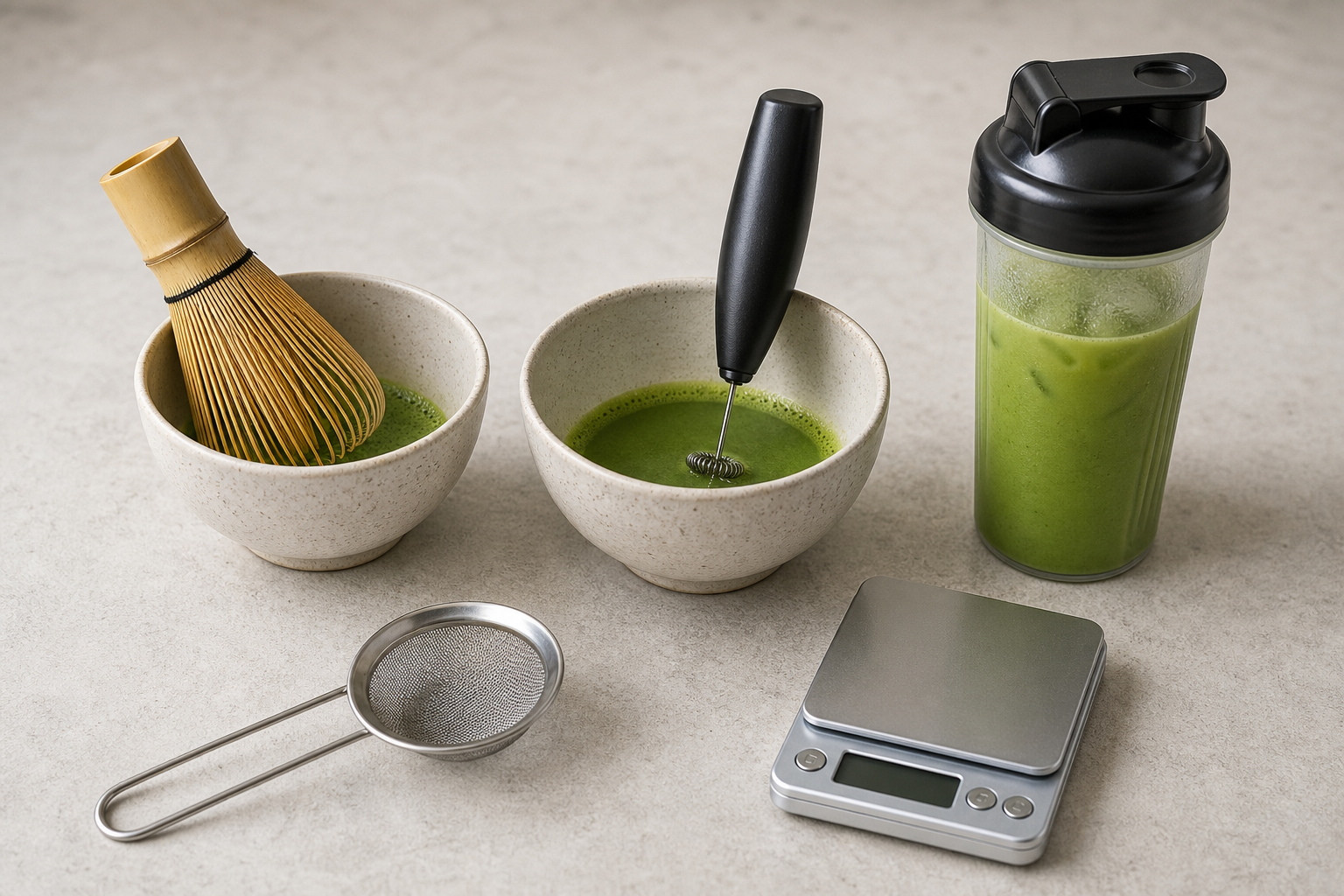
You do not need a bamboo whisk to make smooth matcha. A chasen is excellent at dispersing powder and creating fine foam, but an electric frother, sealed cool-liquid shaker, blender, small kitchen whisk or even a spoon-and-paste method can work. The non-negotiable steps are an accurate dose, controlled liquid, removal of dry clumps and enough shear to create an even suspension.
Matcha does not truly dissolve like sugar. It is finely ground leaf suspended in liquid, so some settling over time is normal. The goal is to break up agglomerates and distribute the particles before serving.
A base formula that works across methods
- Matcha: 1.5–2 g for a lighter straight cup; 2–3 g for a milk drink that needs more presence.
- Initial water: 30–60 g to form a smooth concentrate.
- Water temperature: begin around 70–80°C for hot preparation, then adjust to the sample and taste target.
- Finished straight matcha: dilute the concentrate to roughly 70–100 g water.
- Latte: combine the concentrate with the measured milk, ice and sweetener from the final recipe.
Use a gram scale. A teaspoon changes with powder density, compression and how it is filled. Read the matcha dose and yield guide if recipe cost and consistency matter.
Method 1: bamboo matcha whisk
- Rinse or briefly soften the chasen tines in warm water, then empty and dry the bowl.
- Weigh and sift the matcha into a broad bowl.
- Add a small portion of the measured water and gently combine until no dry pockets remain.
- Add the remaining water.
- Hold the whisk lightly and move rapidly back and forth in an M or W path. Keep the motion in the wrist rather than grinding the tines into the bowl.
- When the suspension is even and the desired foam is present, lift the whisk from the center.
A bamboo whisk’s many fine tines can create a dense layer of small bubbles with relatively little splashing. A wide bowl provides space for the fast movement. Circular stirring is useful for combining the initial paste but is less effective for aerating the finished bowl.
Method 2: handheld electric frother
- Choose a tall vessel with enough headroom to contain splashes.
- Add part of the liquid first, then sift matcha onto it.
- Place the frother head below the surface before switching it on.
- Move through the liquid for approximately 10–20 seconds without pulling the head fully into the air.
- Stop the motor before removing the tool.
- Add the remaining water or pour the concentrate into the latte.
An electric frother is fast and consistent for one drink. Its small coil may create larger bubbles than a good chasen and can throw powder if started dry or too close to the surface. Clean the shaft and head immediately under the manufacturer’s instructions; do not immerse a motor housing that is not designed for washing.
Method 3: shaker bottle or sealed jar
Use cool or cold liquid only. Never shake hot liquid in a sealed container. Heat can increase internal pressure and cause burns when the lid leaks or opens.
- Add 60–100 g cool water to a clean, suitable bottle.
- Add the weighed matcha. If the powder is heavily clumped, sift it first.
- Confirm the lid and drinking cap are fully secure.
- Shake vigorously for 15–30 seconds.
- Open away from clothing and check for undispersed powder.
- Pour over ice or combine with the measured milk.
A wire mixing ball can help, but it is not essential. The method produces a practical cold suspension and noticeable foam; it is less controlled for a formal straight-matcha presentation.
Method 4: countertop or immersion blender
A blender is useful for multiple servings or a café test batch. Add liquid first, then powder, and operate only within the machine’s hot-liquid limitations. A closed household blender can build pressure with hot liquid, so use cool ingredients unless the manufacturer explicitly permits a hot preparation and provides a safe venting procedure.
Blend only long enough to disperse the matcha. Excessive blending can add unwanted foam, warm the drink and make volume measurement harder. For commercial service, define maximum batch size, holding time, refrigeration and cleaning in the food-safety procedure. See the matcha concentrate and batch guide.
Method 5: spoon, fork or small kitchen whisk
This is the lowest-equipment method. Sift the powder, add only enough water to create a thick smooth paste, and press remaining lumps against the side of the cup. Add water gradually while stirring quickly. A small wire whisk works better than a spoon; a fork can help in a wide cup but rarely creates fine foam.
The paste-first technique matters because a large volume lets dry clumps circulate without being crushed. It works especially well when the final matcha will be combined with milk and perfect surface foam is not required.
Which method should you use?
| Method | Best use | Foam | Main risk |
|---|---|---|---|
| Bamboo whisk | Straight matcha and careful tasting | Fine when technique and bowl are suitable | Broken or poorly dried tines |
| Electric frother | Fast single lattes | Fast, sometimes larger bubbles | Splashing and inconsistent depth |
| Cool shaker | Iced matcha and travel | Abundant but variable | Unsafe if used with hot liquid |
| Blender | Several servings or recipe trials | High aeration | Heat/pressure limits and sanitation |
| Paste plus spoon/whisk | Minimal equipment | Low | More effort and residual clumps |
How to prevent matcha clumps
- Keep the powder dry and reseal it promptly after use.
- Sift immediately before mixing rather than far in advance.
- Weigh liquid as well as powder.
- Start with a small concentrate instead of flooding dry powder.
- Use a vessel large enough for the tool.
- Do not overload a frother, shaker or blender.
- Serve soon after preparation or stir again because suspended particles settle.
How long should you whisk matcha?
Stop when the powder is evenly suspended and the target foam has formed, usually within tens of seconds rather than minutes. Time alone is not a quality measure: tool geometry, bowl, dose, temperature and technique matter. If large clumps remain after prolonged whisking, improve sifting and the initial paste instead of simply whisking harder.
Water temperature and taste
Boiling water is not necessary for dispersion and can make a sample taste harsher. Begin around 70–80°C, hold the recipe constant, then adjust. Cold water can also disperse matcha with enough shear; it may emphasize a different flavor balance and requires a tool suited to cold preparation. The temperature and frothing guide explains the variables in more detail.
Cleaning a bamboo matcha whisk
- Rinse promptly with clean water so paste does not dry between the tines.
- Do not force or twist the delicate tines against the bowl.
- Shake off excess water gently.
- Air-dry completely in a clean, ventilated position. A correctly sized whisk holder can help maintain shape.
- Do not store the whisk wet in a closed container.
- Replace it when tines split excessively, break or can no longer be cleaned reliably.
A food-service operator must also follow applicable utensil-washing and sanitation requirements. A decorative home-care instruction does not override local health rules or the business’s hazard controls.
Café consistency test
Prepare the same powder and recipe with the candidate tools. Record mixing time, visible clumps, foam after one minute, sediment after five minutes, temperature loss, clean-up time and drink yield. Blind-taste the finished latte. The fastest tool is not economical if it wastes powder, creates rework or cannot be cleaned between orders.
Sailtik recommends testing 1.5–3 g per cup and selecting a grade based on the finished application. Carol can recommend 10 g samples from suitable internal models after learning the café’s serving format; not every model is sent automatically. Use the three-cup sensory protocol, then contact Carol with the recipe and equipment.
Frequently asked questions
Do you have to whisk matcha?
No. You must disperse it, but a bamboo whisk is only one tool. Choose the method by drink style, desired foam, volume, safety and cleaning workflow.
Can you put matcha directly into milk?
You can, especially with a blender or strong frother, but a small water concentrate is usually easier to smooth and standardize. Direct-to-milk dispersion depends on milk temperature, fat, protein and tool power.
Can matcha be stirred like instant coffee?
It can be stirred into a paste and diluted, but it does not dissolve like instant coffee. Expect more settling and less foam from simple stirring.