
Plain matcha is made from finely ground leaves of the tea plant, Camellia sinensis. It should not need sugar, milk powder, flavoring or green coloring. Those additions belong to formulated products such as matcha latte mixes, not to plain matcha powder.
That short answer is useful, but buyers should ask one more question: does the product follow the cultivation and processing definition expected for matcha, or is it simply another green tea ground into powder? Ingredient identity, production method, origin and quality are separate checks.
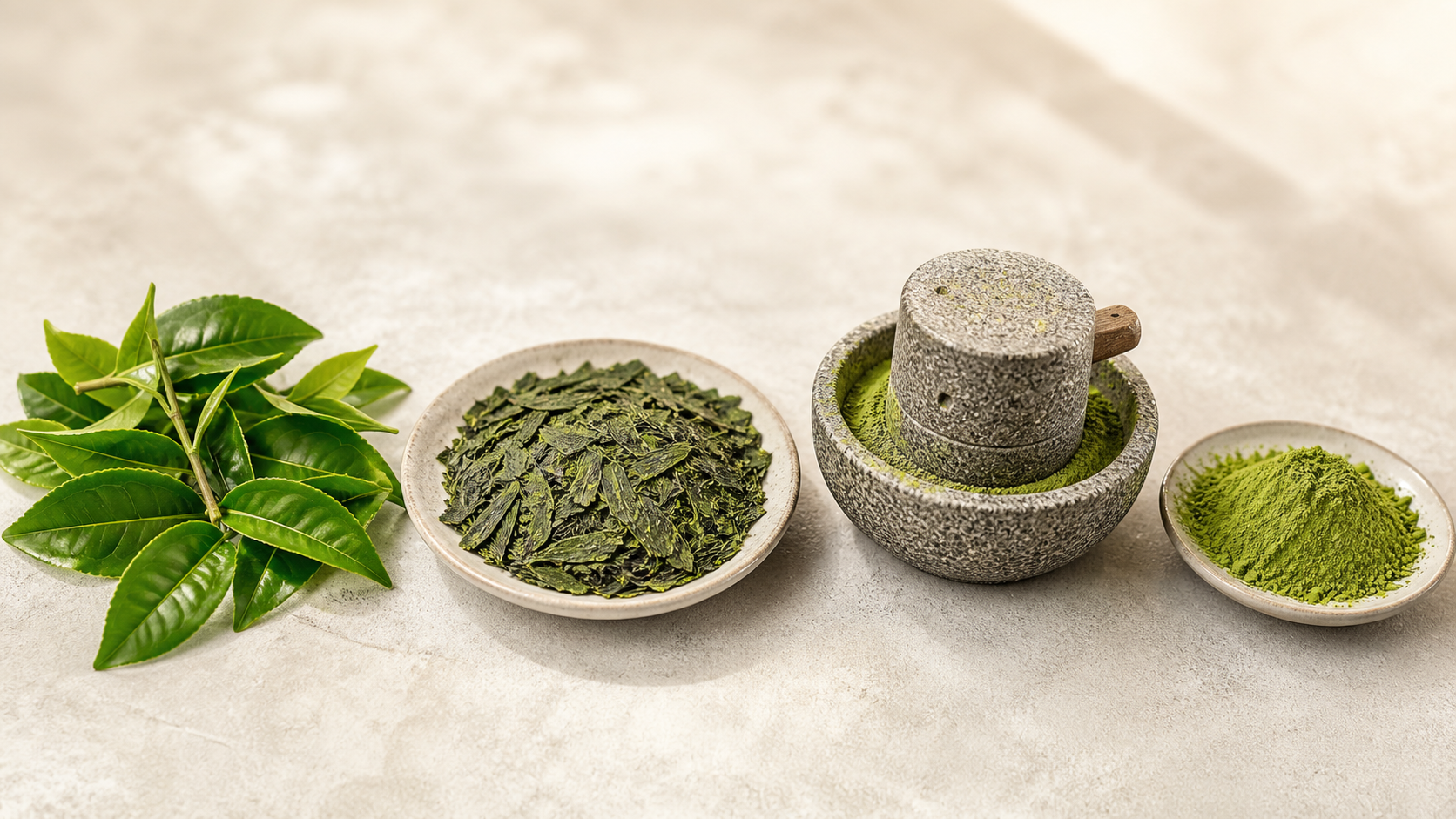
What is inside plain matcha powder?
For an unflavored, single-ingredient product, the ingredient list should identify tea leaf or green tea. Sailtik’s plain matcha ingredient declaration is “fresh tea leaves.” Because the leaf is milled and consumed, matcha forms a suspension in water rather than an infusion that is filtered away.
| Product on the label | Typical composition | Key question |
|---|---|---|
| Plain matcha powder | Finely ground processed tea leaf | Is it a one-ingredient product, and how was the leaf produced? |
| Matcha latte mix | Matcha plus sugar, dairy or plant ingredients, flavors or carriers | What percentage is matcha, and which allergens apply? |
| Flavored matcha | Matcha plus flavorings, fruit powders, spices or sweeteners | Are all additions declared and supported? |
| Instant matcha beverage | May include tea extract, carriers and other soluble ingredients | Is it whole-leaf powder, extract or a formulated blend? |
| Powdered green tea | Ground green tea from a potentially different raw-material process | Does its production match the buyer’s required matcha definition? |
From tea leaf to matcha
The public abstract for ISO/TR 21380:2022 describes matcha through its plant source, cultivation, production and characteristics, and excludes flavored, blended, decaffeinated and soluble products from that report’s scope. In the established Japanese description, the raw leaf is shade-grown, steamed, dried without sencha-style rolling, refined into tencha and finely ground.
- Tea plants are cultivated: the intended raw material begins with Camellia sinensis; shading and field management influence later color and flavor.
- Leaves are harvested: harvest season, maturity and selection affect fiber, bitterness, aroma and cost.
- Oxidation is stopped: heat fixation preserves the green-tea character.
- Leaf is dried and refined: unwanted stems, veins or coarse material may be removed according to the process.
- The refined leaf is milled: grinding produces the fine particles used for whisked tea, drinks and food applications.
- The powder is protected and released: packing, storage and lot testing help control moisture, odor pickup, color loss and safety requirements.
The Japan Matcha Association describes matcha as powdered tencha and distinguishes it from powdered sencha. Japan’s Ministry of Agriculture also describes matcha as powdered tencha. These sources are useful for understanding the classical Japanese production definition; they do not mean every product sold internationally has Japanese origin.
Is matcha just ground-up green tea?
Matcha is a powdered green tea, but “just grind any green tea” is too broad. Sencha, gunpowder tea and other green teas can be milled, yet their cultivation, rolling, refining and sensory behavior may differ. For purchasing, verify the supplier’s raw-material and process description instead of relying only on a vivid green photo or the word “matcha.”
Read the broader what-is-matcha guide for the differences among identity, grade, origin, taste and use.
Does matcha contain stems or veins?
Refining aims to separate coarse stems and veins from the leaf material used for higher-quality powder, but the exact raw material and degree of refinement vary by producer and product tier. A buyer should not infer refinement from “ceremonial grade,” because ceremonial and culinary grade names are not globally standardized.
Are sugar or milk naturally in matcha?
No. Plain matcha leaf powder does not inherently contain added sugar or milk. A sweet café drink may contain sugar from syrup, sweetened powder or milk, and a premixed latte powder may contain dairy ingredients. That is why the ingredient list and allergen declaration—not the drink name—determine what is present.
Does origin change what matcha is made from?
The plant remains Camellia sinensis, but cultivar, climate, soil, shade practice, harvest and processing can change the powder’s color, aroma, taste and cost. “Uji,” “Japan,” “China,” “Guizhou” and “Zhejiang” are origin statements, not ingredient names. They must be stated truthfully and supported by supply-chain records.
Sailtik supplies China-origin matcha from Guizhou or Zhejiang. It does not describe those products as Japanese or Uji matcha. Within each Sailtik grade, multiple internal origin models may be available for testing, but the internal model codes are not published.
What is physically present in the powder?
Because matcha is ground leaf, it naturally contains the leaf’s structural material and constituents, including carbohydrate, protein, fat, fiber, minerals, caffeine, amino acids and polyphenols in amounts that vary by raw material and test method. A generic nutrition article cannot tell you the exact composition of a commercial lot. Use the product’s specification, nutrition information and lot-specific certificate of analysis where relevant.
Do not treat color as a chemical analysis. Lighting, camera processing, particle size, age and storage can all change appearance. Likewise, “organic,” “non-GMO,” “halal” and contaminant claims require their own documents; they cannot be proved by the ingredient line alone.
Label and specification checklist
- Product name: plain matcha, powdered green tea, latte mix, extract or flavored blend?
- Ingredient list: one tea ingredient or multiple components?
- Origin: actual country and region where relevant, without borrowed Uji or Japan language.
- Process: cultivation, fixation, drying, refining and milling description appropriate to the claim.
- Application: straight drinking, latte, baking, ice cream or industrial formulation.
- Lot identity: matching product, batch and dates across the label, CoA and reports.
- Safety and claims: allergen, heavy metals, pesticides/mycotoxins, non-GMO, halal or organic evidence as applicable.
Sailtik can provide, as applicable to the selected product and transaction, an Allergen Declaration, CoA, Food Safety Management System Certificate, Halal Certificate, Heavy Metals Test Report, Non-GMO Declaration, Pesticide / Mycotoxin Residue Test Report and SDS. Use the matcha document guide to check scope, product identity and dates.
Frequently asked questions
Is matcha made from grass?
No. The vegetal aroma can remind people of grass, but matcha is made from tea leaves of Camellia sinensis.
Is matcha made from seaweed?
No. Marine or seaweed-like sensory notes can occur, but seaweed is not the ingredient in plain matcha.
Why does matcha not dissolve completely?
It is fine leaf powder, not a fully soluble extract. Whisking and shaking disperse the particles; settling over time is normal.
What is Sailtik matcha made from?
Sailtik’s plain matcha ingredient declaration is fresh tea leaves, with offered origins in Guizhou or Zhejiang, China. Confirm the selected grade, origin model, lot documents and final label for the actual order.
Verify the powder, not just the name
For samples, Sailtik selects relevant internal models according to the buyer’s business model, recipe and target color or flavor; it does not automatically send every model. Each selected model sample is normally 10 g. Contact Carol with the intended drink or food application, dose, expected volume and destination for a focused recommendation.