
Matcha is a finely ground green tea powder made from Camellia sinensis leaves grown and processed for powdered-tea use. Unlike ordinary brewed tea, the leaf particles remain in the drink: matcha is dispersed in water or milk rather than steeped and removed.
That is the useful short answer to “what is matcha?” The more precise answer requires separating four questions that search results often mix together: what the product is, how it was produced, where it came from and whether its quality suits a particular use. Those are related, but none can safely substitute for the others.
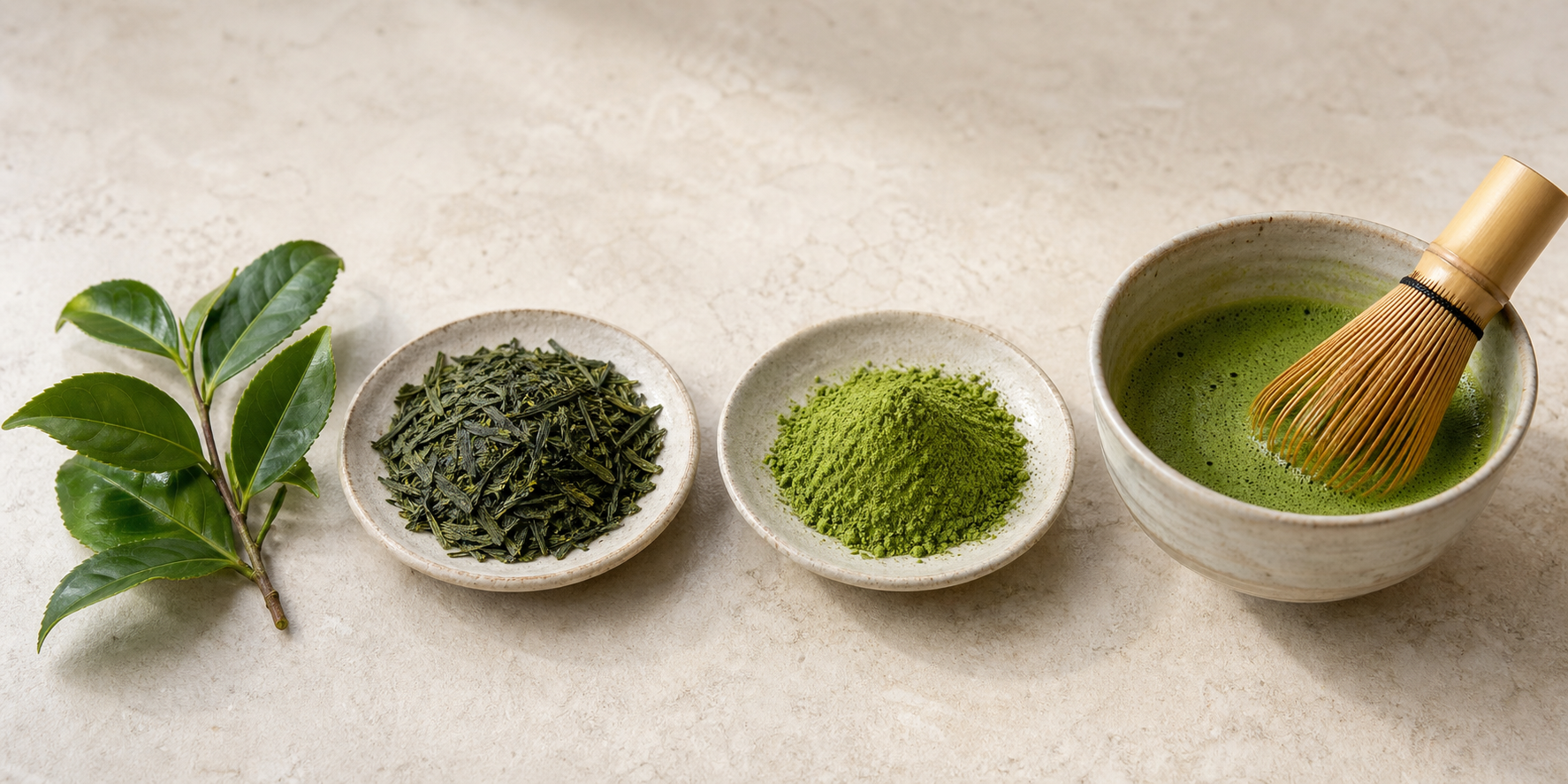
What is matcha made of?
Plain matcha should contain tea leaf—not milk powder, sugar, flavoring or green coloring. Sailtik’s plain matcha ingredient declaration is “fresh tea leaves.” A “matcha latte mix,” “matcha beverage powder” or flavored blend can contain additional ingredients, so the product name alone is not enough: read the ingredient list.
| Product description | What it may contain | What to verify |
|---|---|---|
| Plain matcha powder | Finely ground tea leaf | Ingredient statement, origin, process and specification |
| Matcha latte mix | Matcha plus sugar, milk ingredients, flavors or carriers | Full ingredient order, allergens and matcha percentage |
| Flavored matcha | Matcha plus flavoring or other plant powders | Identity of every added ingredient and claim support |
| Instant or soluble matcha drink | Extracts, carriers or formulated powders | Whether it is leaf powder, extract or a blend |
| Powdered green tea | Finely milled green tea that may follow a different raw-material process | Whether the supplier’s definition and process meet your market requirement |
A standards-aware definition
The public abstract for ISO/TR 21380:2022 describes an internationally agreed matcha definition based on plant source, cultivation and production methods, and covers the characteristics relevant to international trade. It does not apply to flavored, blended, decaffeinated or soluble matcha products.
In the classical Japanese description, shaded tea leaf is steamed, dried without the rolling used for sencha, refined as tencha and then finely ground. The Japan Matcha Association summarizes matcha as powdered tencha and distinguishes it from powdered sencha. Japan’s Ministry of Agriculture likewise describes matcha as powdered tencha.
Matcha is closely associated with Japanese tea culture, but “Japanese” and “Uji” are origin claims, not ingredients. Matcha is also produced in China and elsewhere. A truthful seller should name the actual origin rather than borrowing a famous place name. Sailtik supplies China-origin matcha from Guizhou or Zhejiang and does not present it as Japanese or Uji matcha.
How matcha is produced
The exact equipment and terminology vary, but the commercial sequence is broadly:
- Cultivation: tea plants are managed for the intended raw-material and flavor target; shading is central to established matcha production definitions.
- Harvest: leaf maturity, season and selection affect color, fiber, flavor and cost.
- Heat fixation: steaming or another documented heat process stops enzymatic oxidation.
- Drying and refining: moisture is reduced and unsuitable stems, veins or leaf material may be separated.
- Grinding: refined material is reduced to a fine powder while heat, hygiene and particle characteristics are controlled.
- Blending and packing: lots may be blended for consistency, then protected from moisture, oxygen, heat, light and odors.
- Testing and release: the supplier checks the agreed sensory, specification and safety requirements for the lot.
For a detailed stage-by-stage explanation, see how matcha is grown and produced.
Is matcha the same as green tea?
Matcha is a type of green tea, but it is not interchangeable with every green tea.
| Question | Matcha | Typical leaf green tea |
|---|---|---|
| Plant species | Camellia sinensis | Camellia sinensis |
| Form | Fine leaf powder | Whole or broken processed leaves |
| Preparation | Dispersed and consumed with the liquid | Infused, then leaves are removed |
| Raw-material process | Produced for powdered-tea use; established definitions include shading and non-rolled dried leaf | Varies by tea type and commonly includes rolling or shaping |
| Texture | Suspended particles; may settle | Filtered infusion |
| Commercial behavior | Color, mouthfeel and dispersion matter in the final recipe | Extraction time and filtration are central |
This is why matcha does not truly dissolve like sugar. Fine particles disperse through the liquid and can settle with time. Sifting and controlled whisking improve dispersion; they do not convert leaf into a molecular solution.
What does matcha taste like?
Matcha can combine vegetal, fresh, savory or umami, sweet, creamy, nutty, marine, astringent and bitter notes. The balance changes with leaf material, cultivation, processing, freshness, storage, water, dose and the final recipe. A premium straight-tea powder may be too delicate or expensive for a strongly sweetened latte; a robust café powder may perform better through milk.
Color is also useful but not conclusive. Camera processing, lighting, dose and milk can all change what “bright green” looks like. Compare samples under the same light and recipe, then record flavor, aroma, mouthfeel, color and aftertaste separately.
What is matcha used for?
| Use | Performance priorities | Sailtik grade starting point |
|---|---|---|
| Straight whisked tea | Low harshness, clean aroma, refined mouthfeel | 6A–7A |
| Premium latte or signature café drink | Color, milk penetration, balanced bitterness and cost per cup | 4A–5A |
| Everyday café drinks | Repeatability, visible green color and recipe economy | 3A–4A |
| Ice cream and premium desserts | Flavor strength after dairy, sugar and cold serving | 3A–5A |
| Daily baking or budget milk tea | Heat/flavor survival and ingredient cost | 1A–2A |
| Premium private-label retail | Drinkability, visual position and brand economics | 5A–7A |
These are application starting points, not universal industry grades. “Ceremonial” and “culinary” are used inconsistently across sellers. Sailtik’s 1A–7A system is an internal positioning framework, and the internal model codes are not public. See the matcha grade guide before comparing two suppliers’ grade names.
How much matcha goes in one drink?
Sailtik recommends testing 1.5–3 g per cup. The right dose depends on cup size, milk, sweetness, ice dilution and the powder’s flavor strength. At that range, a 1 kg bag represents about 333–666 theoretical drinks before normal preparation loss. Use the matcha dose calculator and testing guide to model a real menu.
How to verify a matcha product
- Identity: confirm whether it is plain leaf powder, a blend or an extract-based product.
- Origin: request the actual country and, where relevant, region; never infer Uji or Japan from green packaging.
- Process: ask how the raw material was grown, heat-fixed, dried, refined and ground when those details matter to your claim.
- Application: test at the real dose in the real milk, sweetener, bakery formula or frozen dessert.
- Lot documents: match the product name, lot or batch, dates and specification across the CoA and supporting reports.
- Claims: verify organic, non-GMO, halal, allergen and origin statements independently rather than treating one certificate as proof of everything.
Sailtik can provide, as applicable to the selected product and transaction, an Allergen Declaration, CoA, Food Safety Management System Certificate, Halal Certificate, Heavy Metals Test Report, Non-GMO Declaration, Pesticide / Mycotoxin Residue Test Report and SDS. Review the document checklist and supplier due-diligence guide.
Frequently asked questions
Is matcha powdered green tea?
Yes, but the phrase is incomplete. Established matcha definitions also concern how the tea was cultivated and processed. Grinding any finished green tea does not automatically give it the same identity or sensory behavior as matcha.
Does matcha come only from Japan?
No. Japan is central to matcha’s culture and major production traditions, while China and other countries also produce matcha for international trade. Origin must be stated truthfully. Sailtik’s offered matcha is from Guizhou or Zhejiang, China.
Is matcha an instant tea?
Plain matcha is finely milled leaf and forms a suspension; it is not inherently a soluble tea extract. Products marketed as instant matcha may be formulated differently, so inspect the ingredient list and technical description.
How should matcha be stored?
Keep it moisture-proof, away from light, at low temperature and protected from odors, following the product label. Sailtik’s general shelf-life reference is 18 months for the unopened product, subject to the specific label, package and batch.
Choose matcha by use, then verify the lot
Sailtik’s standard bulk packs are 1 kg, 5 kg and 10 kg aluminum-foil bags, with no fixed minimum for standard bulk supply; larger shipments are usually more freight-efficient. Selected samples are 10 g per model, but Sailtik does not send every internal model automatically. Contact Carol with your business model, application, target taste and color, dose, volume and destination so the sample set can be narrowed intelligently.