
Yes, matcha can leave a visible green mark or residue. Whether that mark becomes a persistent stain depends on what was spilled, the material and finish underneath it, how long it remains, and what happens afterward. A fresh splash on a smooth washable surface is a different problem from dried matcha on an absorbent or delicate material.
Why matcha can leave a mark
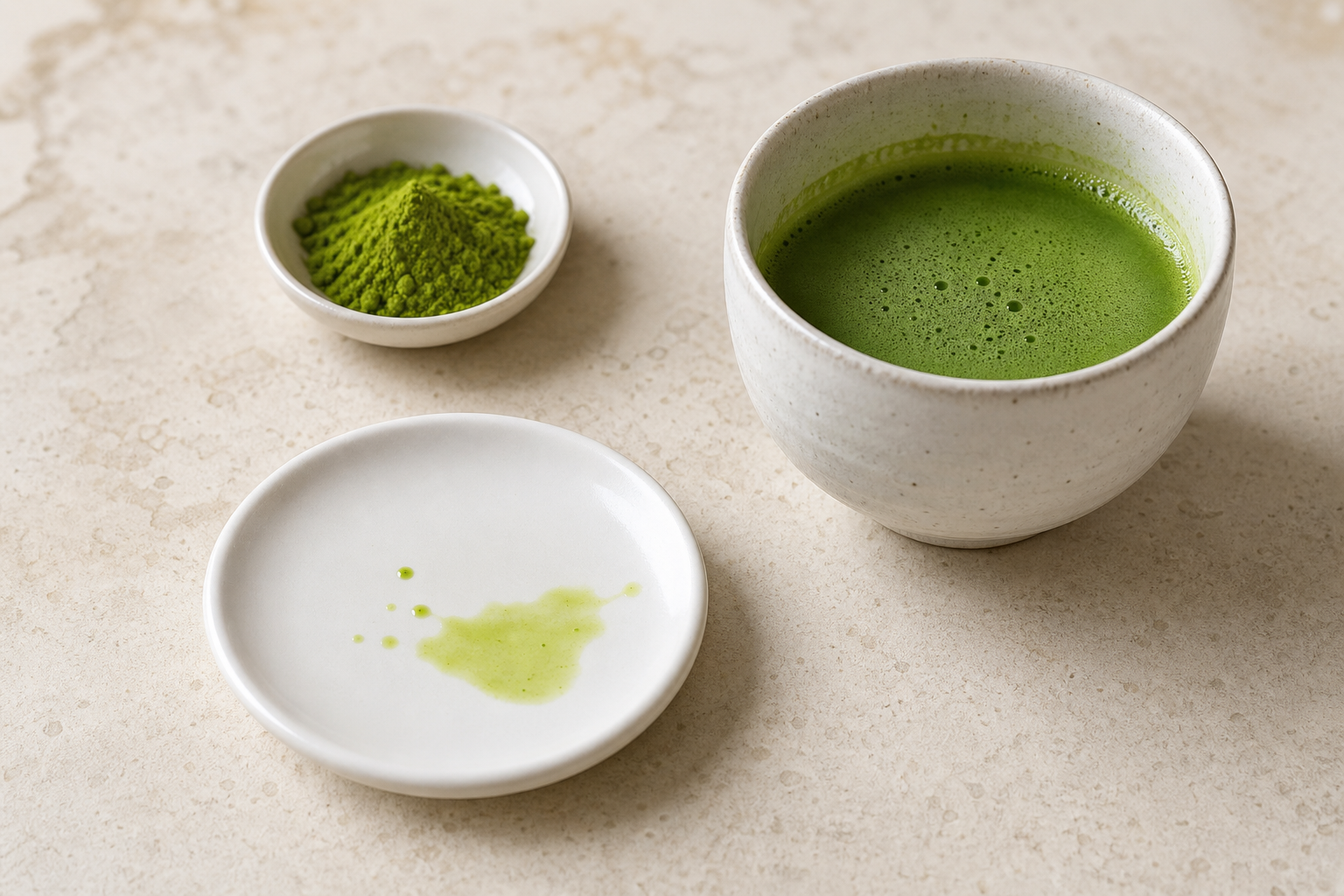
Matcha is not a clear tea infusion. It is finely ground tea material dispersed in water, so a spill carries suspended leaf particles as well as naturally colored plant compounds. Matcha’s green appearance is associated with pigments including chlorophyll. When the liquid evaporates, some of that solid material can remain on or within the contacted surface.
The International Organization for Standardization defines matcha through its tea-plant source, cultivation and production methods, including processing and grinding. That whole-powder format helps explain why a matcha splash can behave differently from a weak, filtered infusion: there is physical leaf material in the drink.
Residue, discoloration and a permanent stain are not the same
- Surface residue sits on top of a material and may disappear with ordinary appropriate cleaning.
- Temporary discoloration remains visible after a quick wipe but can still be removable with treatment suitable for that material.
- A persistent stain remains after normal cleaning because color-bearing material has entered pores, fibers, scratches or an altered finish.
- Material damage is a change to the finish or substrate itself. It should not be assumed merely because a green mark is visible.
This vocabulary matters. Online claims that matcha “stains everything” often combine all four outcomes, while claims that it “does not stain” may refer only to an easily washed cup. Neither absolute statement accounts for the contacted material.
What changes the outcome?
| Factor | Why it matters |
|---|---|
| Porosity and absorbency | Liquid and fine particles can enter some materials more readily than a smooth intact finish. |
| Surface condition | Wear, cracks, unsealed areas and scratches can retain residue differently from an undamaged surface. |
| Contact time | A mark left to dry is generally a different cleaning problem from a spill addressed promptly. |
| Recipe | Milk, syrup, fruit puree, fat and other ingredients can change the residue; not every “matcha stain” is caused by matcha alone. |
| Later treatment | Rubbing, heating or applying an incompatible cleaner can change the mark or the underlying material. |
| Background color | The same residue is more noticeable on pale surfaces than on dark or patterned ones. |
Does matcha tea stain differently from dry powder?
They create different messes. Dry powder can lodge in texture and spread when brushed or wetted. Prepared matcha carries the particles into a liquid splash. A latte adds milk and often sweetener, while a flavored café drink may include fruit, syrup or foam. The correct response should be based on the complete spill and the care requirements of the contacted item—not only the word matcha.
Are matcha stains permanent?
Not necessarily. A visible green spot does not prove permanent coloration. Some marks are removable residue, while others become harder to remove after drying or entering an absorbent material. There is no honest universal promise because “anything” can mean washable ceramic, upholstery, unfinished wood, a coated worktop, clothing or a medical/dental material—each with different care limits.
For a valuable, delicate, sealed or manufacturer-warranted item, follow its care instructions or consult the manufacturer or a qualified cleaner. An aggressive household remedy that works on one surface can bleach, etch, fade or otherwise damage another.
What should you do immediately?
Remove excess liquid without spreading it, identify the material, and consult its care label or maintenance guidance before applying a cleaner. Avoid treating an unknown finish as if it were ordinary washable fabric. Detailed removal instructions should be specific to the surface and spill ingredients; a general matcha article cannot safely replace those instructions.
What this answer does not cover
Dental enamel, aligners, braces and composite bonding are not household surfaces and should be considered separately. The existing matcha teeth-staining evidence review addresses natural teeth. Likewise, fabric removal, cup buildup, and stone or countertop care require material-specific methods rather than one universal stain recipe.
Bottom line
Matcha can leave green residue or discoloration because the drink contains finely ground tea material and natural pigments. That does not mean every splash is permanent. The outcome depends on the complete recipe, surface, finish, contact time and treatment. Treat “does it stain?” as the first question; the next question must be “what exactly did it touch?”