
If one level teaspoon of matcha weighs 2 g, a literature-based estimate is about 38–89 mg of caffeine. That range uses published matcha values of 18.9–44.4 mg caffeine per gram. It is not a universal label value: teaspoon weight, powder composition and batch testing all vary.
The short calculation
A scientific review summarized matcha caffeine concentrations of approximately 18.9–44.4 mg/g. Multiplying that range by an assumed 2 g teaspoon gives:
- Low estimate: 2 g × 18.9 mg/g = 37.8 mg
- High estimate: 2 g × 44.4 mg/g = 88.8 mg
- Practical rounded range: about 38–89 mg caffeine
A randomized study provides a useful real-product check: its 2 g matcha serving contained 66.2 mg caffeine. That value falls inside the literature range, but it describes the study material rather than every matcha sold.
Why a teaspoon is not an exact dose
A teaspoon measures volume. Caffeine calculations require mass and product concentration. A spoon can be level, rounded, heaped, packed or loosely filled. Powder density, clumping, moisture and the spoon’s actual capacity change the number of grams it holds.
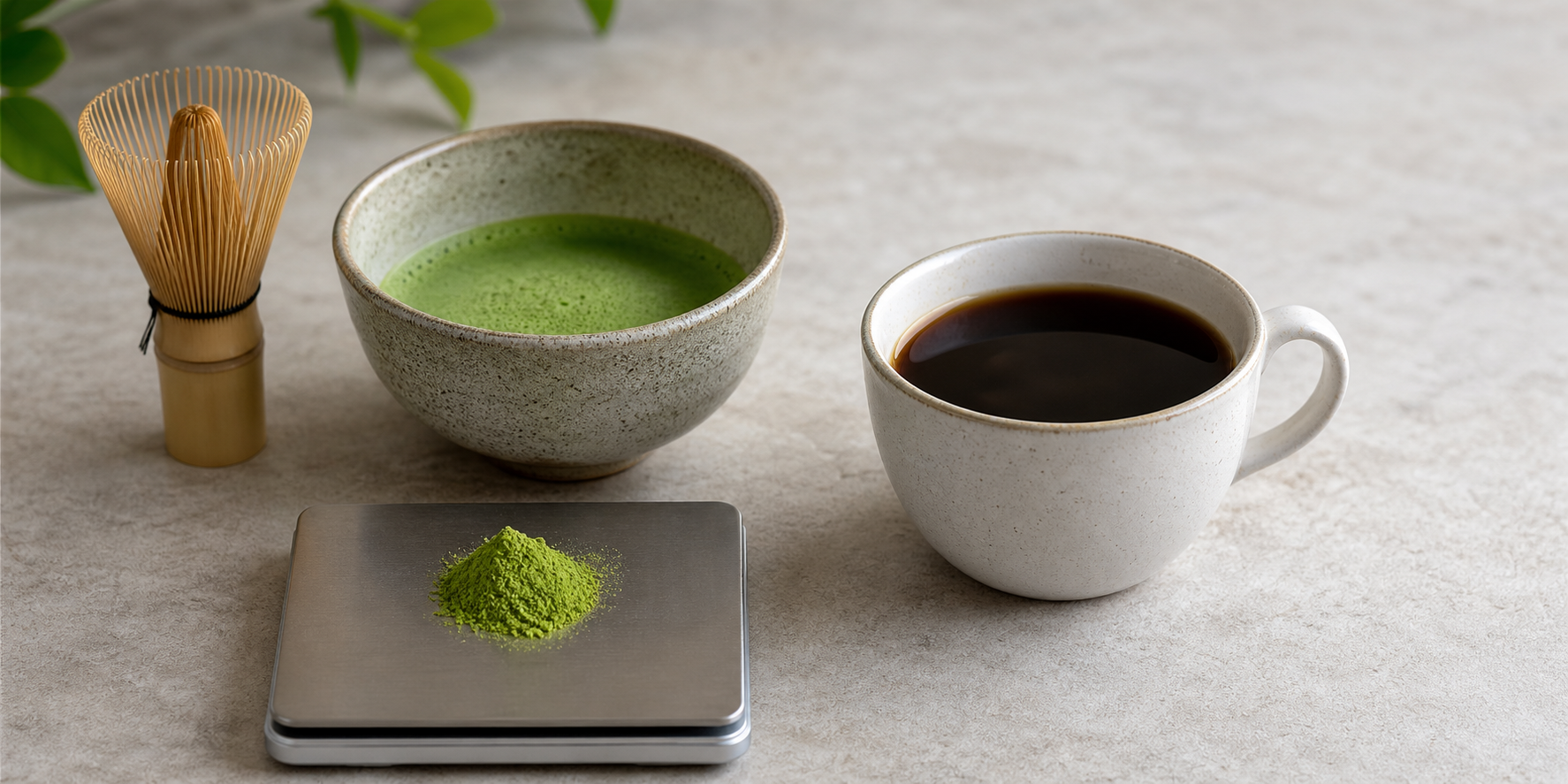
That means “one teaspoon” does not automatically equal 2 g. The 38–89 mg answer is useful only when the spoonful really weighs about 2 g. For a repeatable drink, place the empty cup or dish on a gram scale, tare it, then weigh the powder. A 0.1 g scale is much more informative than judging the spoon by eye.
Use this formula for your weighed teaspoon
Estimated caffeine (mg) = matcha mass (g) × caffeine concentration (mg/g)
If the powder weighs 2 g and the supplier has a relevant result of 33 mg/g, the calculation is 66 mg. If no product-specific result exists, a literature range can illustrate uncertainty but should not be presented as a tested specification. The broad matcha caffeine guide explains the underlying range and comparison with coffee.
What changes the caffeine number?
- Leaf material: cultivar, leaf age, harvest and growing conditions can influence natural caffeine concentration.
- Product type: plain matcha is not equivalent to a sweetened matcha mix or a product blended with other ingredients.
- Actual mass: a dense or heaped teaspoon can contain more powder than a loose level spoon.
- Batch variation: tea is agricultural material, so a result from another product or lot may not transfer.
- Other caffeine sources: espresso, coffee concentrate, chocolate and added caffeine must be counted separately.
Water and milk change drink volume but do not erase caffeine already contributed by the powder. A large cup can therefore contain less caffeine than a small cup if it uses less matcha, and the reverse can also be true.
How this compares with common online answers
Current first-page results often give a single value near 60–70 mg, while others publish much wider ranges. The strongest pages explain the assumed powder weight and acknowledge product variation. Weaker answers silently treat every teaspoon as 2 g and every matcha as chemically identical.
The honest answer therefore has two layers: approximately 38–89 mg for an assumed 2 g serving using the cited literature range, and an unknown exact value until the powder is weighed and its caffeine concentration is supported by appropriate data.
Caffeine safety context
The U.S. Food and Drug Administration cites 400 mg per day as an amount not generally associated with negative effects for most adults, while emphasizing that sensitivity and caffeine elimination vary widely. That is a general reference, not a target and not personalized medical advice.
Count coffee, tea, energy drinks, chocolate, supplements and medicines together. Too much caffeine can contribute to insomnia, anxiety, jitters, nausea, upset stomach, headache, increased heart rate or palpitations. People who are pregnant, breastfeeding, taking medicines, managing a health condition or especially caffeine-sensitive should obtain individualized guidance.
For cafés and private-label buyers
Use grams in recipes, costing sheets and staff training. Do not advertise an exact caffeine value based on a household spoon or a competitor’s number. A quantitative label or menu claim may require product- and lot-appropriate analytical support plus qualified regulatory review.
Sailtik recommends testing roughly 1.5–3 g per cup for its Chinese-origin matcha, depending on the application and target profile. That recipe range is not a caffeine specification. Buyers can contact Carol with the intended drink, target taste, color, cost and volume to receive a focused 10 g sample shortlist.
Frequently asked questions
Is one teaspoon of matcha always 2 grams?
No. Two grams is a convenient assumption used in many examples, but the actual mass depends on the powder and how the spoon is filled. Weigh it.
Can color or grade tell me the caffeine amount?
No. Appearance and a marketing grade cannot replace a relevant caffeine measurement.
Does adding milk reduce the caffeine?
No. Milk changes the recipe and total volume, but it does not remove the caffeine contributed by the matcha dose.