
A fruit matcha latte works when the fruit is bright enough to be recognizable, the matcha remains present after milk and sweetener, and the recipe is measured rather than improvised. Strawberry is the most familiar version, but mango, blueberry, raspberry, peach, banana, vanilla, lavender and other flavors can use the same development framework.
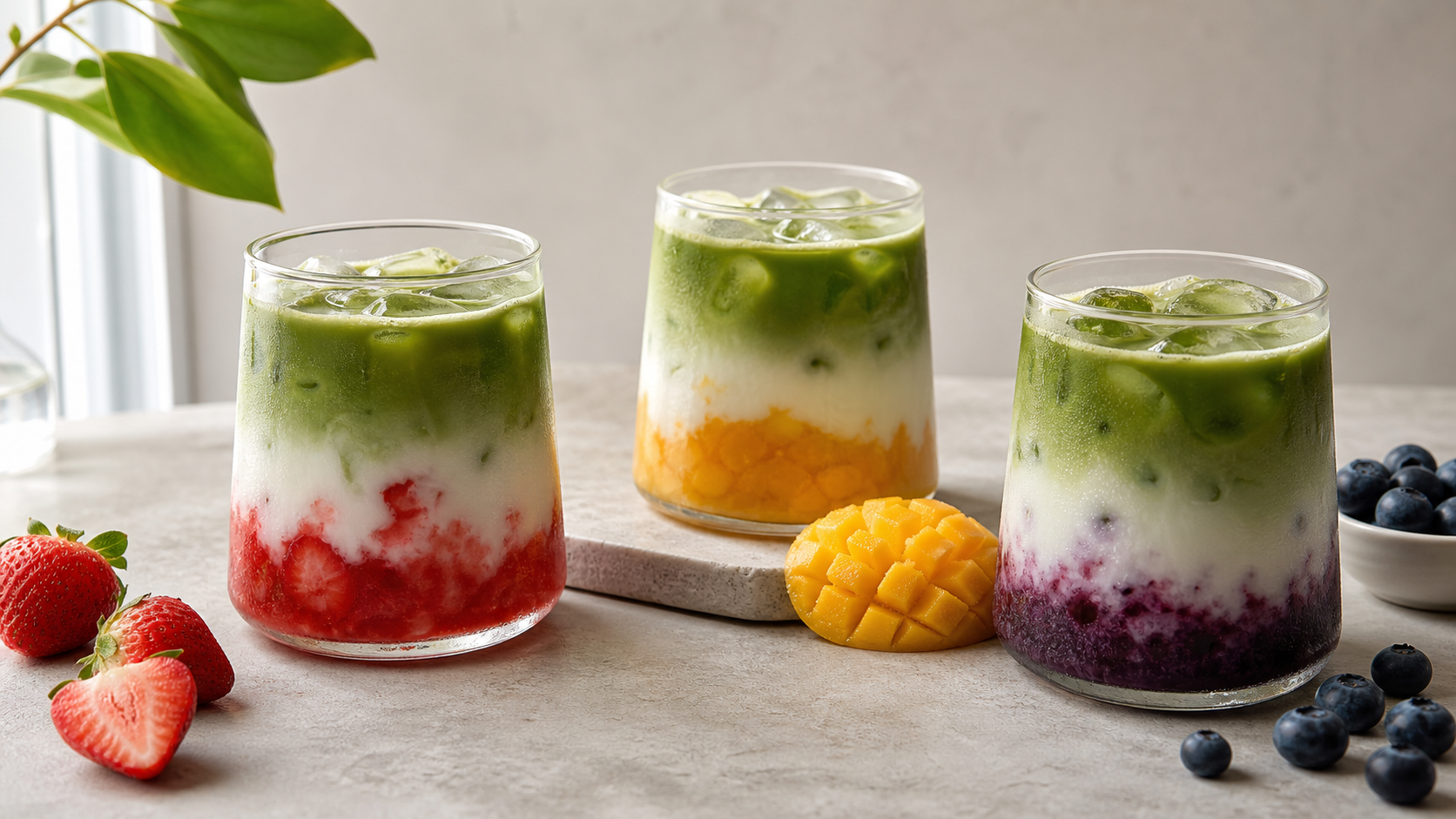
A reliable strawberry matcha starting formula
For one 12–16 fl oz iced drink, begin with the following test formula. Treat it as a development baseline, because glass volume, ice, fruit solids, milk and powder strength all change the result.
- Matcha: 2 g
- Water: 40–50 g at approximately 70–80°C
- Strawberry puree or café fruit base: 25–40 g
- Milk: 140–180 g
- Ice: enough to reach the defined finished fill line
- Additional sweetener: only after tasting the complete drink
- Weigh the strawberry base into the bottom of a clean glass.
- Add ice carefully so it forms a barrier rather than splashing fruit up the sides.
- Pour in the measured milk.
- Sift the matcha, make a smooth paste with part of the water, add the remainder and whisk or froth until evenly suspended.
- Pour the matcha slowly over the ice for a temporary layered appearance.
- Serve with an instruction to stir before drinking; the designed flavor balance assumes the layers are combined.
Matcha does not dissolve like instant coffee, so settling is normal. A smooth concentrate and prompt service matter more than excessive foam. For alternate tools, see how to make matcha with or without a whisk.
Puree, syrup, powder or cold foam?
| Flavor system | Strength | Trade-off | Best control |
|---|---|---|---|
| Fresh or frozen fruit puree | Recognizable fruit texture and variable natural acidity | Seasonal variation, seeds, separation and short handling window | Weigh fruit, sugar and final yield; standardize texture |
| Commercial puree | More consistent color and fruit percentage | Cost and refrigeration after opening | Record supplier lot, open date and portion |
| Syrup | Fast service and repeatable sweetness | May taste candy-like and can overwhelm matcha | Use pumps only after calibrating grams per pump |
| Fruit powder | Dry storage and concentrated flavor/color | Clumping and uneven rehydration | Pre-disperse and specify powder-to-liquid ratio |
| Flavored cold foam | Aroma and visual finish at the top | Extra labor, equipment and allergen handling | Define foam batch size, hold time and portion |
A puree and a syrup are not interchangeable gram for gram. Puree adds water, acid, pulp and variable sugar; syrup mainly adds dissolved sugar and flavor. If a café switches systems, it should rebuild the formula rather than merely replace one ingredient.
How to make strawberry puree for matcha
For a small test, blend clean hulled strawberries with a measured amount of sugar. Record raw fruit weight, sugar weight and finished yield. Strain only if the menu requires a smoother texture. A cooked base may be more uniform and jam-like; an uncooked base usually tastes fresher but requires especially careful refrigerated handling.
A commercial café must establish its own approved food-safety procedure under applicable local rules. Do not copy a home recipe’s “keeps for several days” statement into a business process. Fruit condition, pH, sugar, heating, cooling, container sanitation and refrigerator performance all matter. Label batches, prevent cross-contact and discard according to the validated plan.
Why fruit and milk sometimes separate
Acidic fruit can destabilize dairy or some plant beverages, producing visible flecks or curdling. That may be a texture defect even when the ingredients are otherwise fresh. Test the exact fruit base, milk brand, temperature and proportions. Keeping a dense fruit layer separate until service can delay the effect visually, but stirring still exposes the milk to the acid.
Do not describe separation as proof that a drink is spoiled, and do not assume it is harmless without checking ingredient condition and time-temperature control. Product development and food-safety decisions are related but not identical.
Flavor directions beyond strawberry
- Mango matcha: ripe tropical sweetness and dense puree can support a slightly more assertive matcha dose. Control pulp so the drink remains straw-friendly.
- Blueberry or raspberry matcha: vivid berry acidity can sharpen astringency; adjust fruit and sweetness before reducing the tea.
- Peach matcha: delicate aroma is easy to bury. A clean syrup or strained puree may work better than a heavy base.
- Banana matcha: banana supplies body and sweetness but oxidizes and can make a latte smoothie-like. It is a different operational format from a clear layered drink.
- Vanilla matcha: vanilla can round bitterness without adding fruit acid. Measure extract or syrup carefully; excess reads perfumed.
- Lavender matcha: use a food-grade culinary ingredient and a restrained dose. Floral flavor can become soapy quickly.
- Rose, coconut or ube combinations: attractive color and aroma are possible, but allergens, ingredient names and customer expectations must remain clear.
How to choose matcha for a fruit latte
The most expensive grade is not automatically the best economic choice. Fruit, milk and sugar can conceal subtle aroma while emphasizing bitterness or color. Test a small set of samples at the same matcha dose and complete recipe. Judge the stirred drink, not only the green layer before mixing.
- Does matcha remain identifiable after fruit and milk?
- Does its bitterness balance sweetness or create a harsh finish?
- Does the green remain attractive after five minutes and after stirring?
- Does the powder disperse reliably with the café’s tool?
- What is ingredient cost per sellable cup at the passing dose?
- Can the supplier provide consistent lots and appropriate documents?
Sailtik generally positions 3A for café drinks and premium baking, 4A for premium café drinks, and 5A for ceremonial and high-end drink applications. Those are internal commercial positions, not universal industry grades. Use the matcha comparison guide for preparation fundamentals and test the actual samples.
A café recipe-development matrix
Change one variable at a time. A compact first trial can use matcha at 1.5 g, 2 g and 2.5 g crossed with fruit base at 25 g and 35 g. Hold water, milk, ice and glass constant. That creates six drinks and reveals whether more powder or less fruit improves balance. If sweetness must change, run it as a second experiment.
| Record | Why it matters |
|---|---|
| Ingredient weights and finished yield | Reproduction and cost per cup |
| Matcha dispersion and sediment | Service consistency |
| Fruit identity, sweetness and acidity | Flavor balance |
| Color before and after stirring | Customer expectation |
| Five-minute texture | Realistic drinking experience |
| Ticket time and waste | Operational feasibility |
Calories, sugar, caffeine and allergens
A strawberry matcha latte is not automatically low-calorie or “healthy.” Plain matcha contributes relatively little energy at a normal dose, but puree, syrup, sweetened concentrate, milk and cold foam determine much of the finished nutrition. Calculate from the exact ingredient specifications and portions. The drink still contains caffeine from matcha; fruit flavor does not remove it.
Milk ingredients and toppings can introduce allergens. Plant beverages are not automatically allergen-free, and shared frothers, blenders and utensils may create cross-contact. Follow applicable labeling and food-service requirements. See the matcha nutrition guide for a component-by-component method.
What about Starbucks or Dunkin strawberry and lavender matcha?
Chain menus, app customizations, prices and seasonal drinks change by country, store and date. A social-media order may be an unofficial customization rather than a named menu item. Check the brand’s current official app or local menu before traveling or quoting ingredients. Our U.S. chain matcha menu guide explains how to verify current information and recreate a flavor direction without claiming an exact proprietary formula.
Sampling for a fruit-matcha program
Sailtik recommends testing approximately 1.5–3 g per cup. Ten-gram samples are selected from suitable internal models after Carol understands the fruit system, milk, sweetness, cup size, target cost and expected volume; every model is not sent automatically. Bulk formats are 1 kg, 5 kg and 10 kg foil bags. Contact Carol with a written formula or target flavor to narrow the test efficiently.
Frequently asked questions
What does strawberry matcha taste like?
A balanced version combines strawberry aroma and acidity with creamy milk and matcha’s vegetal, umami, bitter and astringent notes. The result can range from fresh and fruit-forward to sweet and dessert-like depending on the fruit system.
Can I put vanilla extract in matcha?
Yes. Use a food-grade extract, measure a very small trial dose and increase only after tasting. Vanilla aroma can dominate matcha quickly.
Does strawberry matcha have caffeine?
Yes, if it contains matcha. The amount depends mainly on the matcha dose and product composition; strawberry, milk and ice do not remove the caffeine contributed by the powder.