
Matcha is tea, not coffee, and “chai” needs a definition before the three drinks can be compared. Matcha is powdered green tea dispersed in liquid. Coffee is brewed from roasted coffee seeds. In many languages chai simply means tea; on a U.S. café menu, “chai” usually means a spiced black-tea drink or latte. Caffeine and nutrition depend on the actual recipe, not the name on the menu.
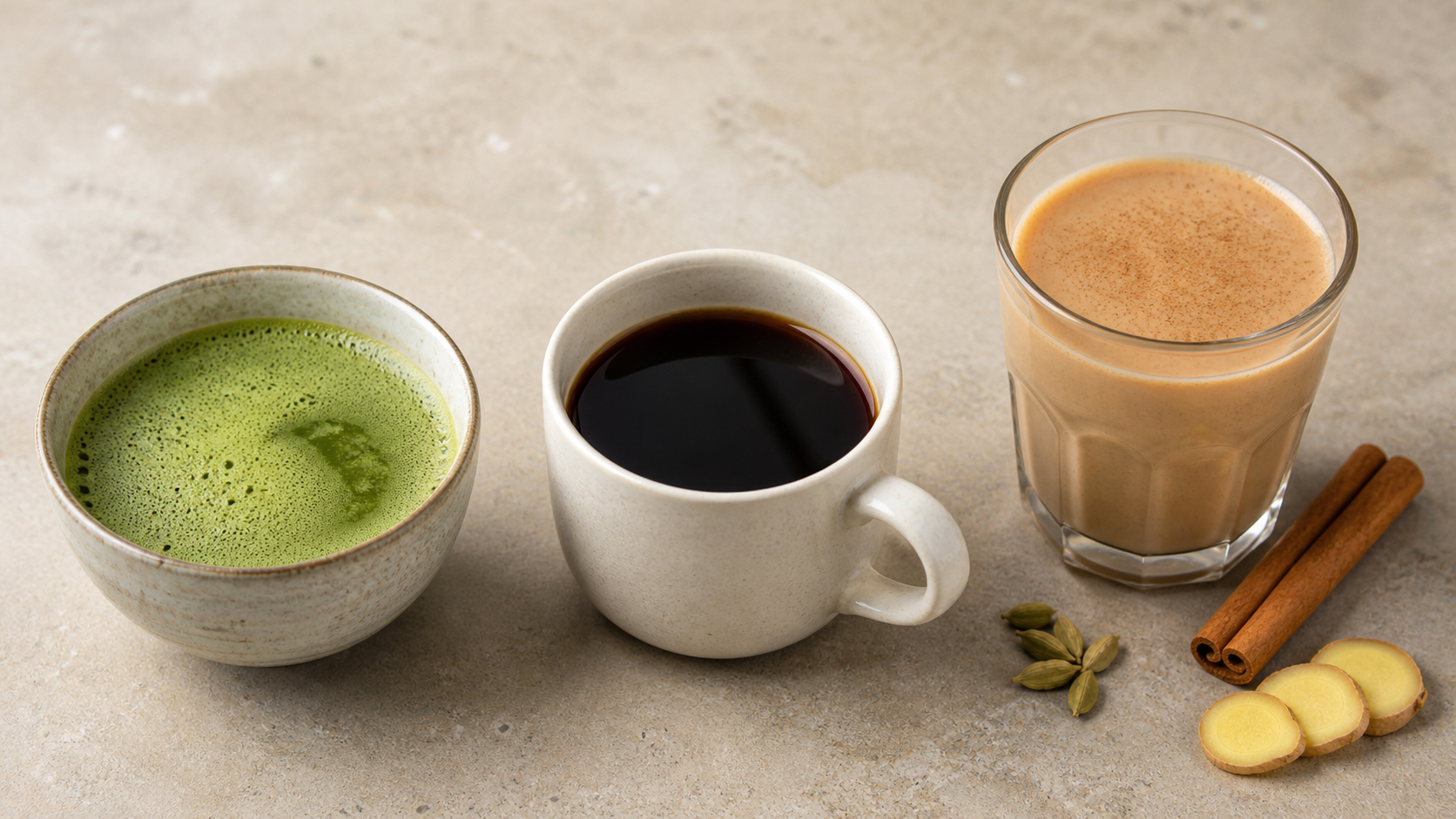
Matcha, coffee and chai at a glance
| Factor | Matcha | Coffee | Café-style chai |
|---|---|---|---|
| Base | Powdered green tea leaf | Roasted coffee brewed with water | Usually black tea plus spices; may be a concentrate |
| Typical taste | Vegetal, umami, sweet, bitter and astringent | Roasted, bitter, acidic, fruity, chocolate or nut notes | Tea, spice, sweetness and milk; formula varies widely |
| Body | Suspended fine particles; full for tea | Varies from light filter coffee to concentrated espresso | Often creamy when served as a latte |
| Main caffeine control | Grams and composition of powder | Coffee dose, brew method and serving volume | Tea type, concentrate strength, portion and dilution |
| Added sugar | None in plain powder; optional in recipe | None in black coffee; optional in recipe | Often present in premade concentrate or café recipe |
Which has more caffeine?
Coffee often has more caffeine than a moderate matcha serving, but neither category has one fixed number. The U.S. Food and Drug Administration lists typical caffeine amounts of 113–247 mg for 12 fluid ounces of regular brewed non-specialty coffee and 37 mg for 12 fluid ounces of green tea. Those category examples do not determine what is in an espresso drink, cold brew, bottled chai or café matcha.
A scientific review reported approximately 18.9–44.4 mg caffeine per gram of matcha. Therefore, a 1.5 g recipe may be estimated at roughly 28–67 mg and a 3 g recipe at roughly 57–133 mg. The wide range is the important point: cultivar, leaf, production and testing differ, while doubling the powder doubles the calculated caffeine from that powder.
Chai is especially difficult to estimate by name. A chai brewed from black tea has caffeine, but the amount changes with tea mass, water temperature and steep time. A liquid concentrate may contain brewed tea, extract, sugar and spices, then be diluted with milk. A caffeine-free herbal “chai” can contain no tea at all. Check the product specification and recipe.
Why serving size creates misleading comparisons
“One cup” may mean a small bowl of matcha, an 8-ounce filter coffee, a 12-ounce café drink or a 16-ounce iced latte filled partly with ice. Espresso is concentrated but served in a small volume. Milk dilutes caffeine per ounce but does not remove caffeine from the espresso, tea concentrate or matcha already used. Ice changes beverage concentration and yield, not the starting caffeine dose.
For an honest menu comparison, record the grams of matcha, dry coffee or tea; brewed output or concentrate portion; number of espresso shots; finished drink size; and supplier caffeine data where available. The caffeine calculation guide shows how to label estimates without false precision.
Does a matcha latte contain coffee?
A standard matcha latte contains matcha, water and milk, with optional sweetener; it does not inherently contain coffee. A drink combining matcha with espresso or brewed coffee is often called a dirty matcha, matcha espresso or matcha coffee. Names vary, so a café should list espresso explicitly and train staff to answer, especially because customers may be controlling caffeine.
Adding matcha to coffee is technically possible. The challenge is sensory balance: roast bitterness, matcha astringency, milk and sweetness can compete. Build the matcha concentrate and coffee separately, measure both, then combine. See the dirty matcha café guide for recipe testing.
Is matcha healthier than coffee or chai?
There is no universally healthiest choice. Plain matcha, plain brewed coffee and unsweetened brewed tea are different from sweetened lattes made with syrups and large milk portions. Calories, carbohydrate, sugar, saturated fat and allergens are properties of the full formula. A premixed chai concentrate may contribute substantial added sugar, while another chai may be brewed unsweetened from tea and spices.
Matcha contains tea catechins, caffeine and amino acids; coffee contains caffeine and other compounds including chlorogenic acids; chai spices add flavor and may contribute compounds of their own. The presence of a compound does not prove that one café serving will prevent disease or produce a particular mental state. Matcha-specific clinical evidence is still limited, and results from extracts or isolated ingredients should not be presented as guaranteed beverage effects.
The FDA states that 400 mg caffeine per day is an amount not generally associated with negative effects for most adults, but sensitivity varies. Pregnancy, breastfeeding, age, medicines and health conditions can change appropriate intake. People seeking medical or nutrition advice should consult a qualified professional. Read the matcha nutrition guide to separate plain powder from a finished latte.
What about “calm energy” and the coffee crash?
Matcha naturally contains caffeine and L-theanine, and controlled research has examined their effects on attention. That does not justify promising that every person will feel calm, avoid jitters or never experience a crash. Response depends on dose, habitual caffeine use, sleep, food intake, genetics, medicines and expectations. A strongly dosed matcha can still cause caffeine-related symptoms in a sensitive person.
Coffee is often described as acidic, but “matcha is alkaline and therefore gentle” is not a dependable health rule. Beverage pH, titratable acidity, milk, serving size and individual conditions are different variables. Someone with reflux, anxiety, palpitations or another concern should not substitute a marketing comparison for medical advice.
Taste: choose by the menu occasion
- Matcha: recognizable green color, vegetal aroma, umami and enough bitterness or astringency to balance milk when the grade and dose fit.
- Coffee: broad roast and origin spectrum, familiar breakfast demand and a strong relationship with espresso-based milk drinks.
- Chai: warming aromatic spices and an accessible sweet-milk profile; the tea character can be light or assertive depending on concentrate.
None is inherently premium. A carefully brewed coffee may be more expensive than a weak matcha, and a fresh house-made chai may be more labor-intensive than a bottled base. Quality should be judged against the intended drink, price point, service speed and customer expectation.
A practical café test
- Define one finished size, hot and/or iced.
- Write the exact base dose: matcha grams, espresso shots or chai-concentrate grams.
- Hold milk, ice and sweetness constant where a direct sensory comparison is intended.
- Record ingredient cost, preparation time, waste and cleaning time.
- Blind-taste aroma, first sip, mid-palate, sweetness, bitterness, spice, aftertaste and texture.
- Check appearance immediately and after five minutes.
- Calculate caffeine only from defensible supplier or analytical data and label estimates as estimates.
- Test customer wording: staff must explain whether “chai” is sweetened and whether “matcha coffee” contains espresso.
Which should a café add?
Coffee addresses a mature daily habit. Chai offers a spice-led, often sweet alternative that can be operationally simple when a concentrate is used. Matcha adds a visually distinctive tea platform that can support straight drinks, lattes, fruit combinations and desserts. The strongest menu may offer more than one, provided each earns its place through demand, margin and execution.
| Decision | Measure |
|---|---|
| Customer fit | Requests, trial conversion and repeat purchase |
| Recipe performance | Flavor at the actual milk and sweetness level |
| Operations | Ticket time, training, shelf life after opening and waste |
| Economics | Ingredient cost per sellable cup, not package price alone |
| Communication | Accurate caffeine, sugar, allergen and ingredient information |
Sourcing matcha for comparison
Evaluate matcha in the finished recipe rather than buying from color or grade language alone. For a latte, test whether the tea remains recognizable through milk and sweetener at an economical dose. Request traceability, ingredient statement, certificate of analysis and relevant food-safety documentation. Store the powder sealed, moisture-proof, protected from light and away from odors.
Sailtik recommends testing approximately 1.5–3 g per cup. It supplies Chinese-origin matcha from Guizhou or Zhejiang in 1 kg, 5 kg and 10 kg foil bags. Ten-gram samples are selected from suitable internal models after the intended business format, recipe, target price and volume are understood; not every model is sent automatically. Contact Carol with those details for a sample recommendation.
Frequently asked questions
Is matcha coffee or tea?
Matcha is powdered green tea. It contains no coffee unless coffee or espresso is added to the recipe.
Does matcha have less caffeine than coffee?
It often does at a moderate powder dose compared with a typical brewed coffee, but the ranges overlap. A strong 3 g matcha can contain more caffeine than a weak or small coffee. Compare the actual recipe and product data.
Does chai or matcha have more caffeine?
Either can, depending on matcha grams and the chai’s tea or concentrate dose. Some herbal chai is caffeine-free; black-tea chai is not. The label and recipe are more informative than the name.
Can you mix matcha and coffee?
Yes. It is commonly called dirty matcha or matcha espresso. The drink contains caffeine from both ingredients, so the doses should be counted together.