
To make one smooth iced matcha latte, sift 2–2.5 g matcha, whisk it with 40 ml warm water, add optional sweetener, then pour it into a 12 fl oz / 355 ml glass with 180 ml cold milk and a measured amount of ice. Stir before drinking.
The reliable trick is to make a small matcha concentrate before it meets cold milk and ice. Matcha disperses; it does not dissolve like sugar. Starting with dry powder in a crowded cold glass is the most common route to floating clumps.
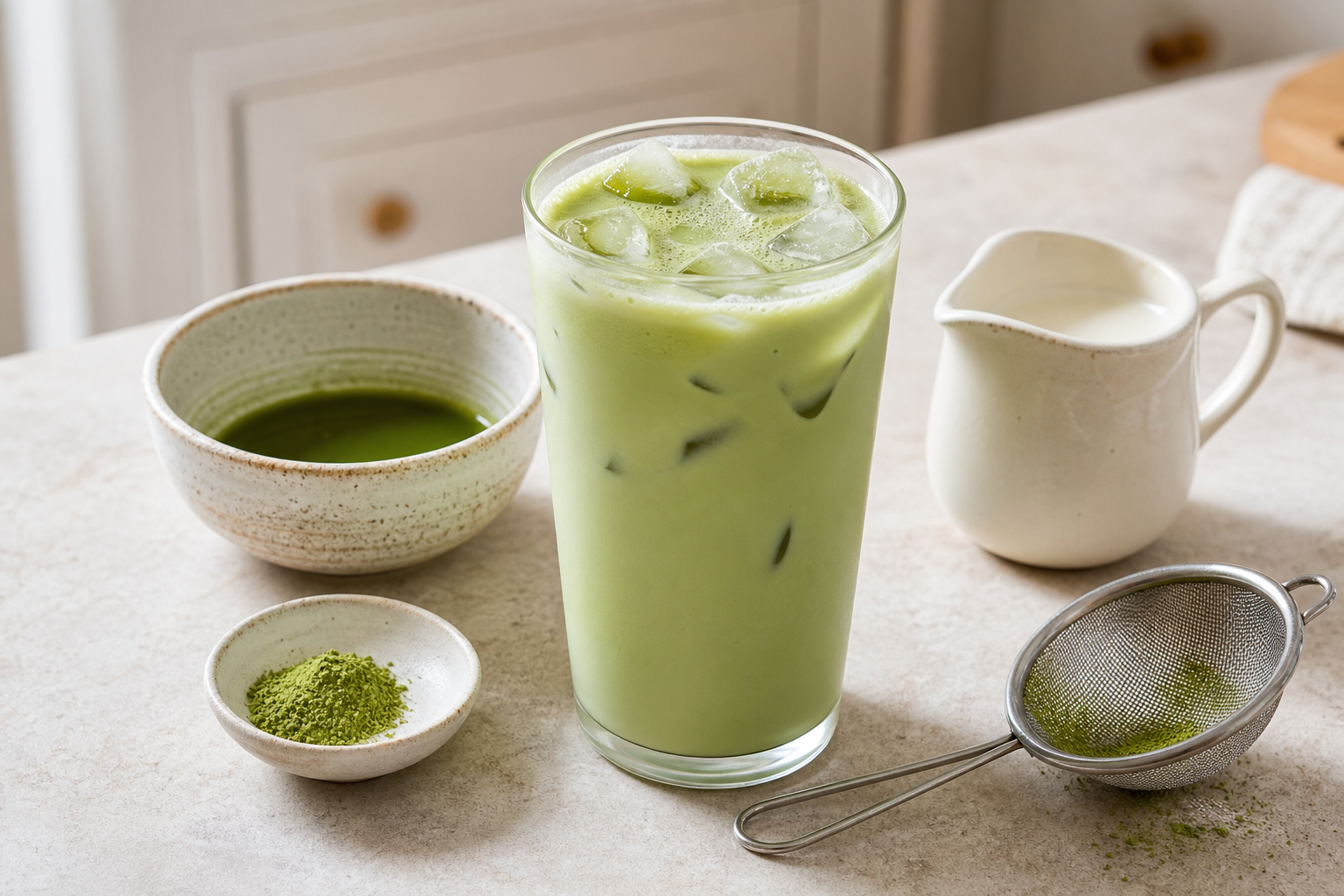
Iced matcha latte ingredients
| Ingredient | Starting amount | Why it is measured |
|---|---|---|
| Matcha | 2–2.5 g | Gives a repeatable strength; use 1.5–3 g when testing |
| Warm water | 40 ml at roughly 70–80°C / 158–176°F | Enough to disperse powder without excessively diluting the latte |
| Cold milk | 180 ml | Works as a controlled starting ratio for dairy or plant milk |
| Sweetener | 0–15 g | Optional; record it separately from matcha strength |
| Ice | Enough to fill the service glass | Weigh it during recipe testing because melt changes flavor |
This formula makes one approximately 12 fl oz drink including ice. Glass geometry and ice size change the actual liquid capacity, so use weights and volumes when comparing versions rather than relying on how full the glass looks.
How to make an iced matcha latte step by step
- Sift 2–2.5 g matcha into a dry bowl, cup or small pitcher. Break up any compacted powder.
- Add 40 ml warm water. Avoid boiling water for the first trial because it can emphasize harshness in some powders.
- Whisk for 15–20 seconds. Move rapidly until the base is uniform and no dry pockets remain. Fine foam is optional; smooth dispersion matters more.
- Add measured sweetener. Dissolve granulated sugar while the base is warm, or use a liquid sweetener.
- Fill the glass with a repeatable amount of ice and add 180 ml cold milk.
- Pour in the matcha concentrate. The layers are visual; stir or shake before drinking for a consistent first sip.
No bamboo whisk? Use one of these methods
| Tool | Method | Watch for |
|---|---|---|
| Handheld frother | Froth the sifted matcha and water in a tall narrow vessel | Keep the head below the surface at first to prevent splashing |
| Sealed jar or shaker | Add matcha and water, seal, then shake vigorously | Do not seal dangerously hot liquid; use warm or cool water |
| Small kitchen whisk | Use a wide cup and whisk briskly | Sifting becomes especially useful because the wires are less fine |
| Blender | Best reserved for several servings or a deliberately blended drink | Extra foam and warming can change texture |
Cold water can work with a powerful frother or shaker. Warm water is simply a forgiving way to make a smooth small concentrate. Whichever method you choose, keep it consistent before deciding that one matcha powder performs better than another.
Choose milk and sweetness by testing
Milk affects body, sweetness, aroma and the visible green color. Dairy milk, oat milk, soy milk, almond milk and coconut milk can all work, but their brands and formulations differ. A sweetened plant milk may already supply enough sweetness before syrup is added.
Run a simple three-cup test: use the same matcha dose and change only the milk. Then repeat with the winning milk at zero, medium and target sweetness. This separates powder quality from recipe preference.
How to keep an iced latte from tasting watery
- Use a small concentrate: 40 ml water is enough to disperse the powder without starting with a diluted base.
- Chill the milk: warm milk melts more ice before service.
- Measure the ice: cube size, freezer temperature and hold time all change melt.
- Serve promptly: a drink photographed for several minutes will not taste like the first version.
- Adjust one variable: reduce water or milk before adding extra matcha indiscriminately.
Troubleshooting
| Problem | Likely reason | Controlled fix |
|---|---|---|
| Clumps | Unsifted powder or dry matcha added directly to milk and ice | Sift and make the separate concentrate first |
| Weak tea flavor | Low dose, too much milk, strong sweetener or ice melt | Try 2.5–3 g or reduce dilution, one change at a time |
| Too bitter | Powder mismatch, excessive dose or very hot water | Lower the dose or water temperature and compare a latte-suited sample |
| Dull color | Powder, age, storage, milk ratio or lighting | Compare fresh samples in identical recipes and light |
| Settling | Normal suspension behavior | Stir before drinking; avoid unnecessary long holding |
How much matcha should you use?
Sailtik recommends 1.5–3 g per cup as a testing range. For this 12 fl oz iced latte, 2–2.5 g is a practical starting point. A larger cup does not always need a proportional dose because ice, milk and sweetness do not scale linearly in sensory terms.
Use the matcha-per-cup calculator and testing guide for yield and cost planning. The broader hot, iced and café-scale latte guide covers staff trials, batch arithmetic and grade selection.
Frequently asked questions
Can I put matcha straight into cold milk?
You can disperse it with a strong shaker or frother, but stirring dry matcha into cold milk usually leaves clumps. A small separately mixed concentrate is more reliable.
Do I need ceremonial-grade matcha?
No universal grade rule requires it. Grade names are not standardized across suppliers. Test the powder in the actual milk, sweetness, dose and price position rather than buying by the label alone.
Can I make an iced matcha latte without sweetener?
Yes. Sweetener is optional. Milk contributes its own flavor and sometimes added sugar, so taste the complete unsweetened recipe before adjusting.
Can I prepare it in advance?
Matcha settles and milk drinks require appropriate time and temperature control. Make-ahead preparation is a separate workflow; for cafés, use the matcha batch and concentrate guide instead of assuming a finished latte can be held indefinitely.
Sailtik can recommend selected 10 g samples according to a customer’s drink format, target color, milk, sweetness and commercial position. Internal model codes are not published, and the right sample is determined by actual recipe testing rather than a universal “best” label.