
To make matcha taste good, fix the preparation variables before adding more sugar: use fresh powder, measure the dose, sift it, use warm rather than boiling water, keep the water amount controlled, and whisk hard enough to suspend the powder. If the cup is still too sharp, then adjust milk, sweetness, ice or food pairing.
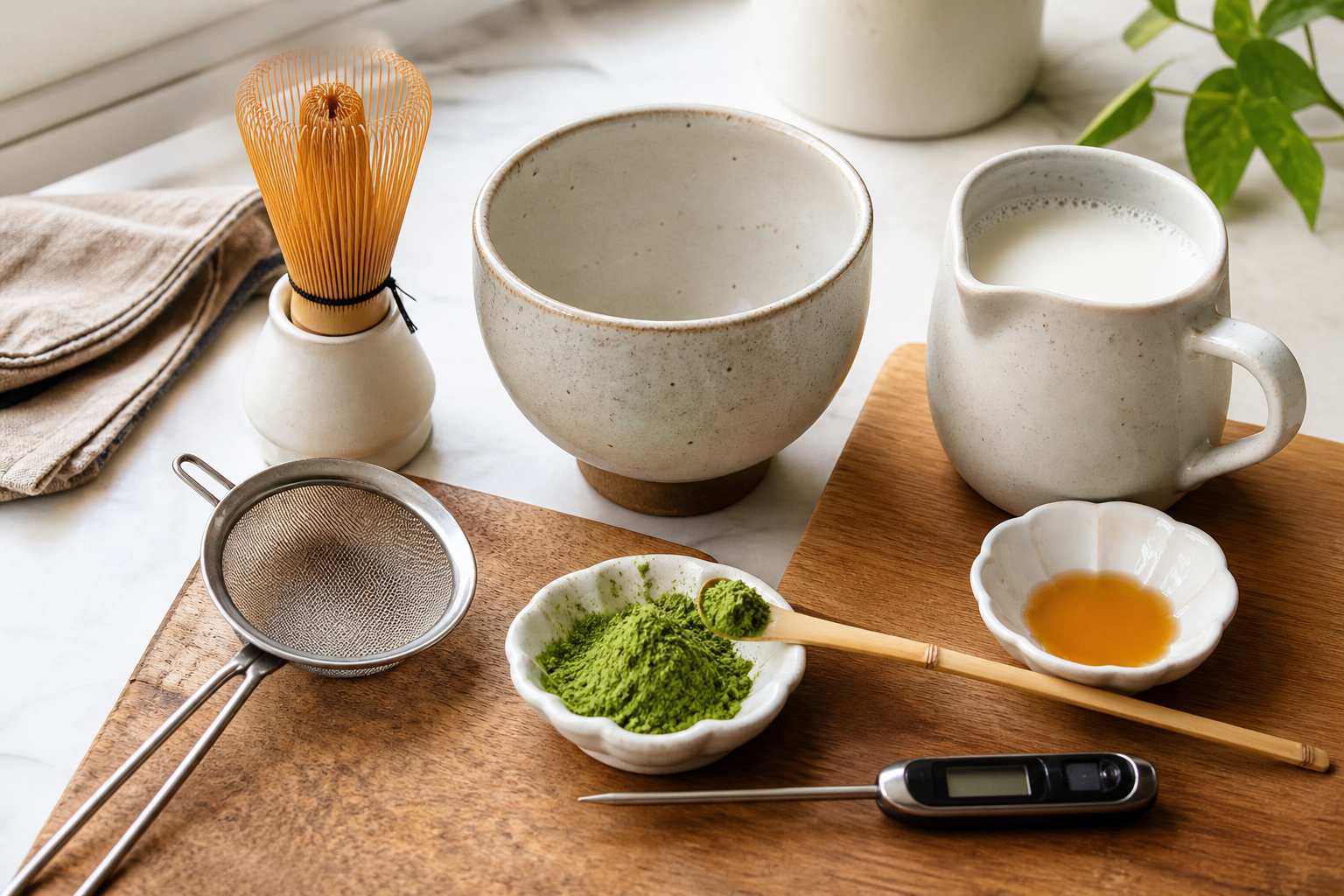
Matcha does not truly dissolve like sugar. It is ground tea leaf suspended in liquid, so flavor and mouthfeel depend on powder quality and on how evenly those fine particles are dispersed. A good recipe can make decent matcha taste cleaner; it cannot turn stale, harsh or badly stored powder into premium tea.
Start with this baseline
For a straight bowl, a controlled starting point is about 2 g matcha with roughly 60 ml water around 80°C / 176°F, then whisk quickly. Ippodo’s current foamy-matcha guide uses 2 g matcha, 60 ml water at 80°C and about 15 seconds of vigorous M-shaped whisking. Treat that as a test baseline, not a law: your powder, bowl, water and taste preference can justify small adjustments.
For a latte, do not pour a huge amount of water over the powder. Make a small smooth concentrate first, then add milk. Too much water at the start can make the drink thin and can make foam harder to build.
Diagnose the bad taste first
| Problem | Likely cause | Best first fix |
|---|---|---|
| Bitter or sharp | Water too hot, too much powder, low-grade or stale powder | Use 70–80°C water, reduce powder slightly, and test a fresher powder. |
| Grassy or seaweed-like | Normal vegetal notes are too dominant for your recipe | Use milk, a small sweetener amount, vanilla, fruit or a food pairing instead of forcing it plain. |
| Clumpy or chalky | Unsifted powder or weak mixing | Sift first, make a paste with a small amount of water, then add the rest and whisk. |
| Watery | Too much water, milk or ice for the powder dose | Use less initial water, increase powder carefully, or reduce dilution from ice. |
| Flat or dull | Old powder, poor storage, too little powder, or too much milk | Use an airtight container, avoid heat and light, and test the powder in water before hiding it in milk. |
| Gritty sediment | Coarser powder, insufficient sifting, or slow drinking after settling | Sift, whisk more thoroughly and drink promptly. |
The order that usually works
- Smell the dry powder. It should smell fresh, green and tea-like. If it smells stale, dusty, fishy or like old hay, recipe changes have limits.
- Measure once by weight. A “teaspoon” can vary when powder is fluffy, compacted or clumped. Use grams while testing.
- Sift into the bowl. Sifting is not decoration; it breaks clumps that later taste chalky.
- Add a small amount of warm water first. Make a smooth paste or concentrate before adding the rest.
- Use warm water, not boiling water. Sailtik’s water-temperature guide uses 70–80°C / 158–176°F as a practical starting range.
- Whisk quickly near the surface. A fast W, M or zigzag motion suspends powder better than slow circles.
- Adjust the final drink. Only after the base is smooth should you tune sweetness, milk, ice or flavor pairing.
If you want plain matcha to taste better
Plain matcha exposes everything: powder freshness, bitterness, astringency, umami, water temperature and texture. Do not begin with a large mug. Use a small bowl, about 2 g powder and controlled water. If it is too intense, add a little more water after whisking rather than starting with a large dilute volume that is hard to foam.
If the flavor is pleasant but strong, that may be normal. If it is harsh, drying and unpleasant even at a normal dose, the issue may be powder quality or storage. Use Sailtik’s matcha flavor guide to separate fresh vegetal character from excessive bitterness or astringency.
If you want a latte to taste better
A latte solves some taste problems and creates others. Milk rounds bitterness, but too much milk can erase the tea. Sweetener makes matcha friendlier, but it can also hide whether the powder was prepared well. Start with a smooth concentrate, then add milk and sweetener in small steps.
For many lattes, 1.5–3 g matcha per finished cup is a practical testing range. Use less for a light drink, more for a larger iced drink, and record the cup size, milk volume and ice amount. If a latte tastes weak, changing the water amount may help before you increase powder cost.
What not to do
- Do not use boiling water as a default. It can make bitterness more obvious.
- Do not keep adding powder blindly. More powder can mean more body, but also more bitterness and astringency.
- Do not skip sifting when texture is the complaint. A frother cannot always rescue dry clumps.
- Do not judge powder only in a sweet latte. Test a small water preparation first so you know what the tea itself tastes like.
- Do not store matcha open near heat, light or strong odors. Stale powder is harder to make taste good.
Bottom line
Make matcha taste good by controlling the base: fresh powder, measured dose, sifting, warm water, small initial water volume and vigorous whisking. Then adapt the finished drink with milk, sweetness or pairing. If a carefully prepared small bowl still tastes harsh or stale, the honest fix is usually a better-stored or better-suited powder, not more sugar.