
Open a matcha café in this order: validate demand, choose the smallest workable operating format, cost a short menu, confirm permits and utilities, test suppliers in the finished recipes, then commit to the lease and inventory. A beautiful concept cannot rescue weak location economics or an inconsistent drink. A controlled test can reveal both before the expensive decisions become difficult to reverse.
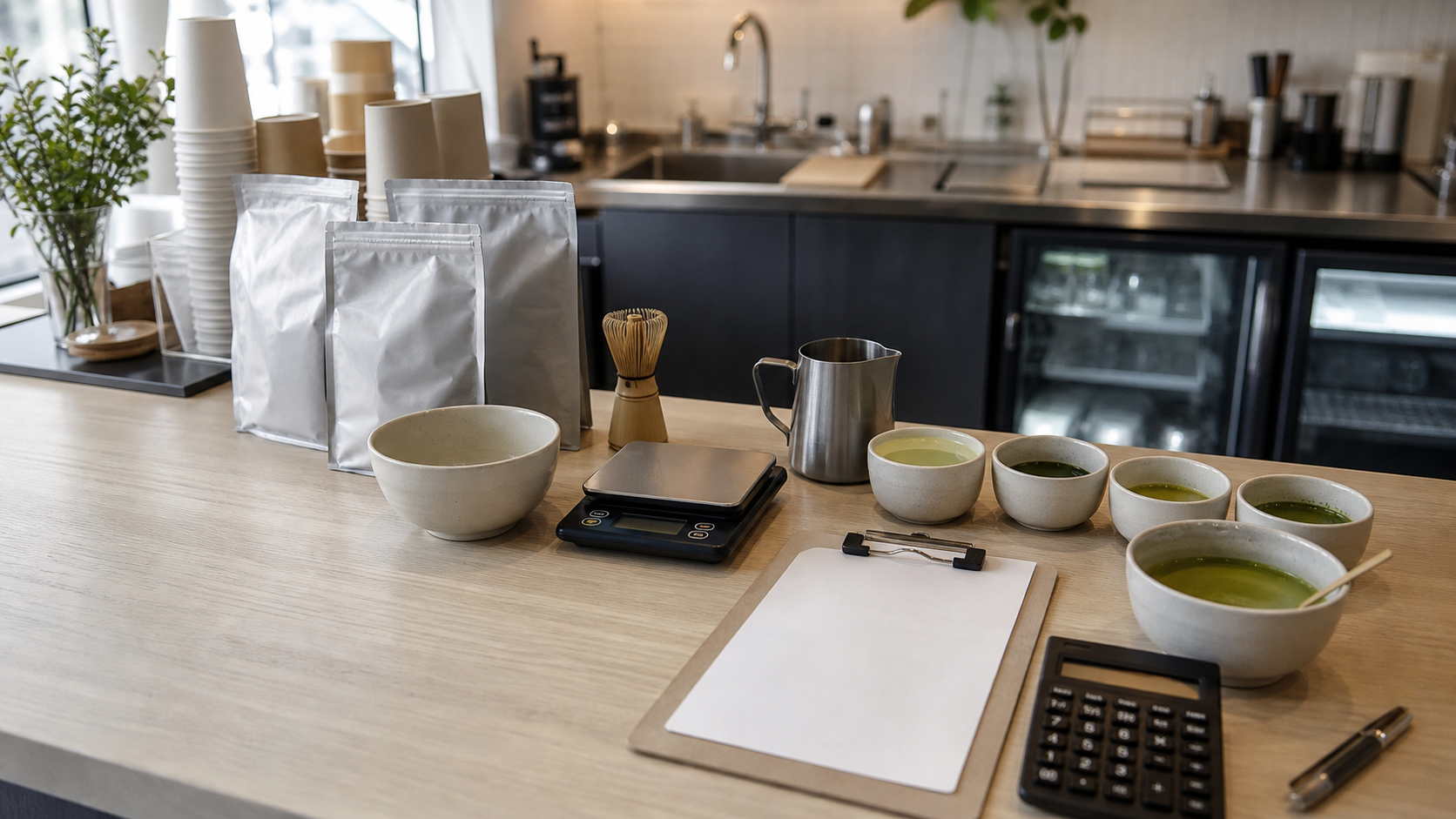
1. Choose the business model before the shop design
| Format | What it tests | Main constraint |
|---|---|---|
| Matcha on an existing café menu | Demand using current rent, staff and traffic | Must fit the existing workflow and brand |
| Market stall or pop-up | Product-market fit, pricing and event demand | Venue rules, weather, utilities and irregular traffic |
| Delivery or shared-kitchen concept | Online acquisition and drink travel quality | Packaging, delivery time and platform fees |
| Matcha kiosk | Focused menu in a small footprint | Storage, water, drainage and peak queue capacity |
| Full specialty café | Complete brand, seating and broader menu | Highest fixed cost and operational complexity |
A first-time operator does not need to begin with the largest format. Run paid tastings or a legitimate permitted pop-up where possible. Track transactions, not social-media likes: conversion, average ticket, repeat purchase, preparation time, waste and the percentage of customers choosing matcha without a discount.
2. Write a business plan that can reject the idea
A useful plan is a decision tool, not a promotional document. Define the customer, trade area, competing occasions, price range, opening hours, service format, staffing, menu, supply route and cash required before break-even. Build a base case, an optimistic case and a downside case.
- Fixed monthly costs: rent, common-area fees, insurance, software, professional services, base payroll and debt obligations.
- Variable cost per drink: matcha, milk, sweetener, flavor, ice, cup, lid, straw, payment fee, delivery commission and expected waste.
- Contribution per drink: selling price minus variable cost.
- Break-even drinks: monthly fixed costs divided by average contribution per drink.
- Capacity check: break-even drinks divided by open days and realistic transactions per hour.
This arithmetic does not guarantee profit. It exposes whether the required traffic fits the location and labor capacity. Do not use a supplier’s claimed “70% margin” as a business forecast unless the definition and every local cost are included.
3. Confirm permits and food-safety requirements early
Requirements vary by country and jurisdiction. In the United States, the FDA’s starting-a-food-business overview explains that restaurants and retail food establishments are generally regulated by state and local authorities, with licenses and permits depending on the product and facility. The FDA also publishes a state retail-food code directory.
Before signing a lease or ordering equipment, ask the authority having jurisdiction about zoning, plan review, food-establishment permits, sinks, water, drainage, refrigeration, ventilation, employee hygiene, allergen procedures, waste, accessibility and inspections. Obtain professional legal, tax, insurance and food-safety advice appropriate to the site. This guide is operational education, not a permit determination.
4. Start with a small menu architecture
A launch menu can prove the concept with four platforms rather than twenty unrelated recipes:
- Straight matcha: reveals powder quality and gives customers a low-sugar option.
- Classic hot or iced latte: establishes the core milk recipe and training standard.
- One fruit or seasonal latte: creates visual interest while sharing the same matcha base.
- One signature drink: differentiates the café but must remain fast and costed.
Add sizes only when they are operationally clear. Every size needs its own matcha, milk, syrup, ice and fill-line specification; scaling only the milk can make a large drink taste weak. Use the hot and iced matcha latte guide and fruit-matcha development guide as starting frameworks.
5. Build a recipe specification, not a barista suggestion
- Weigh matcha to 0.1 g rather than relying on a heaped spoon.
- Specify water mass and temperature range.
- Define the dispersion tool, vessel and mixing time.
- Record milk, syrup, puree, ice and finished cup weight.
- Taste immediately and after five minutes.
- Measure preparation time and cleaning time during a realistic queue.
- Calculate ingredient cost from the actual passing formula.
Sailtik’s recommended starting range is approximately 1.5–3 g per cup. At that range, one kilogram theoretically supplies about 667 drinks at 1.5 g or 333 drinks at 3 g before training loss, spills and unusable residue. Use the dose and yield calculator for exact planning.
6. Choose café equipment by throughput
| Equipment | Purpose | Selection question |
|---|---|---|
| 0.1 g resolution scales | Powder dosing and recipe control | Are they fast, stable and easy to clean? |
| Fine sifter | Breaks dry agglomerates | Can it be cleaned and dried between use? |
| Bamboo whisk or electric frother | Disperses matcha | Which produces the required texture at peak volume? |
| Bowls or tall mixing vessels | Contains whisking and splashes | Does the geometry match the tool? |
| Hot-water system | Controlled concentrate preparation | Can staff obtain a repeatable temperature safely? |
| Refrigeration and ice | Milk, fruit and cold service | Does capacity hold under the busiest hour? |
| Approved warewashing setup | Cleaning and sanitation | Does it meet local plan-review requirements? |
A bamboo whisk is useful for tasting and presentation, while a suitable electric frother may be faster for a latte station. A blender can support batches but adds sanitation, foam and holding questions. Test the workflow before buying multiples. See five matcha preparation methods.
7. Evaluate matcha suppliers with a written brief
Send each potential supplier the same information: country of sale, business type, hot and iced cup sizes, milk and sweetness, target matcha dose, target cost per drink, expected monthly usage, preferred origin, packaging and required documents. Then compare like with like.
- Confirmed origin and traceability
- Ingredient statement and allergen information
- Lot-specific certificate of analysis where appropriate
- Food-safety system documentation
- Heavy-metals and pesticide/residue evidence appropriate to the purchase
- Shelf life, storage and opened-pack handling
- Pack sizes, minimum order, lead time and shipping terms
- Lot consistency and process for approving a replacement lot
Do not choose from color photos alone. Lighting, camera processing and screen settings make them unreliable. Blind-test samples in water and the finished milk recipe, then use the supplier due-diligence checklist.
8. How Sailtik supports café testing
Sailtik supplies Chinese-origin matcha from Guizhou or Zhejiang. Its internal commercial positions include 3A for café drinks and premium baking, 4A for premium café drinks and high-end baking, and 5A for ceremonial and high-end drink or ice-cream applications. These labels are Sailtik’s system, not a regulated universal matcha standard.
Each grade has three internal models with different color and taste. Internal model codes are not published. After learning the café’s business and recipe, Carol recommends appropriate 10 g samples rather than automatically sending every model. Customers should judge suitability in their own water, milk, sweetener and equipment because sensory differences are subjective.
Bulk packaging is available in 1 kg, 5 kg and 10 kg foil bags. There is no fixed minimum for bulk powder, although larger quantities can make freight more efficient. Available documentation can include an Allergen Declaration, CoA, Food Safety Management System Certificate, Halal Certificate, Heavy Metals Test Report, Non-GMO Declaration, Pesticide/Mycotoxin Residue Test Report and SDS. Confirm which documents apply to the selected product and shipment.
9. Plan inventory from drinks, not kilograms
Forecast weekly drinks by recipe. Multiply sellable drinks by matcha grams, add a measured allowance for training and waste, then divide by the opened-pack and sealed-stock plan. At 2 g per cup, 10 kg represents a theoretical 5,000 drinks before waste; 50 kg represents 25,000. Those quantities are unsuitable for a new café without demonstrated sales, storage capacity and a consumption schedule.
Matcha is sensitive to moisture, light, heat and odors. Keep sealed stock in its protective packaging under the supplier’s instructions, rotate by lot, record opening dates and avoid repeatedly exposing a large pack during service. Sailtik’s general shelf life is 18 months, but the applicable label and lot documentation control; shelf life is not a promise that an opened bag will retain peak sensory quality for 18 months.
10. Train, soft-open and measure
- Train every employee to weigh, sift, disperse, build and present the same drink.
- Run peak-hour drills with realistic ice, milk and dishwashing constraints.
- Soft-open with the short menu and log remake reasons.
- Record daily units, ingredient use, waste, ticket time and customer feedback.
- Compare theoretical powder consumption with actual inventory movement.
- Change one recipe variable at a time and document approval.
- Set reorder points from consumption and confirmed lead time, not intuition.
Common opening mistakes
- Signing a lease before utility and permit review
- Launching too many flavors and sizes
- Using “ceremonial” as the only purchasing specification
- Comparing powder price instead of cost per passing drink
- Buying months of stock before demand is proven
- Ignoring freight, duties, payment fees and spoilage
- Using health claims as the main sales promise
- Implying Japanese or Uji origin for a product from elsewhere
- Allowing every barista to use a different scoop and method
A compact launch checklist
- Define the customer and smallest viable format.
- Test paid demand and collect operating data.
- Model contribution, break-even volume and downside cash needs.
- Confirm site, permits, utilities and food-safety requirements.
- Standardize four or fewer launch drink platforms.
- Compare supplier samples in the finished recipes.
- Approve documents, origin, pack size, logistics and reorder process.
- Purchase equipment only after workflow testing.
- Train with written recipes and run a controlled soft opening.
- Expand only when data shows which products deserve space.
For a sourcing recommendation, contact Carol with the café format, country, cup sizes, recipes, target cost, launch date and expected monthly volume. The answer should be a small, testable sample plan—not an assumption that the highest grade or largest order is automatically right.