
Matcha is green tea, but it is not the same drink as a cup made by steeping green tea leaves and removing them. With matcha, finely milled tea leaf is dispersed in water and consumed. With ordinary brewed green tea, water extracts part of the leaf’s soluble material and the leaf is discarded. That difference changes the texture, flavor, preparation, dose and amount of caffeine delivered.
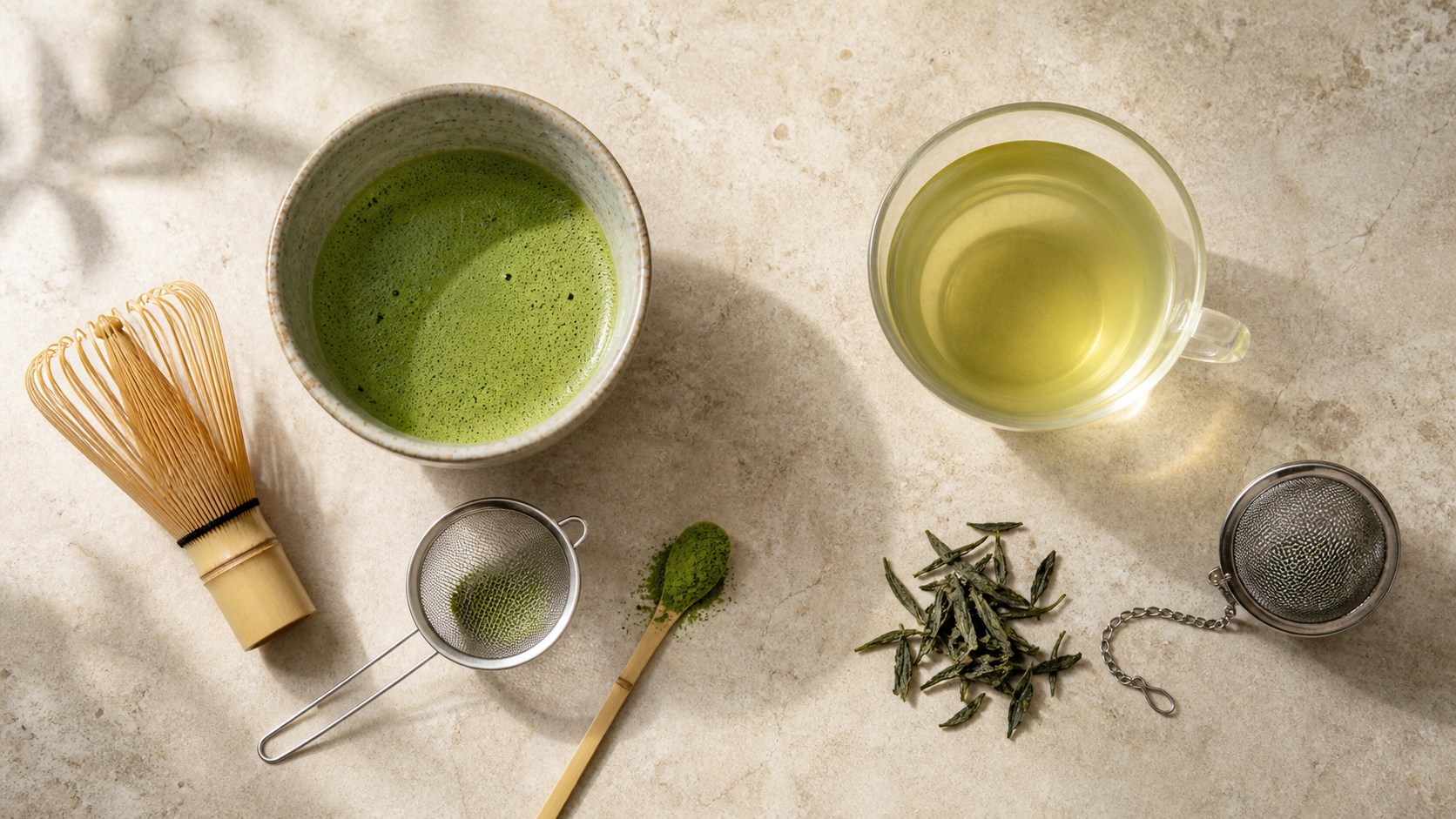
The short comparison
| Question | Matcha | Brewed green tea |
|---|---|---|
| What is consumed? | Fine tea-leaf powder suspended in the drink | A water infusion after the leaves or tea bag are removed |
| Texture | Opaque, fuller and capable of settling | Clear to slightly hazy and relatively light |
| Typical preparation | Weigh, sift and whisk or froth | Steep leaves, then strain |
| Caffeine | Driven mainly by grams of powder and its composition | Driven by leaf quantity, tea, temperature and steep time |
| Flavor | Concentrated vegetal, umami, sweet, bitter and astringent notes | Usually lighter; style may be vegetal, floral, nutty, marine or roasted |
| Best fit | Straight bowls, lattes, smoothies and food applications | Clear, lighter tea service and repeated infusions |
Is matcha the same as green tea?
Matcha belongs to the green-tea category because both come from Camellia sinensis and are processed to limit the oxidation associated with black tea. “Green tea,” however, covers many styles. A sencha, longjing, gunpowder tea, tea-bag blend and matcha can all be green teas while differing substantially in cultivar, farming, heat treatment, particle form and brewing method.
Matcha is not instant tea. It does not dissolve at the molecular level like sugar. Whisking distributes fine particles through the liquid, and some settling is normal. Brewed tea is an extract: compounds move from the leaves into the water during steeping, while much of the leaf material remains behind.
Does origin decide whether a powder is matcha?
Origin and style are separate questions. Japan has influential matcha traditions and recognized production regions, while powdered green teas are also produced elsewhere. “Uji,” “Nishio,” “Zhejiang” and “Guizhou” are geographic statements, not interchangeable quality grades. A buyer should verify an origin claim through traceability rather than assume that color, price or the word ceremonial proves it.
For commercial sourcing, compare samples under the intended recipe. Sailtik supplies Chinese-origin matcha from Guizhou or Zhejiang. That makes it unsuitable for a buyer who specifically requires certified Japanese or Uji origin, but it does not stop the product from being evaluated as matcha for café, food-service or private-label applications.
Matcha vs green tea caffeine
There is no honest universal answer in “milligrams per cup” without defining both preparations. A published review reported matcha caffeine values of approximately 18.9–44.4 mg per gram. At 1.5 g, that mathematical range is about 28–67 mg; at 3 g, it is about 57–133 mg. Those are estimates from a literature range, not the measured value of every powder.
The U.S. Food and Drug Administration lists 37 mg as a typical value for 12 fluid ounces of green tea, while emphasizing that caffeine varies among products and serving sizes. Leaf quantity, broken versus whole leaf, water temperature, steep duration and repeated infusion all affect brewed tea. For matcha, adding milk or water changes concentration per sip but does not remove caffeine already contributed by the powder.
To compare two actual menu drinks, obtain a supplier analysis when available or use a defensible product-specific estimate. Record powder grams for matcha and the tea, leaf mass, water, temperature and time for brewed tea. See the detailed matcha caffeine guide for calculations and limitations.
Taste and texture differences
Matcha creates a concentrated sensory experience because the suspended powder contributes body as well as flavor. Depending on raw material and preparation, it can show umami, fresh vegetal notes, sweetness, bitterness and astringency. Too much powder, excessively hot water, poor storage or a recipe with insufficient milk can make harshness more obvious.
Brewed green tea is usually lighter in body. Its profile depends on the tea: steamed leaf may taste grassy or marine, pan-fired tea may be chestnut-like, and roasted green tea may be toasty. Over-steeping can increase bitterness and astringency. Neither category has one fixed flavor, so “matcha tastes stronger” is a useful starting observation, not a quality verdict.
Is matcha healthier than green tea?
Consuming powdered leaf can deliver more of some tea constituents per serving than drinking an infusion, but greater chemical exposure does not automatically prove a greater health outcome. Matcha-specific human research remains limited, products differ, and the complete diet matters. Terms such as “antioxidant-rich” should not be converted into promises to detoxify the body, prevent disease or produce weight loss.
The U.S. National Center for Complementary and Integrative Health reports no safety concerns for green tea consumed as a beverage by adults, while noting its caffeine. It also distinguishes beverages from concentrated green-tea extracts, for which side effects, rare liver injury and medicine interactions have been reported. A food or drink is not equivalent to an extract capsule.
People who are pregnant, breastfeeding, sensitive to caffeine, taking medicines or managing a medical condition should seek individualized professional advice. The FDA cites 400 mg caffeine per day as an amount not generally associated with negative effects for most adults, not a personal target or a guarantee of safety for everyone.
How to prepare a fair taste comparison
- Use fresh water and clean, neutral vessels.
- Weigh every ingredient instead of comparing an undefined scoop with a tea bag.
- Prepare the brewed tea to its supplier’s starting recommendation and record leaf mass, temperature and time.
- For matcha, begin with 1.5–2 g in 60–100 g water for straight tasting; sift and whisk until evenly suspended.
- Taste both unsweetened first, at comparable drinking temperatures.
- Record aroma, sweetness, umami, bitterness, astringency, body, finish and visible color.
- Repeat before drawing a purchasing conclusion; a single preparation error can dominate the result.
A café comparing latte performance should run a separate milk test. Use the same finished drink size, milk, ice and sweetness. Matcha that is pleasant in water may disappear in a sweet milk formula, while a stronger sample may balance it. The matcha flavor and sensory guide provides a repeatable three-cup protocol.
Which is more practical for a café?
| Operational factor | Matcha | Brewed green tea |
|---|---|---|
| Equipment | Scale, sifter and whisk/frother | Scale or portion control, infuser and timer |
| Service speed | Fast after the dispersion method is standardized | Requires controlled steep time unless batched safely |
| Visual identity | Opaque green and strong latte contrast | Translucent, delicate appearance |
| Menu versatility | Strong across lattes and recipes | Strong as straight tea and flavor base |
| Waste/control | Powder dose is consumed; dry storage is critical | Spent leaf must be handled; infusion yield must be controlled |
Use the drink that fits the job. A calm table-service tea program may prefer a clear infusion. A high-throughput latte menu may value matcha’s color, texture and ability to carry through milk. Some cafés should offer both because they answer different customer occasions.
Buying matcha for a commercial recipe
Do not select by a ceremonial label alone. Ask for origin, ingredient statement, lot-specific certificate of analysis where applicable, food-safety documentation, packaging, shelf life and storage guidance. Then calculate cost per finished cup using the dose that passes the recipe test—not merely the lowest price per kilogram. The bulk matcha buyer’s guide explains the application-first method.
Sailtik generally recommends 1.5–3 g per cup. Samples are 10 g per selected internal model; the team recommends suitable models after learning the customer’s business and recipe rather than automatically sending every option. Bulk formats are 1 kg, 5 kg and 10 kg foil bags, with no fixed bulk minimum, although larger shipments can use freight more efficiently. Contact Carol with the drink size, milk, sweetness, target cost and expected monthly volume.
Frequently asked questions
Can you brew matcha like loose-leaf green tea?
Matcha is normally dispersed and consumed rather than steeped and removed. If it is simply stirred into water, the powder remains suspended temporarily and settles; it does not become a conventional clear infusion.
Does matcha always contain more caffeine?
No fixed comparison covers every recipe. Matcha often delivers more caffeine than a typical brewed green tea because the powdered leaf is consumed, but a light matcha and strong long-steeped tea can narrow or reverse an assumed difference. Compare actual doses.
Is matcha green tea powder?
Yes, but not every powdered green tea is produced to the same raw-material and processing specification. Buyers should evaluate traceability, sensory performance and documents rather than treating the generic phrase as a complete specification.