
The best matcha green tea is the one that fits your use case, budget and evidence requirements. There is no single powder that is automatically best for every bowl, latte, cake, private-label tin and café menu. A smoother, vivid, expensive powder may be best for straight drinking; a stronger, more cost-efficient powder may be better for milk drinks or baking.
Start with the intended use
Search results often rank matcha as if everyone wants the same thing. That is not how matcha works. A powder for thin tea with water is judged differently from a powder that must stay visible through oat milk, survive ice cream production, or hit a private-label price point. Decide the use first, then compare samples under that condition.
| Use case | What “best” usually means | What to avoid |
|---|---|---|
| Straight matcha with water | Smooth texture, fresh aroma, balanced umami, controlled bitterness and a natural green color. | Buying only by price or assuming every “ceremonial” label is equivalent. |
| Iced or hot matcha latte | Enough flavor and color to remain clear through milk, ice and sweetener. | Choosing a delicate powder that disappears in milk and raises cost per cup. |
| Baking and desserts | Flavor and color after heat, fat, sugar and holding time. | Judging from dry powder color without testing the finished recipe. |
| Café service | Repeatable taste, dispersion, prep speed, cost per serving and supply stability. | Comparing kilogram price without calculating accepted serving dose. |
| Private label | Truthful origin, suitable sensory profile, packaging fit, documents and batch consistency. | Using Japanese imagery or grade language that exceeds the actual origin and evidence. |
Check identity before quality
First confirm what the product is. Plain matcha should be finely powdered tea leaf, not a latte mix, flavored beverage powder or generic green-tea powder with a matcha-style name. The Japan Matcha Association describes matcha as powdered tencha in the classical Japanese framing. That definition is useful because it separates matcha identity from ordinary powdered green tea, sweetened mixes and finished drinks.
For buying, the identity question is practical: What is the ingredient statement? Is the powder plain or blended? Does the supplier identify origin, grade position, application and storage conditions? If the product is a mix, one gram of powder is not necessarily one gram of matcha.
Do not let one signal decide
Color, origin, organic certification, stone milling, “ceremonial” wording and price can all be useful signals. None of them alone proves that a matcha is best.
- Color: a fresh natural green is promising, but lighting, photo editing, storage and recipe dilution change perception. See why matcha is green.
- Grade names: ceremonial, premium, café and culinary are market descriptions, not one universal legal ranking. See matcha grades explained.
- Origin: Japan, Uji, China and other origins can matter, but origin must be truthful and should not replace sample testing. See the Japanese and Uji origin-check guide.
- Price: high price can reflect quality, scarcity, packaging, origin claim or channel markup. Low price can be suitable for a recipe but risky if identity and documents are weak.
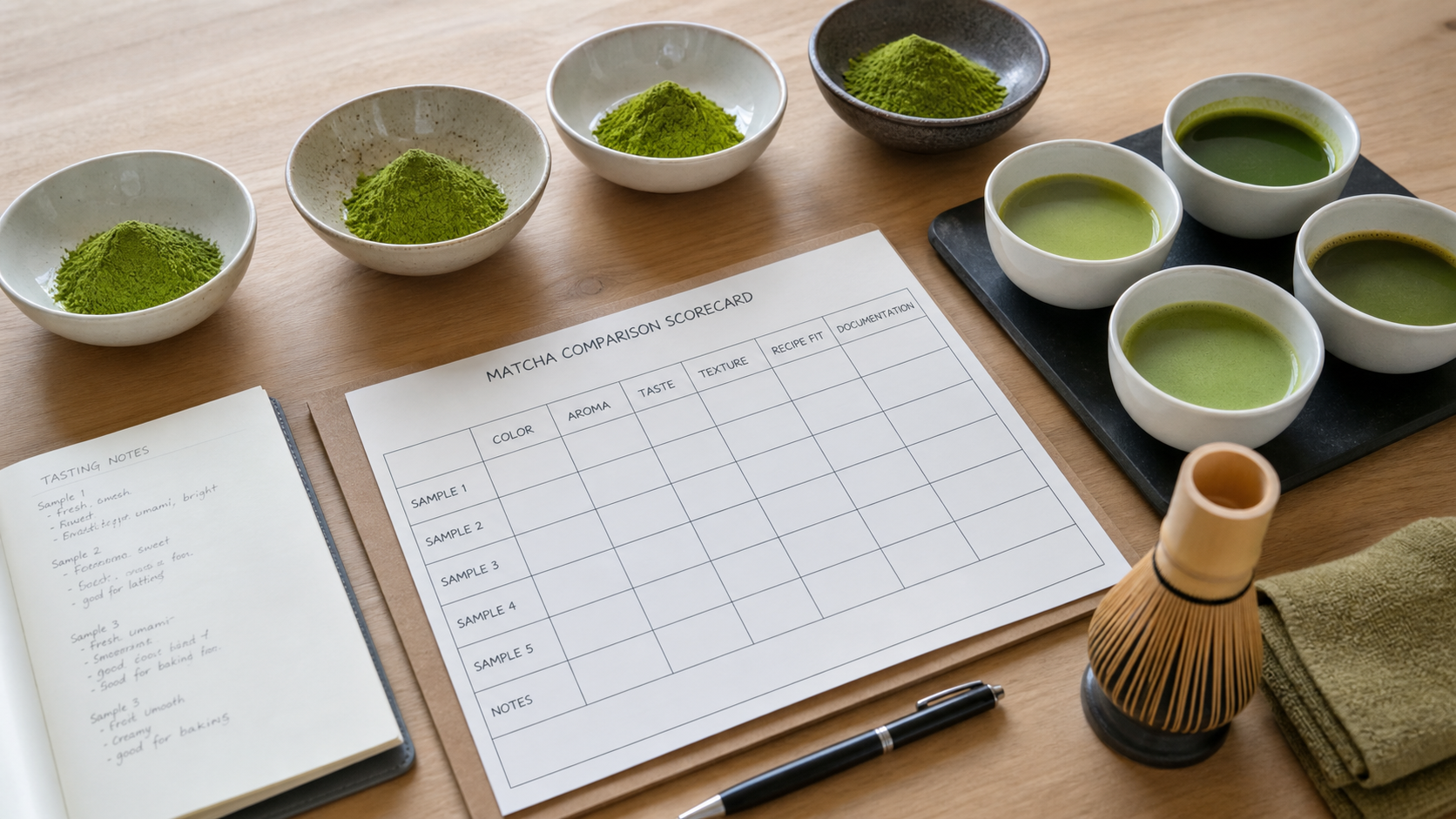
A six-part sample scorecard
For a more defensible answer than “this brand is best,” compare samples side by side. Use the same dose, water, milk, temperature, cup size and holding time for every powder.
| Criterion | What to record | Why it matters |
|---|---|---|
| Color | Dry powder, whisked tea and final recipe under the same lighting. | Color changes across water, milk, ice and heat. |
| Aroma | Fresh, vegetal, marine, nutty, stale, smoky or flat notes. | Aroma often reveals freshness and storage problems faster than a label. |
| Taste | Umami, sweetness, bitterness, astringency and aftertaste. | The best straight-drinking powder is rarely chosen by color alone. |
| Texture | Clumping, grit, suspension, foam and sediment. | Poor dispersion slows service and hurts mouthfeel. |
| Recipe fit | How it performs in the actual drink, dessert or product. | A powder can be excellent in water and weak in milk, or the reverse. |
| Documentation | Ingredient statement, origin, lot traceability and tests required for the market. | Commercial buyers need evidence, not only sensory preference. |
Which matcha is best for beginners?
For a beginner drinking matcha with water, choose a plain powder with a clear ingredient statement, fresh aroma, smooth texture and moderate bitterness. Avoid very large packages until you know you can finish the powder while it is fresh. If you mostly make lattes, choose a powder that still tastes like tea after milk and ice rather than buying the most delicate straight-tea option.
Which matcha is best for cafés?
For cafés, the best matcha is not necessarily the highest grade. It is the powder that delivers the accepted flavor, color, speed and cost per cup in the café’s real recipe. Test it with the exact milk, ice, syrup, water temperature, whisking tool, batch method and staff workflow. If one sample needs more grams per drink to taste acceptable, compare cost per accepted serving rather than kilogram price alone.
Which matcha is best for baking?
For baking, judge the finished food after cooling and holding. Heat, fat, flour, sugar and storage can mute aroma and shift color. A bright drinking-grade powder may be wasted in a strongly flavored cookie, while a culinary powder that tastes too strong in water may work well in ice cream or cake. The best baking matcha is the one that performs after the whole process.
A practical answer
If you want the safest general rule: choose plain matcha with a clear identity, fresh aroma, natural green color, smooth dispersion, a taste profile suited to your recipe, and documentation appropriate to the purchase. Then buy the smallest practical amount until you have tested it. “Best” should be proven in your cup, recipe or commercial process, not borrowed from a generic ranking.
Related guides
For production factors, read how matcha is grown and made. For taste evaluation, use the matcha flavor and quality guide. For grade terminology and Sailtik’s application-based grade framework, see matcha grades explained.
FAQ
Which matcha is best?
The best matcha depends on use. Straight tea usually favors smoother, more delicate powder; lattes and baking need stronger recipe performance and cost control.
Is ceremonial matcha always the best?
No. “Ceremonial” usually suggests a drinking-oriented powder, but the term is not a universal regulated quality grade. It may be wrong for cost-sensitive lattes or baking.
Is the best matcha always Japanese?
No country should be treated as a universal quality shortcut. Japanese and Uji claims must be truthful and can be important for some buyers, but the right product still depends on sample performance, documents and use case.
What matcha green tea is best for lattes?
Use a powder that keeps tea flavor and green color through milk and ice. Test at the intended grams per drink and calculate cost per accepted serving.